Antony Jarvis, the creator of Doddington Hall’s famous iris display, shares his advice for growing irises, including the ‘Doddington system’ of division
RHS Editorial Team
7-minute read
Doddington Hall and Gardensis an RHS Partner Garden near Lincoln, a stunning Elizabethan house enclosed by its original garden walls. The East Front is simple and formal, while the West Garden is richly planted and reaches its peak in early summer. Spring shine in the wild gardens alongside ancient trees, and the estate also includes a productive kitchen garden.
Irises are a signature feature of the West Garden, where they have been grown since the 1980s. Set within box and grass-edged parterres, their sumptuous blooms create a striking tapestry through May and early June.
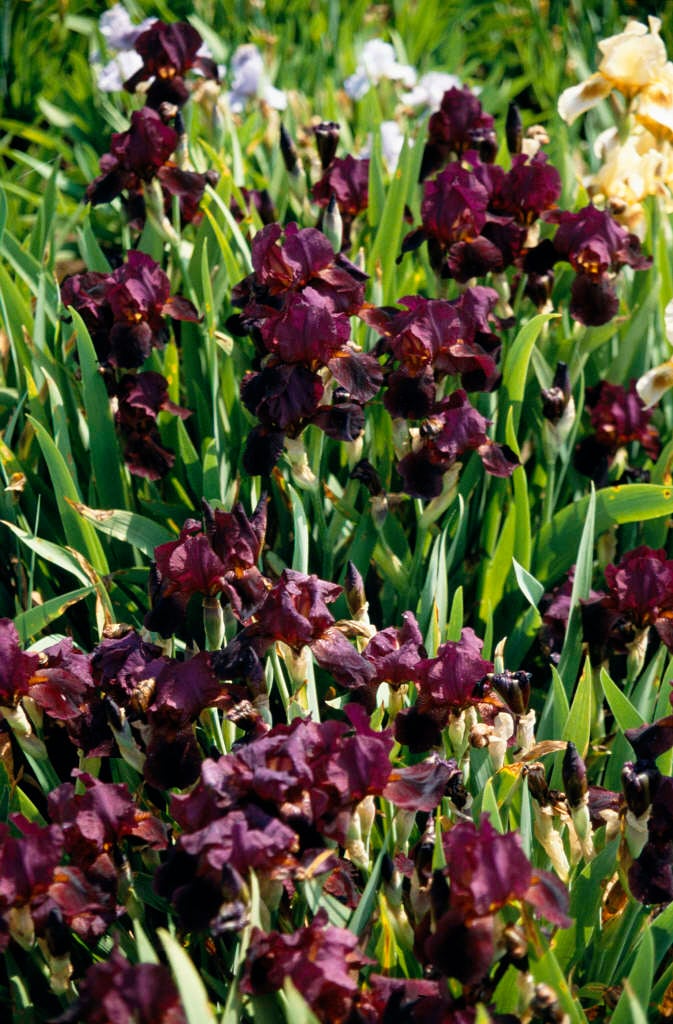
Different irises are featured at Doddington, including ‘World Premiere’
Antony Jarvis, whose family inherited the Doddington Estate in 1830 and still calls it home, shares his insight into getting the very best from these elegant plants.
"Bearded iris flowers are held high in the air and their translucence makes them particularly beautiful in the evening light."
Antony Jarvis, Doddington Hall & Gardens
When well grown, irises provide a surprisingly long show, each stem producing its full number of flowers. Out of season, their foliage continues to earn its place, offering attractive groundcover that helps maintain structure and interest well beyond the early summer display.
Antony’s favourite bearded irises
‘Langport Wren’ irises are a rich pop of colour against the greenery
Iris ‘Langport Wren’is a wonderful, deep mahogany , known for being tough and reliably full of flowers. Its glaucous green foliage and stems hold up to four blooms, combining rich reddish purple standards with deep maroon falls, washed with dull greenish yellow beside the dark red-tipped beard. Plants reach around 70cm in height. Hardiness rating H7.
Iris ‘Ma Mie’, bred by the famous French iris hybridiser Ferdinand Cayeux in 1906, is an unruffled and delightfully graceful variety. Its elegant white flowers are traced with blueish purple veins, giving it a refined, vintage charm that can easily steal the show. Semi-evergreen foliage adds interest beyond flowering, and plants grow up to 90cm tall. Hardiness rating H7.
‘Wabash’ irises feature silky white and velvety purple petals
Iris ‘Wabash’is a striking bicolour, displaying stark white standards above rich purple falls. This vigorous rhizomatous grows to around 1m in flower, supported by upright, sword-shaped, grey-green leaves that give it structure throughout the season. Hardiness rating H7.
Iris ‘Blue Florentine’ produces bright French blue flowers with a noticeable fragrance, which is why it has long been valued in perfume making. It sends up stems to 120cm, bearing medium-sized blooms with wide, erect, cupped standards and narrow, distinctly drooping falls. Both are silvery white with a blue tinge, finished with yellow beards. Hardiness rating H6.
The ‘Doddington system’ of iris division
Doddington Hall & Gardens
View of the iris parterres at Doddington Hall Gardens
The garden team finds its ‘Doddington system’ a trouble-free way to divide irises. “Irises need an absolute minimum of attention under this system. Some of the older cultivars continue to flourish after 28 years in the same beds,” says Antony. “The key advantages are a regular and full flower display, speed and physical convenience.”
The system is underpinned by two characteristics of iris plants:
Irises set flower initials in August, determining how many flowers each stem will carry the following May
To set the maximum number of flower initials, the plants need to be undisturbed and warmed by sunlight between August and October
“The traditional system of autumn every three to four years allows irises to become overcrowded, leading to shading, explains Antony. ‘It also disturbs the plants at the very moment they are trying to set flower initials, resulting in an unreliable show of flowers the following year.”
Step-by-step guide from Doddington Hall
Split the irises every year, after flowering has ended in June. At this point, the early summer leaves and flower stems have started to die back, and the late summer leaves have started to grow
Split individual plants by cleaving the older parts of rhizomes off with a spade, leaving the part to be retained undisturbed in the soil. Remove about 30–50 percent of the total plant mass this way. The aim is to leave plants about the size that would fit under an A5 sheet of paper, with a clear space of 25–30cm (9–12in) in all directions between other plants. Irises have a considerable power to colonise bare ground, so don’t be shy with the spade
When deciding which parts of a plant to keep, look for fat, first-year rhizomes with a pair of shoots carrying the early-summer leaves. These are the initials for next summer’s rhizomes and flower stems. Choose rhizomes that point in the direction you wish the plant to move – it advances perhaps 13cm (5in) a year and so can be guided to fill gaps in the overall plant pattern
After splitting, cut back the early-summer leaves on the remaining plants, and cut or break off the spent flower stems. Finally, topdress the plants – at Doddington Hall, a dressing of 70–100g per square metre (2–3oz per square yard) of bone meal is raked into the soil between the plants
A major advantage of this system is that the whole job can be done from a standing position, using a light spade and fork and a pair of shears. With no replanting of irises (which is a tricky job to do well), the task of thinning is far quicker than the traditional method
If there is an awkward gap in the iris plants, it might occasionally be necessary to plant a rhizome or two. These, if planted in June, will flower with the rest in the following May
If switching to the Doddington system, you may have a transitional year or two before you reach a steady state. The actual size of the clumps of rhizomes you choose to leave is not critical, and larger clumps can have larger gaps between them
Additional take-home growing tips
Doddington Hall & Gardens
Doddington's West Garden irises
For maximum flowers, iris need to be warmed by the sun in August and September. Avoid overcrowding of plants, as this shades the rhizomes, meaning few or no flowers next year
If a bed has looked poor the previous May, try a light of in November. Antony finds mushroom compost or strulch (a straw-based mulch) works best
Remove late-summer withered leaves when they will pull away from the rhizomes, or they can be left until spring, providing shelter for the rhizomes over winter
Remove deadheads using shears. This job becomes more important as flowering advances, and finally, whole spent flower stems can be removed
Visit Doddington Hall & Gardens
Free days out for RHS Members in 2026: 4 February–24 July and 9–30 September, Wednesday–Sunday, plus October, daily, when open. Gardens only