Secret gardeners: the rich tapestry of life hidden in an urban oasis
Dr. Mark Millan explores the smallest forms of life that keep an urban oasis alive and thriving
To me as a kid, the garden was mainly a place to kick a football about or improvise a ‘game’ of cricket, rather than a floral paradise. And I was more interested in our pet cat, Jenny, than the local wildlife. Fiery clearwing moth taking nectar from ragwort
On the other hand, I adored the fascinating wildlife programmes of David Attenborough and other naturalists, so my childhood dream was to go to Africa to study glamorous beasts like lions and elephants. Zoology (with a hefty dose of Ecology) was the logical choice for University yet, for a variety of reasons, I ended up in Munich retraining in Neuroscience and trying to improve the treatment of brain disorders, from Autism to Alzheimer’s disease. Brains, like gardens and other ecosystems, are complex and dynamic networks vulnerable to stress, so there are several parallels, but this wasn’t what I had planned. Happily, many years later, things took another surprising turn, allowing me to belatedly rekindle my passion for nature, and in a different garden.
In late 2019, concerned by reports that HIV/AIDS and other viruses damage the brain and impair mood and memory, I came up with an idea to mitigate their impact, with my proposal finalised just ahead of the SARS-CoV-2/COVID onslaught. So, like most of us, I soon found myself spending a lot of time at home and in my garden.
It was the start of a great discovery for me – every day learning there was a lot more to see than just daffodils and tulips. Gardening morphed into a personal ‘Covid Project’ for photographically documenting life in the partly-rewilded yet partly-cultivated, mosaic-like green space beyond the back door.
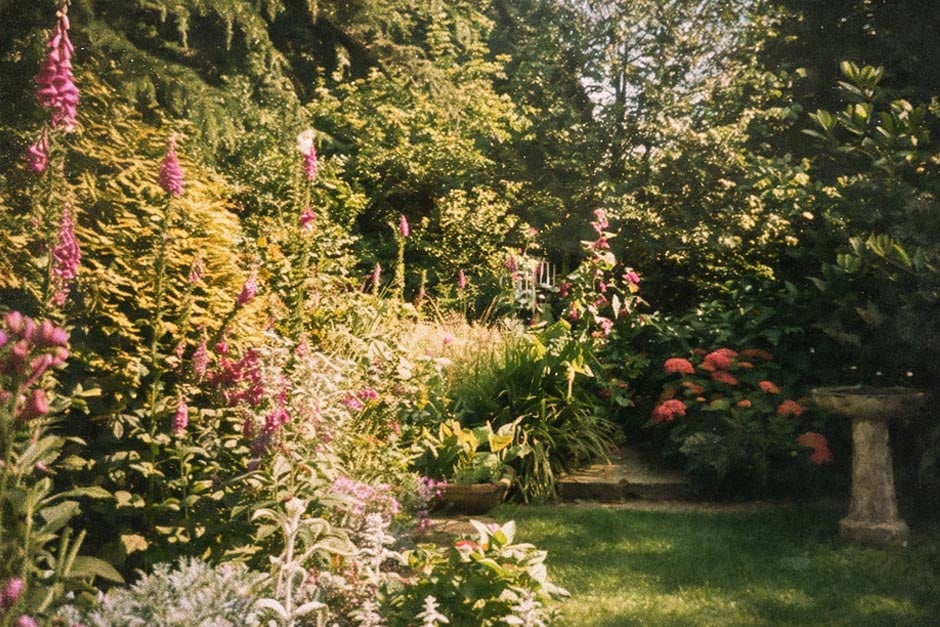
Not Africa, admittedly, but after five years of study, this little oasis (4,500 square feet) of urban nature has transpired to harbour a vast suite of no less intriguing (if rather smaller!) animals. Around 500 different ones, in fact: in addition to a variety of birds, resident bats, the occasional red squirrel, hedgehog, frog and toad, it's most striking facet is a remarkable diversity of invertebrates, including dozens of different types of spider and zillions of insects.
Now, they had presumably been there the whole time but overlooked since, compared to the proverbial herds of wildebeest sweeping majestically across the plain, insects are a darned sight harder to see.
A river clubtail dragonfly resting on a lilac tree
Leaf-shake renders non-fuzzy photos all but impossible and when it’s raining they are hiding under leaves anyway, so there’s no point getting soaked. Even when the sun is shining, it’s a bit like mother bears and their cubs: don’t get between the sun and your subject since, once once that shadow has been thrown, it instantly buzzes off. On the positive side, I’ve found that patience eventually pays off and, while a fancy camera and lens is certainly a plus, you can get pretty decent pics with a smartphone. This allows you to upload your photo into Apps for identification. Places like the Royal Entomological Society are also available to help, and I’ve been lucky enough to get support from several, very generous experts.
Cross-checking with reference books helped interpret the behaviour I’d seen and it became clear that many of the little creatures in the garden are living remarkable lives in interaction with the rest of the flora and fauna. Every insect tells a story.
‘Insect’ is not synonymous with ‘yukky’ or ‘pest’. While not having quite the same aura as otters or ospreys, there’s a lot more to bugs than creepy cockroaches, marauding mosquitoes and grotty greenfly.
A bee beetle feeding on oxe-eye daisy
Together with microbes, earthworms and mollusks, insects like ants and springtails recycle the leaf-litter to enrich the soil and facilitate plant growth. A good reason for leaving leaves in place rather than – together with the smaller denizens of gardens like insects, frogs and hedgehogs – blasting them into oblivion with a leaf-blower.
True, a few notorious species of insect are enemies of plants, yet many insects themselves consume pests: in addition to ladybirds, various species of wasp, fly, cricket and beetle feast on aphids, plant-chewing bugs, slugs and/or mildew. One slightly bemusing example looked for all the world like a lump of jelly (or snot!) smeared onto the stem of my ‘prize’ roses. It was, in fact, the larva of a hoverfly which polishes off greenfly no less voraciously than ladybirds, of which the garden boasts a rainbow-like assortment of 8 different varieties.
I was also surprised to uncover miniature crocodile-like things that I later learned were the larvae of delicate and aptly named lacewings: they likewise mop up greenfly. On the other hand, I have witnessed countless insects ending up as lunch for ravenous spiders, themselves captured by vengeful wasps or plucked from their webs by great tits.
A green woodpecker searching for ants
Even certain humans appear nutritionally insect-inclined, though I can’t say I’ve ever been tempted to join the ladybirds in dining on greenfly.
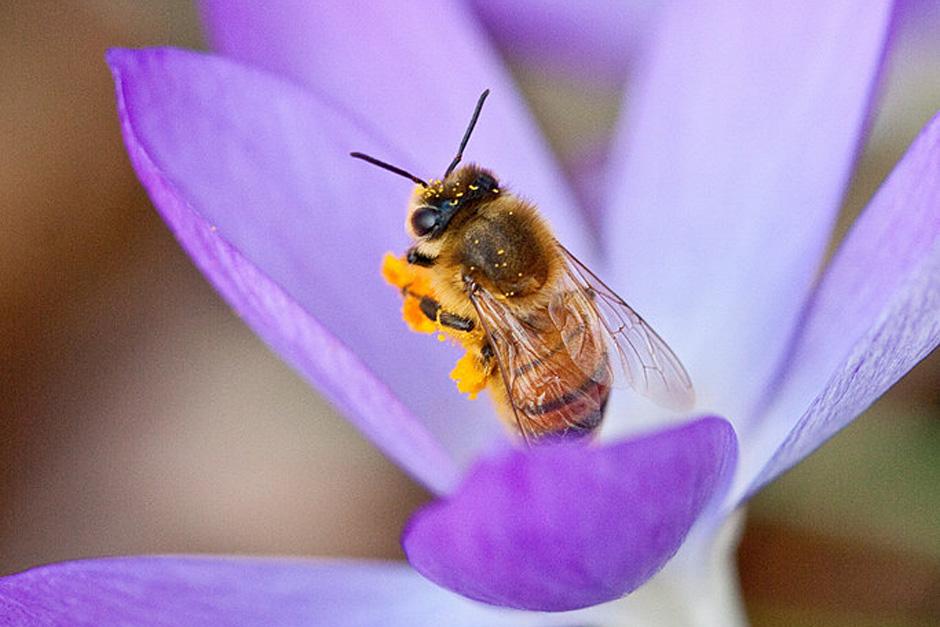
Most adult insects only live for a few weeks, so you only get to see a selection at any one particular time, with a procession of species providing an annual parade all the way from late winter/early spring through to late autumn. Each profits in turn from a range of flowers, shrubs and trees (dozens of different ones). Bees provide a good illustration. Early-waking, post-hibernation, queen bumble bees are first out of the blocks, foraging on hellebores during the warm days of late winter, together with cute little orchard bees that target grape hyacinths and crocuses.
Conversely, bookending the
While glad to discover all these different sorts of (veggie) bee, there turned out to be just as many types of (carnivorous) wasp, and not just the ‘common’ culprit who loves to spoil our picnics. In fact, they offer a free dustbin service by cleaning up the assorted debris littering the ground. Moreover, most wasps are harmless. As mentioned above, I have one or two that specialise in catching spiders (good news for arachnophobes!) and, last year, the aphid-hunting pemphredon arrived, providing yet another weapon for checkmating those wretched greenfly. Moreover, the garden has always been enlivened by stunning, little flying jewels called ruby wasps. Reasons enough to nab wasps with a camera rather than a rolled-up newspaper – Snap not Splat!
A brief word on much-maligned flies which are infinitely more interesting than the all-too-familiar fruit and house varieties. There are a phenomenal number (100 odd!) of species in the garden, and several help clear it of plant-chewing bugs as well as aphids and slugs (see above). For example, the spectacular feather-legged fly is a parasite of the green shield bug. Further, exemplifying their many bizarre designs, the scorpion fly looks just like, well, a scorpion – even if it doesn’t sting. And I eventually worked out that that several types of bee, bumble bee, wasp and even ant are nothing of the sort!
Rather, flies in disguise which have evolved as look-a-likes in order to avoid getting eaten by birds who don’t like being stung.
Lygus the ‘love bug’ on ragwort
Bugs are often surprisingly pretty too as well as being masters of camouflage, essential to minimize predation. The same holds for the ten or so species of cricket and grasshopper which can be easier to hear (singing) in the garden than actually to see. Conversely, techicolour dragonflies don’t need to hide at all since they are super-fast predators adept at snaffling unsuspecting flies – including, as the daytime counterpart of bats, mosquitoes.
Finally, more than 20 species of gorgeous butterfly have fluttered by, from peacocks emerging out of hibernation in spring to late-breaking red admirals in autumn. It is nonetheless the diversity (more than 50 species) of moths that has most impressed me. They include the striking Jersey tiger (clearly off-course!), the yellow underwing – which once materialised on my coffee machine – and, less amusingly, the stunning fiery clearwing. This Southern species has no business being so far north: it is a worrying cipher of climate change and global warming, yet underlines the point that gardens can tell us things of broader relevance to wildlife and its preservation.
I can’t do much about climate change, but I can take small actions that have a big impact. I mow as late and as little possible (vive le No Mow May campaign!) and ban destructive leaf blowers. I don’t use ‘cides’ except in severe cases, with companion plants like marigolds and aromatics helping to protect against pests. I keep the lights off at night since they disorient moths. If a tree dies but is safe, I leave it as a nesting site for bees and a feeding station for woodpeckers, and use piles of dead wood and sticks to make bee and beetle hotels.
A scissor bee sleeping on mallow
This didn’t, nonetheless, imply doing nothing at all and abandoning it to chaos. Nature can be nudged in the right direction and kept from getting out of hand while upfronting favourite plants and bumping up pollen and nectar-rich resources for wildlife throughout the year. Both cultivated plants and wildflowers are important - ‘weeds’ is a word poorly understood by nature!
Doing something for nature has helped me counter those occasional feelings of helplessness when contemplating all the damage still being done (locally and globally) to the environment, and to our flora and fauna. Gardening for nature-rich green (rather than concrete-grey) isn’t just good for
Sharing and community can also have cognitive benefits – I write, exhibit and hold talks. Others could invite people into their gardens, post on social media, or have a chat with friends in a coffee shop or down the pub. Whatever the means, spreading the word about nature-friendly gardening is good for the planet and good for people!
You can only protect something if you know it is there. It is surprising, then, that the type of documention I have been doing has only rarely been undertaken since the pioneering work of Jennifer Owen who, upon returning from Africa in 1974, devoted 30 years to describing the plants, animals and fungi in her garden near Leicester. There is plenty scope for others to take up the torch!