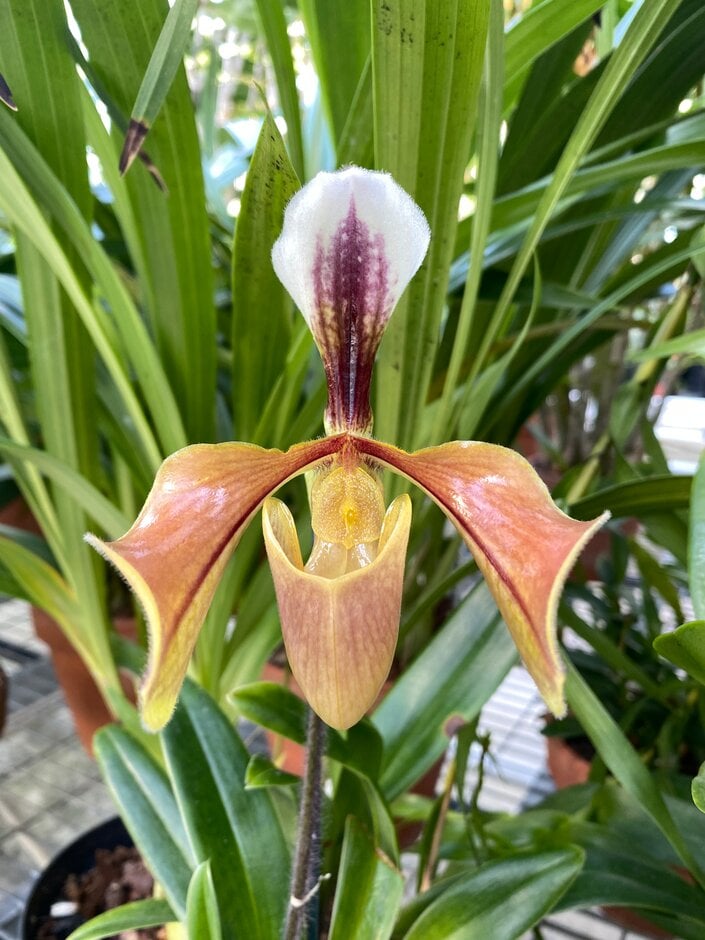
Paphiopedilum villosum

RHS Plant Profile
villose paphiopedilum
villose paphiopedilum Valeria Valkova
Conservatory Greenhouse

A medium-sized, clump-forming, terrestrial orchid with strap-shaped, dull mid-green leaves, 25-40cm long and 3-4cm wide. Solitary, glossy, red-brown flowers, 8cm across, with green and brown upper sepals and light yellow-bronze to green pouches, appear from winter to spring on upright, 30cm tall, terminal stems.

Position

Partial shade

Max Height

0.1-0.5 metres

Max Spread

0.1-0.5 metres

Size

Time to Maturity
2–5 years
Max Spread
0.1-0.5 metres
Max Height
0.1-0.5 metres

Growing Conditions

Moisture
Well–drained
pH
Neutral

Position

Partial shade
Aspect
East–facing or South–facing or West–facing or North–facing
Exposure
Sheltered
Hardiness
H1A

Colour & Scent

Season Stem Flower Foliage Fruit
Spring
Summer
Autumn
Winter

Botanical Details

Family
Orchidaceae
Native to GB/Ireland
No
Foliage
Evergreen
Habit
Clump forming
Genus
Paphiopedilum are mainly terrestrial, and lithophytic or epiphytic. They lack pseudobulbs and produce short stems with strap-shaped leathery leaves. Each shoot ends in a solitary flower or racemes of 2-8 flowers each with a distinctive variably-shaped lip or pouch
Name Status
Correct
Plant Range
S China, SE Asia

How to Grow

Cultivation

Grow in terrestrial, bark based orchid mix, with added sphagnum moss and perlite, or crushed limestone chips. In summer, provide higher humidity and bright, filtered light. Average summer temperatures are between 20 - 25°C, with winter temperatures falling to 18 - 22°C. Apply fertiliser with every third watering. Avoid heavy misting or overhead watering. As the plant lacks pseudobulbs, it shouldn't be left dry for long time. Water plant as it approaches dryness, but avoid standing in water, or keeping wet for prolonged period. See Paphiopedilum cultivation for more detailed advice.

Propagation

Propagation by seed is only possible in a controlled laboratory environment. Mature plants may be divided when the plant overgrows its container. Each division should have at least 3 healthy, rooted plant rosettes with a suffient amount of stored energy and water, to support new growth and reduce stress after repotting.

Suggested planting locations and garden types

  • Houseplants
  • Conservatory and greenhouse

Pruning

No pruning required.

Pests

Generally pest-free. May be susceptible to mealybugs.

Diseases

Generally disease-free. Overhead watering in combination with low temperatures may cause bacterial rots in the centre of leaf rosettes.