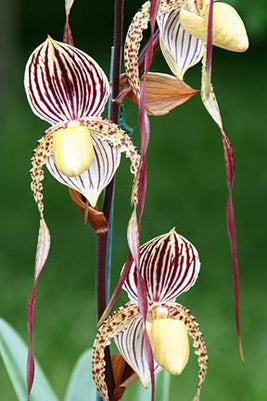
Quick facts
Common name - Slipper orchid
Botanical name - Paphiopedilum
Group - Houseplant
Flowering time - Variable
Planting time - After flowering, in February to June
Height and spread - Both 15-30cm (6in-1ft)
Aspect - Filtered light shaded from direct sunshine in spring and summer; bright light in winter
Hardiness - Tender
Difficulty - Moderate


Cultivation notes
This is a group of mostly terrestrial orchids (growing in the ground), but unlike many other terrestrial orchids, they do not produce pseudobulbs at the base of their stems.
Grow Paphiopedilum in a shaded position in summer, with protection from direct sunshine. Move to a position in bright, un-shaded light in winter.
The plain green-leaved slipper orchids are cool temperature growers, preferring a growing temperature range of 10-25°C (50-77°F), and requiring a minimum winter temperature of 10-13°C (50-55°F).
The mottled-leaved types tend to require a warmer temperature, needing a minimum night temperature of 18°C (65°F) and a daytime temperature of 20-30°C (68-86°F) with high .
Slipper orchids generally flower from November to March, but flowers can appear at any time of the year. Flowers last up to three months, and may need support with a stake.
Watering, humidity and feeding
Water Paphiopedilum orchids regularly in spring and summer. Allow the to dry out a little between watering and avoid overwatering. Reduce watering during the winter months, but don’t let the compost dry out completely. Avoid overhead watering and wetting the leaves.
Do not mist this orchid. Instead, increase humidity by standing plants on an upturned saucer in a tray of damp pebbles.
Apply proprietary orchid fertiliser every two to three weeks at the application rate recommended on the packet. Reduce the frequency and/or strength of feeding in the winter.
Re-potting
Re-pot after flowering between February and June, using specialist orchid compost. Do not re-pot into a container that is larger than necessary; choose a pot just large enough to comfortably contain the roots.
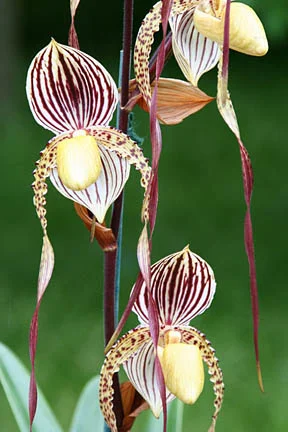
Propagation
After flowering, divide the plant by separating an offshoot with a good root system that has developed on the edge of a large clump. Pot it on individually as per the advice given above for re-potting.
Cultivar Selection
Paphiopedilum Pinocchio: This has a lime green dorsal sepal, a pink pouch, and off-white side petals with maroon spots on them.
P. Maudiae: This has green and white blooms with a strongly striped dorsal sepal.
P. insigne: This is one of the more cold-tolerant slipper orchids, with a coppery-gold colouring to the flowers.
P. niveum: This has large petals with a slightly frilled edge, all in snowy white.
Problems
Paphiopedilum are prone to the same problems as other indoor orchids.