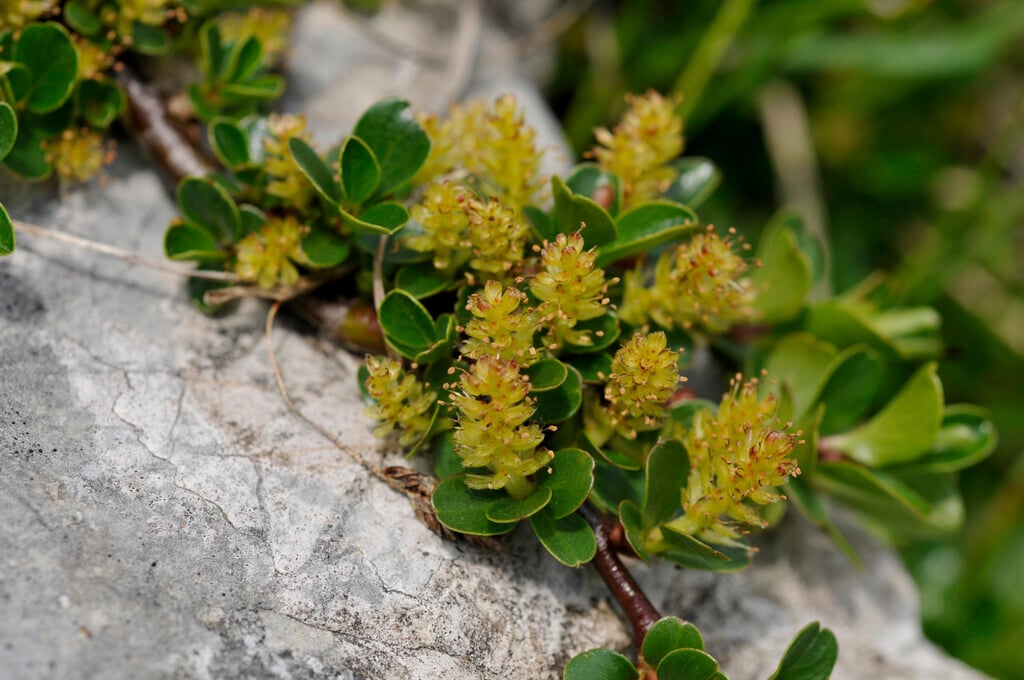
Salix retusa

<em>Salix</em> <em>retusa</em> visionspictures.com

Synonyms

Salix apoda misapplied

Plants for pollinators
Shrubs Alpine Rockery

A low-growing deciduous alpine shrub, with creeping stems that root at the nodes, and small, oval to oblong glossy green leaves. Small, upright, silvery catkins are produced alongside the leaves in spring

Position

Full sun

Soil Types

Clay, Loam, Sand

Max Height

Up to 10 cm

Max Spread

0.1-0.5 metres

Size

Time to Maturity
2–5 years
Max Spread
0.1-0.5 metres
Max Height
Up to 10 cm

Growing Conditions

Clay Loam Sand
Moisture
Moist but well–drained
pH
Acid or Alkaline or Neutral

Position

Full sun
Aspect
East–facing or South–facing or West–facing
Exposure
Exposed or Sheltered
Hardiness
H7

Colour & Scent

Season Stem Flower Foliage Fruit
Spring
Summer
Autumn
Winter

Botanical Details

Family
Salicaceae
Native to GB/Ireland
No
Foliage
Deciduous
Habit
Matforming, Trailing
Genus
Salix are deciduous shrubs and trees of diverse habit, with simple leaves and tiny flowers in catkins, male and female usually on separate plants. Some are valued for their brightly coloured winter shoots, others for their foliage or showy male catkins
Name Status
Correct

How to Grow

Cultivation

Grow in any deep, moist but well-drained soil in full sun. Avoid shallow chalk soil

Propagation

Propagate by division, by softwood cuttings in early summer or by hardwood cuttings in winter

Suggested planting locations and garden types

  • Coastal
  • Cottage and informal garden
  • Rock garden
  • Wildlife gardens
  • Banks and slopes

Pruning

Pruning group 1 or 7

Pests

May be susceptible to aphids, caterpillars, willow leaf beetle, sawflies and willow scale insects

Diseases

May be susceptible to willow anthracnose, honey fungus and rust diseases