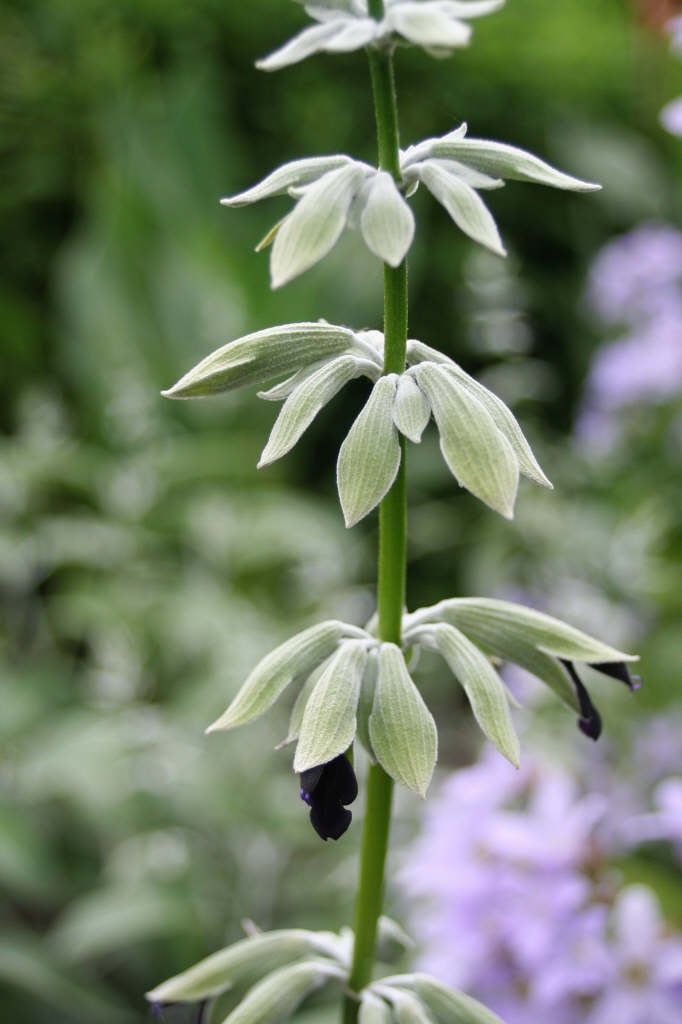
Salvia discolor

RHS Plant Profile
Andean silver-leaf sage
Andean silver-leaf sage RHS 1999
Conservatory Greenhouse Herbaceous Perennial

An upright perennial to 45cm in height, with white-woolly branched stems bearing oblong mid-green leaves, white-hairy beneath; deep indigo-black flowers 2.5cm in length with contrasting white-downy calyces, are produced in late summer and early autumn

Position

Full sun, Partial shade

Soil Types

Loam

Max Height

0.1-0.5 metres

Max Spread

0.1-0.5 metres

Size

Time to Maturity
2–5 years
Max Spread
0.1-0.5 metres
Max Height
0.1-0.5 metres

Growing Conditions

Loam
Moisture
Moist but well–drained
pH
Acid or Alkaline or Neutral

Position

Full sun Partial shade
Aspect
East–facing or South–facing
Exposure
Exposed or Sheltered
Hardiness
H2

Colour & Scent

Season Stem Flower Foliage Fruit
Spring
Summer
Autumn
Winter

Botanical Details

Family
Lamiaceae
Native to GB/Ireland
No
Foliage
Deciduous
Habit
Bushy
Genus
Salvia can be annuals, biennials, herbaceous or evergreen perennials, or shrubs. They have paired, simple or pinnately lobed, often aromatic leaves and 2-lipped flowers in whorls, forming simple or branched spikes or racemes
Name Status
Correct
Plant Range
Peru

How to Grow

Cultivation

Grow under glass in peat-free potting compost in full light with shade from hot sun. Grow outdoors in moderately fertile, moist but well-drained soil in full sun or dappled shade in a frost-free border. Protect from excessive winter wet. See our video How to care for tender salvia for more advice

Propagation

Propagate by softwood cuttings in spring or semi-hardwood in late summer

Suggested planting locations and garden types

  • Cottage and informal garden
  • Gravel garden
  • Patio and container plants
  • Wildlife gardens
  • Mediterranean climate plants
  • City and courtyard gardens
  • Coastal
  • Flower borders and beds
  • Wall side borders
  • Conservatory and greenhouse

Pruning

Cut back spent flower spikes to prolong flowering

Pests

Generally pest-free

Diseases

May be susceptible to honey fungus (rarely), powdery mildews, verticillium wilt and foot and root rots