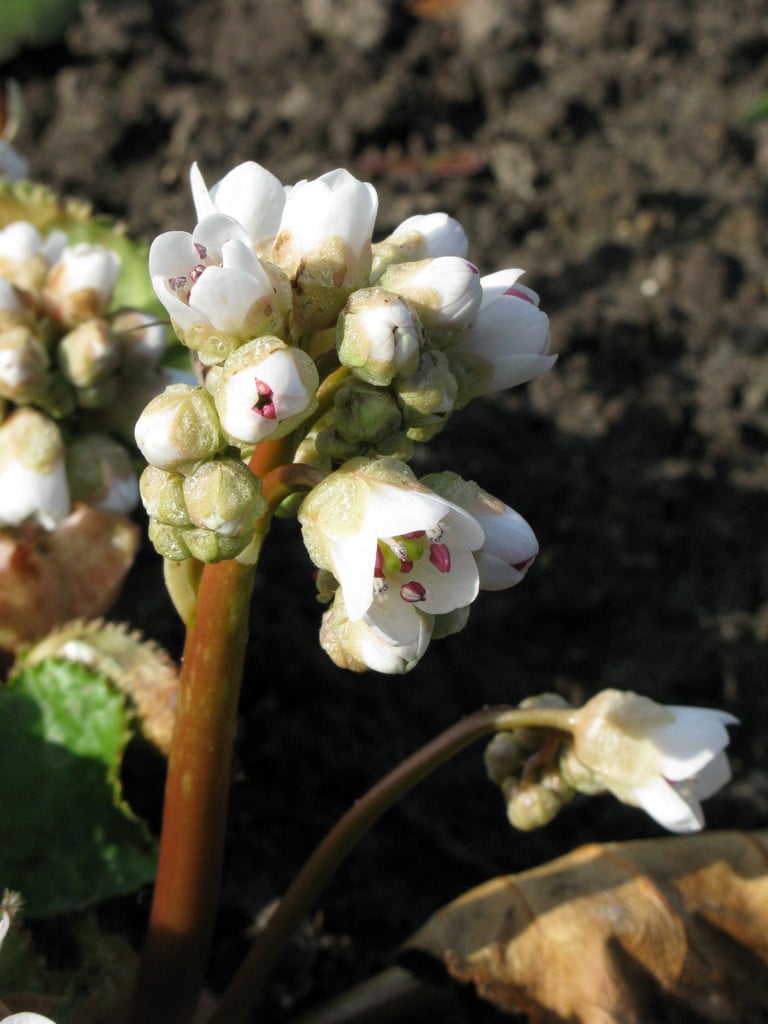
Bergenia pacumbis

RHS Plant Profile
Chinese elephant's ears
Chinese elephant's ears RHS

Other common names

she yan bai cai

Synonyms

Bergenia himalaica
Bergenia ciliata f. ligulata

Plants for pollinators
Herbaceous Perennial

A clump-forming, evergreen perennial to around 20cm high. The smooth, green, rounded to ovate leaves, 10-15cm long, have hairy, serrated margins. In spring, short stout stems bear white to pink flowers

Position

Full sun, Partial shade

Soil Types

Chalk, Clay, Loam, Sand

Max Height

0.1-0.5 metres

Max Spread

0.1-0.5 metres

Size

Time to Maturity
2–5 years
Max Spread
0.1-0.5 metres
Max Height
0.1-0.5 metres

Growing Conditions

Chalk Clay Loam Sand
Moisture
Moist but well–drained
pH
Acid or Alkaline or Neutral

Position

Full sun Partial shade
Aspect
South–facing or West–facing or East–facing
Exposure
Exposed or Sheltered
Hardiness
H6
Drought Resistance
Yes

Colour & Scent

Season Stem Flower Foliage Fruit
Spring
Summer
Autumn
Winter

Botanical Details

Family
Saxifragaceae
Native to GB/Ireland
No
Foliage
Evergreen
Habit
Clump forming
Genus
Bergenia are evergreen rhizomatous perennials with leathery, rounded leaves and dense, erect clusters of bell-shaped pink or white flowers in spring
Name Status
Correct
Plant Range
Afghanistan to China

How to Grow

Cultivation

Grows well in most humus-rich soils but dislikes extremes of heat and drought. Frosts may damage early flowers. See Bergenia cultivation for further advice

Propagation

Propagate by division or root rhizome sections in spring after flowering

Suggested planting locations and garden types

  • City and courtyard gardens
  • Patio and container plants
  • Cottage and informal garden
  • Wildlife gardens
  • Underplanting of roses and shrubs
  • Flower borders and beds

Pruning

Remove faded flower spikes

Pests

May be susceptible to vine weevil and slugs and snails

Diseases

May be susceptible to a leaf spot