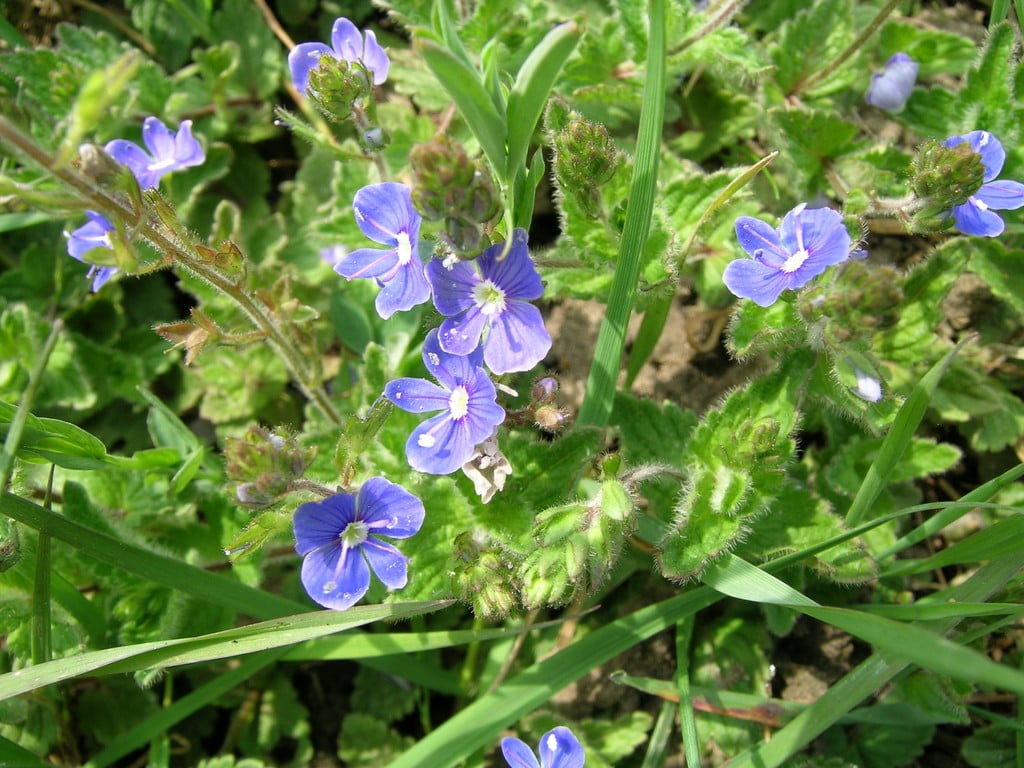
Veronica chamaedrys

RHS Plant Profile
germander speedwell
germander speedwell RHS

Other common names

angels' eyes, bird's eyes, blewort, blue eyes, bluewort, cat's eyes, female fluellen, God's eye, blue stars, eyebright

Plants for pollinators
Herbaceous Perennial

A creeping plant, rooting at the nodes, with spires of bright blue flowers. These have white centres, are up to 1cm across, four-lobed and bloom in spring and early summer. Flowering stems have two vertical lines of hairs. Leaves are entire, pointed, hairy, toothed ovals

Position

Full sun, Partial shade

Soil Types

Clay, Loam

Max Height

0.1-0.5 metres

Max Spread

0.1-0.5 metres

Size

Time to Maturity
1–2 years
Max Spread
0.1-0.5 metres
Max Height
0.1-0.5 metres

Growing Conditions

Clay Loam
Moisture
Moist but well–drained
pH
Acid or Neutral

Position

Full sun Partial shade
Aspect
West–facing or East–facing or South–facing
Exposure
Exposed or Sheltered
Hardiness
H7
Drought Resistance
Yes

Colour & Scent

Season Stem Flower Foliage Fruit
Spring
Summer
Autumn
Winter

Botanical Details

Family
Plantaginaceae
Native to GB/Ireland
Yes
Foliage
Deciduous
Habit
Matforming
Genus
Veronica can be annuals, perennials or sub-shrubs with paired leaves and small flowers usually in terminal or axillary racemes or spikes
Name Status
Correct
Plant Range
Eurasia

How to Grow

Cultivation

Naturally occurs in hedgerows, damp places, grassland and woodland, prefering moist but well-drained soil in sun or light shade. Will bring colour, and attract pollinators, to a species-rich lawn. See speedwell for more information

Propagation

Propagate by seed

Suggested planting locations and garden types

  • Wildlife gardens
  • Wildflower meadow

Pruning

No pruning required

Pests

May be susceptible to aphids

Diseases

May be susceptible to downy mildews, fungal leaf spot, fungal rot, Phytophthora and sometimes honey fungus