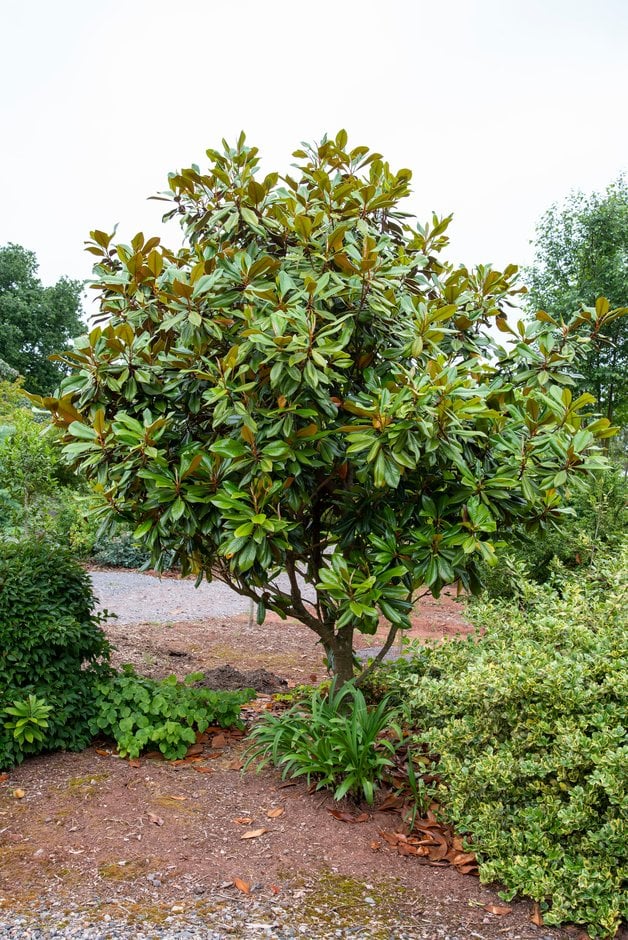
Magnolia grandiflora 'D.D. Blanchard'

RHS Plant Profile
evergreen magnolia 'Blanchard'
evergreen magnolia 'Blanchard' RHS

Synonyms

Magnolia grandiflora 'Blanchard'
Magnolia 'D.D.Blanchard'

Trees

A large, spreading tree up to 10m in height, with glossy dark green leaves with brown, furry undersides. Large, scented, open cup-shaped, creamy white flowers are produced from summer through to autumn

Position

Full sun, Partial shade

Soil Types

Clay, Loam, Sand

Max Height

8-12 metres

Max Spread

wider than 8 metres

Size

Time to Maturity
10–20 years
Max Spread
wider than 8 metres
Max Height
8-12 metres

Growing Conditions

Clay Loam Sand
Moisture
Moist but well–drained or Well–drained
pH
Acid or Neutral

Position

Full sun Partial shade
Aspect
South–facing or West–facing
Exposure
Sheltered
Hardiness
H5

Colour & Scent

Fragrance Flower
Season Stem Flower Foliage Fruit
Spring
Summer
Autumn
Winter

Botanical Details

Family
Magnoliaceae
Native to GB/Ireland
No
Foliage
Evergreen
Habit
Spreading branched
Genus
Magnolia can be deciduous or evergreen trees or shrubs, with large, showy, often fragrant flowers, often opening before the leaves, and sometimes followed by colourful cone-like fruit
Name Status
Accepted

How to Grow

Cultivation

Grow in moist, well-drained preferably neutral to acid soil in sun or part shade. Tolerates dry, alkaline soil. See magnolia cultivation advice

Propagation

Propagate by softwood cuttings from late spring to early summer or semi-ripe cuttings from late summer to autumn

Suggested planting locations and garden types

  • Architectural
  • City and courtyard gardens
  • Cottage and informal garden
  • Mediterranean climate plants
  • Low Maintenance
  • Hedging and screens
  • Wall side borders

Pruning

Pruning group 9 or pruning group 13 if wall-trained. See magnolia pruning

Pests

May be susceptible to scale insects, horse chestnut scale and capsid bug

Diseases

May be susceptible to coral spot, phytophthora, grey moulds, honey fungus, a virus or fungal leaf spot