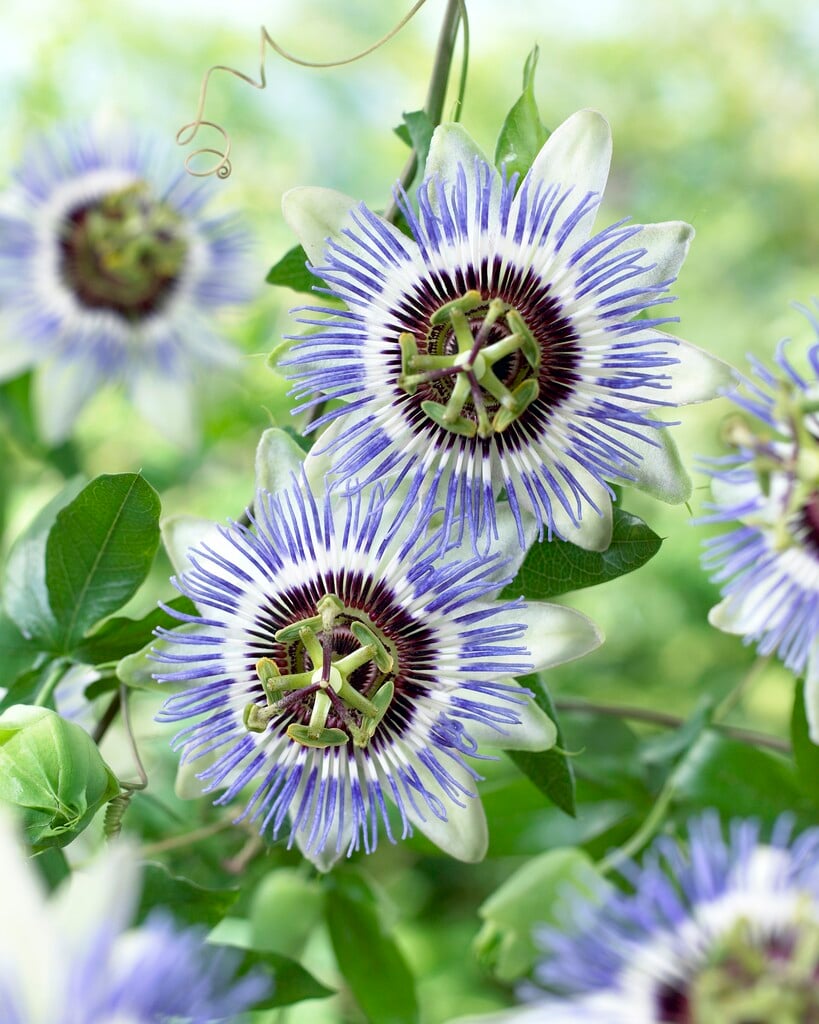
Passiflora caerulea 'Clear Sky'PBR

RHS Plant Profile
passion flower 'Clear Sky'
Climber Wall Shrub

A vigorous, semi-evergreen climber to 5m, with deeply lobed, dark green leaves and 11cm wide, star-shaped white passion flowers with a central crown of pale blue, clear white and purple, and contrasting purple branches, in spring, summer and autumn. Egg-shaped orange fruits appear after flowering which are edible but not particularly tasty

Position

Full sun, Partial shade

Soil Types

Chalk, Loam, Sand

Max Height

4-8 metres

Max Spread

2.5-4 metres

Size

Time to Maturity
5–10 years
Max Spread
2.5-4 metres
Max Height
4-8 metres

Growing Conditions

Chalk Loam Sand
Moisture
Well–drained or Moist but well–drained
pH
Acid or Alkaline or Neutral

Position

Full sun Partial shade
Aspect
South–facing or West–facing
Exposure
Sheltered
Hardiness
H4
Drought Resistance
Yes

Colour & Scent

Season Stem Flower Foliage Fruit
Spring
Summer
Autumn
Winter

Botanical Details

Family
Passifloraceae
Native to GB/Ireland
No
Foliage
Semi evergreen, Evergreen
Habit
Climbing
Genus
Passiflora are mostly tender tendril-climbing shrubs, with simple or palmately-lobed, generally evergreen leaves and showy flowers of distinctive structure with often colourful coronal filaments, followed by conspicuous fruits, edible in some species
Name Status
Accepted

How to Grow

Cultivation

Fast-growing climber for sun or partial shade, thrives in moist but well-drained soil. In cold areas, grow in a container and overwinter indoors. Has the potential to become a nuisance in some gardens due to its vigorous nature. See passion flower cultivation for more information

Propagation

Propagate by seed, semi-hardwood cuttings or by layering in spring or autumn

Suggested planting locations and garden types

  • Patio and container plants
  • City and courtyard gardens
  • Cottage and informal garden
  • Mediterranean climate plants
  • Sub-tropical
  • Climber and wall shrubs
  • Conservatory and greenhouse
  • Wall side borders
  • Edible fruit

Pruning

See pruning group 1 - tidy after flowering. See pruning group 11 or pruning group 12 if necessary, in early spring

Pests

May be susceptible to glasshouse red spider mite, glasshouse whitefly, mealybugs and scale insects under glass

Diseases

May be susceptible to honey fungus (rarely) and a virus