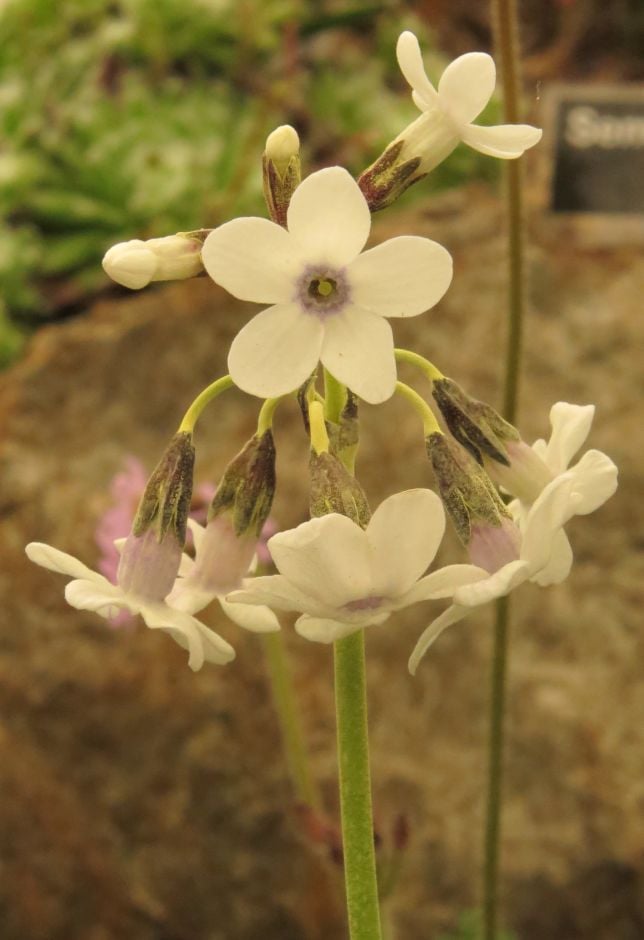
Primula chionantha subsp. chionantha (Cy)

RHS Plant Profile
snow-white primrose
snow-white primrose RHS
Bogs Herbaceous Perennial

A rosette-forming, deciduous perennial with mid-green leaves up to 25cm long covered in white or yellow meal. From late spring to early summer stout, mealy stems produce one or more whorls of pendant, tubular to funnel shaped, scented, milk-white flowers up to 2.5cm across

Position

Full sun, Partial shade

Soil Types

Clay, Loam

Max Height

0.5-1 metres

Max Spread

0.5-1 metres

Size

Time to Maturity
2–5 years
Max Spread
0.5-1 metres
Max Height
0.5-1 metres

Growing Conditions

Clay Loam
Moisture
Moist but well–drained or Poorly–drained
pH
Acid or Neutral

Position

Full sun Partial shade
Aspect
South–facing or East–facing or North–facing or West–facing
Exposure
Exposed or Sheltered
Hardiness
H6

Colour & Scent

Fragrance Flower
Season Stem Flower Foliage Fruit
Spring
Summer
Autumn
Winter

Botanical Details

Family
Primulaceae
Native to GB/Ireland
No
Foliage
Deciduous
Habit
Bushy
Genus
Primula are herbaceous or semi-evergreen perennials, forming a basal rosette of simple leaves, with salver-shaped or bell-shaped flowers which may be solitary or carried in an umbel or in whorls on an erect stem
Name Status
Correct
Horticultural Group
Crystallophlomis primulas form long, narrow, upright leaves with several flower stems per plant carrying one to three whorls of pink, purple, white or cream flowers
Plant Range
Yunnan, China

How to Grow

Cultivation

Grow in partial shade in deep, humus-rich, moist, neutral to acid soil. Will tolerate sun if soil remains moist at all times. Benefits from regular division

Propagation

Propagate by seed in containers in a frame as soon as ripe or in late winter or in early spring; or divide in early spring

Suggested planting locations and garden types

  • Cottage and informal garden
  • Flower borders and beds

Pruning

Cut back after flowering

Pests

May be susceptible to aphids, caterpillars, slugs and vine weevil

Diseases

Brown core of primulas, grey moulds, primula leaf spot and a virus may be a problem