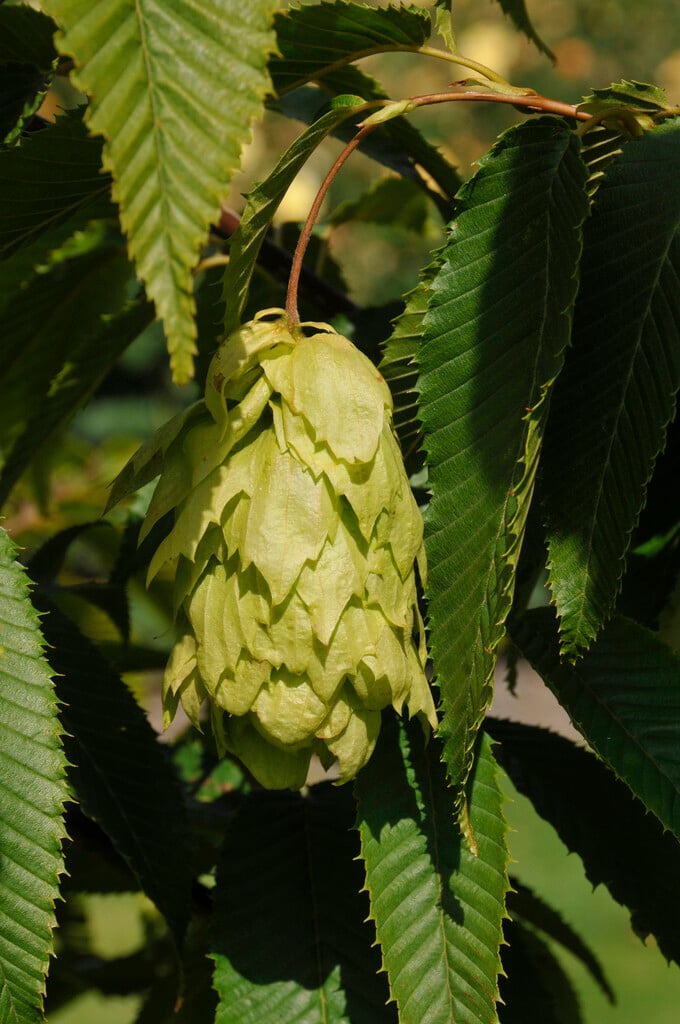
Carpinus japonica 'Chinese Lantern'

RHS Plant Profile
Japanese hornbeam 'Chinese Lantern'
Japanese hornbeam 'Chinese Lantern' visionspictures.com
Trees

A medium-sized deciduous tree with grey bark, brownish-grey on the younger branches and reaching a height of around 8-10m (27-33ft). The foliage in spring emerges red and matures in summer to bright green. In autumn it turns to bright yellow. The yellow-green, male and female catkins are produced separately on the same tree in April. After fertilisation, the female flowers develop into hop-like clusters in late summer to autumn, containing winged seeds that disperse on the wind when ripe

Position

Full sun, Partial shade

Soil Types

Chalk, Clay, Loam, Sand

Max Height

8-12 metres

Max Spread

4-8 metres

Size

Time to Maturity
10–20 years
Max Spread
4-8 metres
Max Height
8-12 metres

Growing Conditions

Chalk Clay Loam Sand
Moisture
Poorly–drained or Well–drained or Moist but well–drained
pH
Acid or Alkaline or Neutral

Position

Full sun Partial shade
Aspect
South–facing or West–facing or East–facing
Exposure
Exposed or Sheltered
Hardiness
H6

Colour & Scent

Season Stem Flower Foliage Fruit
Spring
Summer
Autumn
Winter

Botanical Details

Family
Betulaceae
Native to GB/Ireland
No
Foliage
Deciduous
Habit
Bushy
Genus
Carpinus are deciduous shrubs and trees with attractive foliage and hop-like fruit clusters in late summer and autumn
Name Status
Unresolved

How to Grow

Cultivation

Easy to grow in most soils after establishment including those which are dry or wet.

Propagation

Propagate by softwood cuttings in spring and early summer or grafting

Suggested planting locations and garden types

  • Architectural
  • City and courtyard gardens
  • Cottage and informal garden

Pruning

Pruning group 1

Pests

May be susceptible to caterpillars and aphids

Diseases

May be susceptible to powdery mildews, coral spot and sometimes honey fungus