Nerine bowdenii 'Bicolor'
Bowden lily 'Bicolor'
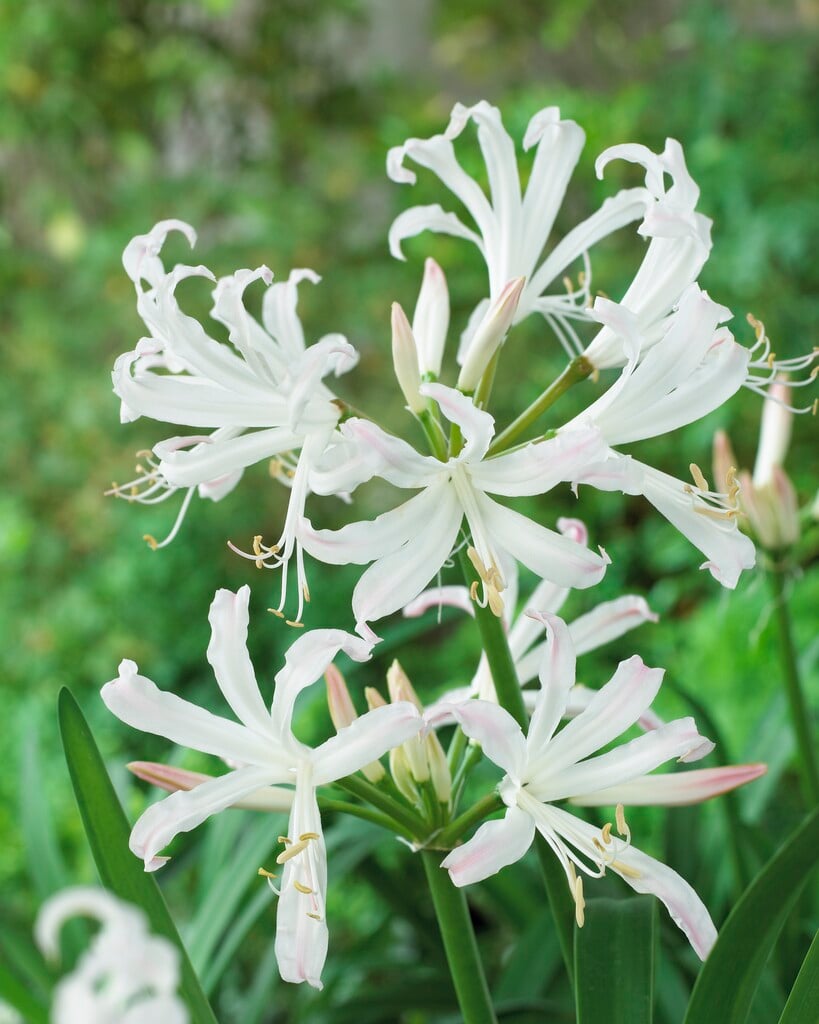
A perennial bulb, dormant in summer and flowering before the strap-shaped leaves appear in late autumn. Clusters of 6-12 white flowers, with crinkled, recurved petals streaked with pink along the middle, are borne on upright stems to to 50cm high in early autumn
Size
Ultimate height
0.1–0.5 metresTime to ultimate height
2–5 yearsUltimate spread
0.1–0.5 metresGrowing conditions
Moisture
Moist but well–drained, Well–drainedpH
Acid, Alkaline, NeutralColour & scent
| Stem | Flower | Foliage | Fruit | |
| Spring | ||||
|---|---|---|---|---|
| Summer | ||||
| Autumn | White Pink | Green | ||
| Winter | Green |
Position
- Full sun
Aspect
South–facing or West–facing
Exposure
Sheltered Hardiness
H5Botanical details
- Family
- Amaryllidaceae
- Native to GB / Ireland
- No
- Foliage
- Deciduous
- Habit
- Columnar upright
- Potentially harmful
- Ornamental bulbs - not to be eaten. Wear gloves and other protective equipment when handling. Pets: Ornamental bulbs - not to be eaten - see the HTA guide to potentially harmful plants for further information and useful contact numbers
- Genus
Nerine are summer-dormant, perennial bulbs with erect leafless stems each bearing a terminal umbel of funnel-shaped flowers in autumn, and strap-shaped or linear leaves appearing after the flowers
- Name status
Unresolved
How to grow
Cultivation
Thrives in well-drained soil, preferably in a sunny, sheltered position for best flowering performance. Plant bulbs 10cm apart with the neck of the bulb showing above the soil, except for colder areas where they will prefer to be planted 5cm underground for frost protection. See nerine cultivation
Propagation
Propagate by division after flowering, or by chipping, see bulb propagation
Suggested planting locations and garden types
- City and courtyard gardens
- Cottage and informal garden
- Gravel garden
- Mediterranean climate plants
- Patio and container plants
- Low Maintenance
- Cut flowers
- Flower borders and beds
- Wall side borders
Pruning
No pruning required
Pests
May be susceptible to slugs
Diseases
Generally disease-free
Get involved
The Royal Horticultural Society is the UK’s leading gardening charity. We aim to enrich everyone’s life through plants, and make the UK a greener and more beautiful place.