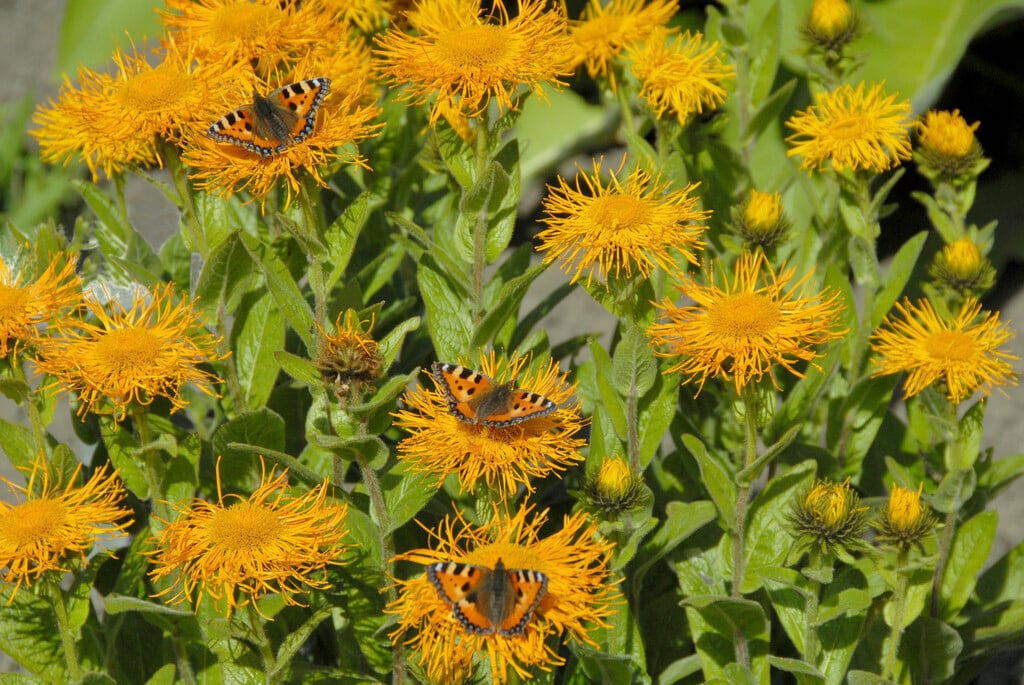
Inula orientalis

RHS Plant Profile
Georgian fleabane
Georgian fleabane visionspictures.com

Synonyms

Inula glandulosa

Plants for pollinators
Herbaceous Perennial

A compact-growing herbaceous perennial with leafy stems with hairy, mid-green oval or inverted lance-shaped foliage. In summer, large orange-yellow daisy-like flowers with ray-florets that are thin and wavy, emerge from very hairy buds

Position

Full sun, Partial shade

Soil Types

Sand, Loam, Clay, Chalk

Max Height

0.1-0.5 metres

Max Spread

0.1-0.5 metres

Size

Time to Maturity
2–5 years
Max Spread
0.1-0.5 metres
Max Height
0.1-0.5 metres

Growing Conditions

Sand Loam Clay Chalk
Moisture
Moist but well–drained or Well–drained
pH
Neutral or Alkaline or Acid

Position

Full sun Partial shade
Aspect
South–facing or West–facing or North–facing or East–facing
Exposure
Exposed or Sheltered
Hardiness
H6

Colour & Scent

Season Stem Flower Foliage Fruit
Spring
Summer
Autumn
Winter

Botanical Details

Family
Asteraceae
Native to GB/Ireland
No
Foliage
Deciduous
Habit
Spreading branched
Genus
Inula may be annuals, herbaceous perennials or sub-shrubs, moslty with large basal leaves and daisy-like yellow flower-heads, often with narrow ray-florets
Name Status
Correct

How to Grow

Cultivation

Grows easily in any moisture retentive soil in sun or partial shade

Propagation

Propagate by division in

Suggested planting locations and garden types

  • Cottage and informal garden
  • Wildflower meadow
  • Wildlife gardens
  • Flower borders and beds

Pruning

Cut back to ground level at the end of the season

Pests

Generally pest-free

Diseases

Generally disease-free, although powdery mildews may be a problem if the soil is too dry