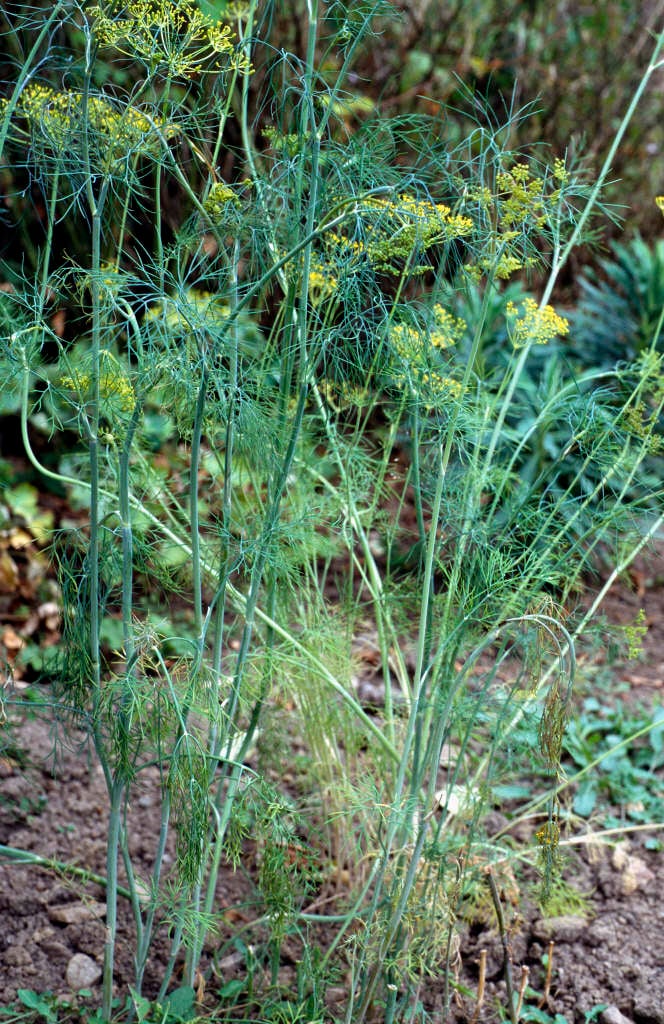
Anethum graveolens

RHS Plant Profile
dill
dill RHS 2002

Other common names

anet, dill-oil plant, East Indian dill, meeting-seed, Sabbath day posy, Indian dill

Synonyms

Anethum sowa hort. non Roxb. ex Flem.

Plants for pollinators
Herbs - Culinary Annual Biennial

An upright annual or biennial herb 60-100cm tall, with finely dissected, aromatic blue-green leaves approximately 35cm long. Flat umbels of tiny yellow flowers are produced on upright, finely ribbed stems in mid-summer. Dill is often grown as a herb for fresh scented leaves and as a cut flower. Dill seeds are also important culinary additions. Essential oil contained in seeds has medicinal properties. Various cultivars of dill are available; cultivar 'Mammoth' can reach up to 1.5m tall and cultivar 'Mariska' is very popular with florists

Position

Full sun

Soil Types

Chalk, Loam, Sand

Max Height

0.5-1 metres

Max Spread

0.1-0.5 metres

Size

Time to Maturity
1–2 years
Max Spread
0.1-0.5 metres
Max Height
0.5-1 metres

Growing Conditions

Chalk Loam Sand
Moisture
Well–drained
pH
Acid or Alkaline or Neutral

Position

Full sun
Aspect
South–facing or West–facing or East–facing
Exposure
Sheltered
Hardiness
H4

Colour & Scent

Fragrance Foliage
Season Stem Flower Foliage Fruit
Spring
Summer
Autumn
Winter

Botanical Details

Family
Apiaceae
Native to GB/Ireland
No
Foliage
Deciduous
Habit
Columnar upright
Genus
Anethum can be annuals or biennials, scented of aniseed, with leaves finely divided into linear segments, and umbels of small yellow flowers in summer
Name Status
Correct
Plant Range
S W Asia

How to Grow

Cultivation

Easy to grow in well-drained soil, in full sun sheltered from strong winds. Follow dill cultivation for more advice.

Propagation

Propagate by seed sown in succession from spring to mid-summer

Suggested planting locations and garden types

  • Cottage and informal garden
  • Wildlife gardens
  • Flower borders and beds
  • Cut flowers

Pruning

No pruning required; can be left to self-seed after flowering

Pests

Generally pest-free

Diseases

Generally disease-free