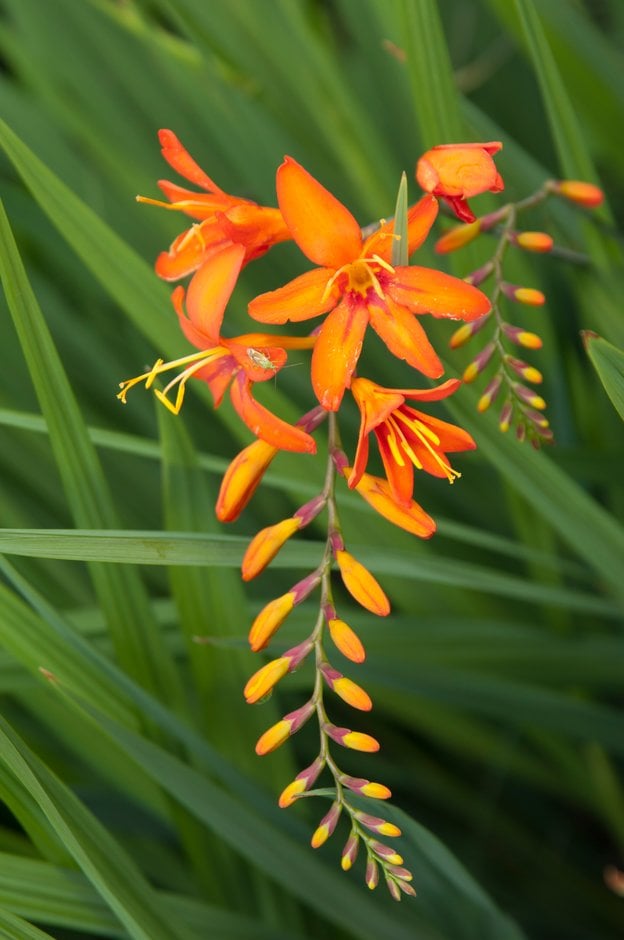
Crocosmia 'Jupiter'

RHS Plant Profile
montbretia 'Jupiter'
montbretia 'Jupiter' RHS

Synonyms

Crocosmia 'Saturn'
Crocosmia fucata 'Jupiter'
Crocosmia masoniorum 'Jupiter'

Herbaceous Perennial

A clump-forming, deciduous perennial to 75cm tall with upright, sword-shaped leaves. Arching stems bear spikes of outward-facing, funnel-shaped, orange flowers with red striping down each petal

Position

Full sun, Partial shade

Soil Types

Chalk, Clay, Loam, Sand

Max Height

0.5-1 metres

Max Spread

0.1-0.5 metres

Size

Time to Maturity
2–5 years
Max Spread
0.1-0.5 metres
Max Height
0.5-1 metres

Growing Conditions

Chalk Clay Loam Sand
Moisture
Moist but well–drained
pH
Acid or Alkaline or Neutral

Position

Full sun Partial shade
Aspect
East–facing or South–facing or West–facing
Exposure
Exposed or Sheltered
Hardiness
H5

Colour & Scent

Season Stem Flower Foliage Fruit
Spring
Summer
Autumn
Winter

Botanical Details

Family
Iridaceae
Native to GB/Ireland
No
Foliage
Deciduous
Habit
Clump forming
Genus
Crocosmia are deciduous cormous perennials with erect, sword-shaped leaves and branched spikes of showy, funnel-shaped flowers in summer
Name Status
Accepted

How to Grow

Cultivation

Plant 8-10cm deep in fertile, humus-rich, moist but well-drained and preferably sandy soil in full sun or partial shade; in colder areas plant somewhere with shelter from cold drying winds, such as near a wall, and protect in winter with a thick, dry, organic mulch. If clumps become congested, divide them in early spring. Has the potential to become a nuisance in some gardens if not managed well

Propagation

Propagate by division in early spring, just before growth starts

Suggested planting locations and garden types

  • Coastal
  • Mediterranean climate plants
  • Cottage and informal garden
  • Prairie planting
  • Flower borders and beds
  • Cut flowers
  • Wall side borders

Pruning

No pruning required, except removal of dead leaves and flower stems before new growth starts in spring

Pests

May be susceptible to glasshouse red spider mite

Diseases

Generally disease-free