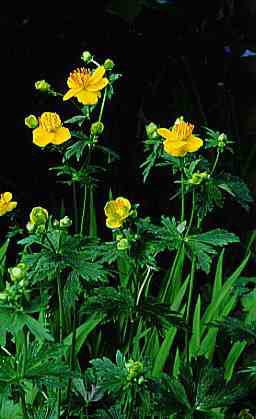
Trollius chinensis 'Golden Queen'

RHS Plant Profile
globeflower 'Golden Queen'
globeflower 'Golden Queen' Dorling Kindersley 2003

Synonyms

Trollius × cultorum 'Golden Queen'

Award of Garden MeritPlants for pollinators
Herbaceous Perennial Bogs

A clump-forming, herbaceous perennial to 90cm, with deeply lobed, sharply-toothed dark green leaves and long-stalked, solitary, terminal, bowl-shaped flowers 5cm in width, with orange-yellow petals

Position

Full sun, Partial shade

Soil Types

Clay, Loam

Max Height

0.5-1 metres

Max Spread

0.1-0.5 metres

Size

Time to Maturity
2–5 years
Max Spread
0.1-0.5 metres
Max Height
0.5-1 metres

Growing Conditions

Clay Loam
Moisture
Poorly–drained
pH
Acid or Alkaline or Neutral

Position

Full sun Partial shade
Aspect
East–facing or South–facing
Exposure
Exposed or Sheltered
Hardiness
H7

Botanical Details

Family
Ranunculaceae
Native to GB/Ireland
No
Foliage
Deciduous
Habit
Clump forming
Genus
Trollius are herbaceous perennials which form a clump of palmately lobed leaves, with erect stems bearing solitary, yellow, globose or bowl-shaped flowers composed of several petal-like sepals surrounding much-reduced nectar-bearing petals
Name Status
Accepted

How to Grow

Cultivation

Grow in deep preferably heavy, moist soil that does not dry out, in full sun or partial shade. Cut back hard after flowering and apply a balanced liquid fertiliser to encourage further blooms

Propagation

Propagate by division in spring

Suggested planting locations and garden types

  • Cottage and informal garden
  • Wildflower meadow
  • Wildlife gardens
  • Flower borders and beds

Pruning

Cut back hard after flowering

Pests

Generally pest-free

Diseases

May be susceptible to powdery mildews
