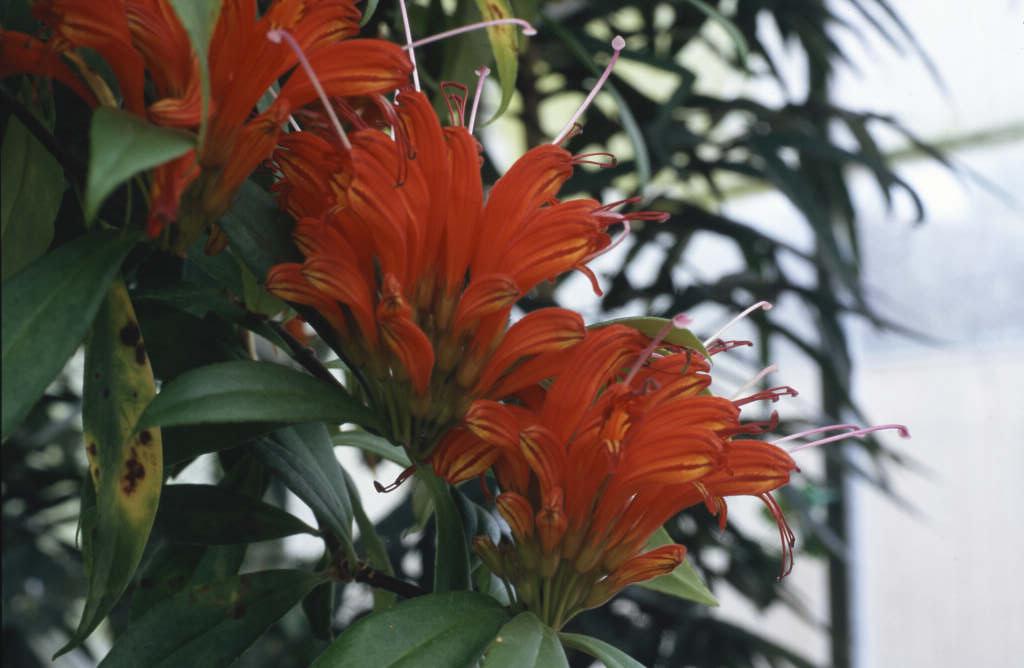
Aeschynanthus pulcher

RHS Plant Profile
red bugle vine
red bugle vine RHS 2002

Other common names

lipstick plant, royal red bugler, scarlet basket vine

Synonyms

Aeschynanthus 'Jack Lobbianus'
Aeschynanthus javanicus hort.
Aeschynanthus lobbianus
Aeschynanthus parvifolius
Aeschynanthus lanceolatus
Aeschynanthus pulchra
Aeschynanthus lamponga
Aeschynanthus radicans lobbianus
Aeschynanthus boschianus

Award of Garden Merit
Conservatory Greenhouse Houseplants

A tender epiphytic evergreen climber to 75cm in height, with aerial rooting stems bearing glossy, oval, dark green leaves 4.5cm long, and terminal clusters of 6-8 hooded, bright red tubular flowers 6cm long, with yellow throats, produced from summer to winter

Position

Partial shade

Soil Types

Loam

Max Height

0.5-1 metres

Max Spread

0.1-0.5 metres

Size

Time to Maturity
2–5 years
Max Spread
0.1-0.5 metres
Max Height
0.5-1 metres

Growing Conditions

Loam
Moisture
Moist but well–drained
pH
Acid or Neutral or Alkaline

Position

Partial shade
Aspect
West–facing or East–facing
Exposure
Sheltered
Hardiness
H1A

Colour & Scent

Season Stem Flower Foliage Fruit
Spring
Summer
Autumn
Winter

Botanical Details

Family
Gesneriaceae
Native to GB/Ireland
No
Foliage
Evergreen
Habit
Climbing
Genus
Aeschynanthus can be climbers, subshrubs or trailing perennials with simple, fleshy, evergreen leaves and showy tubular flowers, some with a contrasting calyx
Name Status
Correct
Plant Range
Indonesia

How to Grow

Cultivation

Grow as a house or conservatory plant indoors in a peat-free houseplant compost. Position the container in bright, filtered light for best growth and flowering. Water freely and apply a half strength, general liquid feed monthly from mid spring to late summer. Water sparingly in winter. See houseplant cultivation for further information

Propagation

Propagate by softwood cuttings in spring or semi-ripe cuttings in summer

Suggested planting locations and garden types

  • Houseplants
  • Sub-tropical
  • Conservatory and greenhouse

Pruning

Trim back weak or overly-long shoots as necessary

Pests

May be susceptible to aphids and mealybugs

Diseases

Generally disease-free