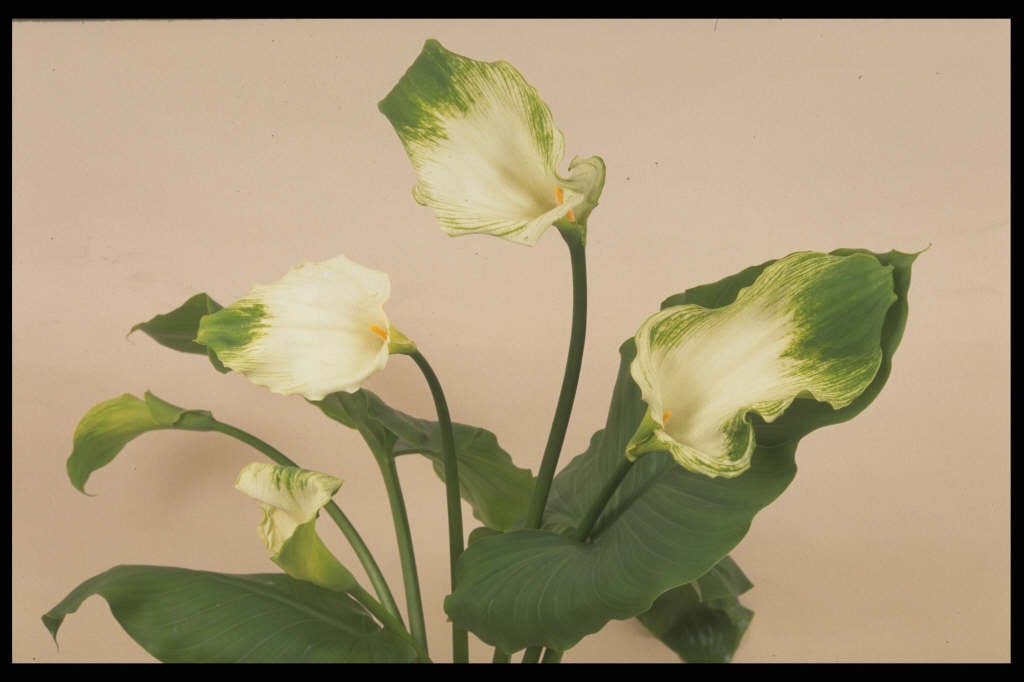
Zantedeschia aethiopica 'Green Goddess'

RHS Plant Profile
arum lily 'Green Goddess'
arum lily 'Green Goddess' www.gardenworldimages.com

Synonyms

Zantedeschia 'Green Goddess'

Award of Garden Merit
Aquatic Herbaceous Perennial

A clump-forming herbaceous or semi-evergreen perennial to 90cm, with large arrow-shaped dark green leaves and green spathes, white in the throat, 15-20cm long, with yellow spadices

Position

Full sun, Partial shade

Soil Types

Clay, Loam

Max Height

0.5-1 metres

Max Spread

0.1-0.5 metres

Size

Time to Maturity
5–10 years
Max Spread
0.1-0.5 metres
Max Height
0.5-1 metres

Growing Conditions

Clay Loam
Moisture
Poorly–drained
pH
Acid or Alkaline or Neutral

Position

Full sun Partial shade
Aspect
South–facing or West–facing
Exposure
Sheltered
Hardiness
H4

Colour & Scent

Season Stem Flower Foliage Fruit
Spring
Summer
Autumn
Winter

Botanical Details

Family
Araceae
Native to GB/Ireland
No
Foliage
Deciduous
Habit
Clump forming
Potentially harmful
Harmful if eatenskin/eye irritant. Wear gloves and other protective equipment when handling. Pets: Harmful if eatenskin/eye irritant - for further information and contact numbers regarding pets, see the HTA guide to potentially harmful plants
Genus
Zantedeschia can be deciduous or semi-evergreen, tuberous perennials with lance-shaped or arrow-shaped leaves and tiny yellow flowers forming a dense spike-like spadix, with a showy, hood-like spathe, sometimes followed by orange berry-like fruits
Name Status
Accepted

How to Grow

Cultivation

Grow outdoors in full sun or part shade in moisture-retentive soil; in containers planted in peat-free John Innes No2 potting compost or can also be grown as a marginal plant in water up to 30cm (1ft) deep. Use aquatic compost and a 30cm (1ft) deep planting basket. See Zantedeschia cultivation

Propagation

Propagate by division in spring

Suggested planting locations and garden types

  • Patio and container plants
  • Sub-tropical
  • Mediterranean climate plants
  • Cottage and informal garden
  • Flower borders and beds

Pruning

Tidy any foliage blackened by frosts

Pests

May be susceptible to aphids and thrips

Diseases

May be susceptible to fungal and bacterial rots and a virus