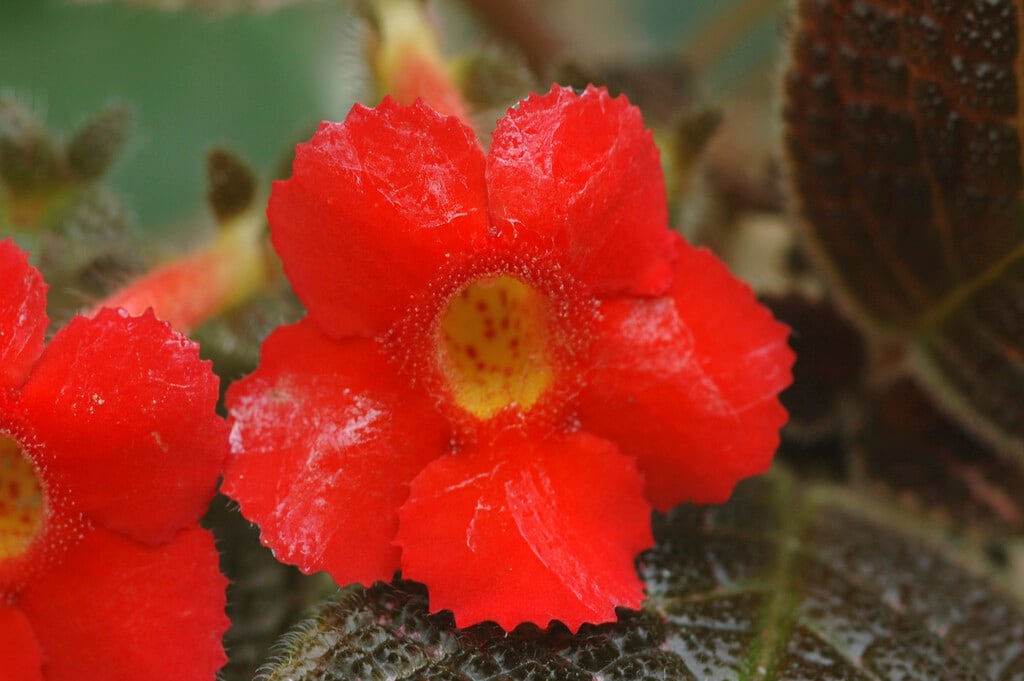
Episcia cupreata

RHS Plant Profile
flame violet
flame violet visionspictures.com
Houseplants Conservatory Greenhouse

An evergreen, low-growing perennial usually grown as a houseplant with creeping stems bearing colourful, textured green, brown and red foliage with silvery-green veining. Funnel-shaped, bright red flowers with a yellow eye appear intermittently from spring into autumn

Position

Partial shade

Soil Types

Loam

Max Height

Up to 10 cm

Max Spread

0.5-1 metres

Size

Time to Maturity
2–5 years
Max Spread
0.5-1 metres
Max Height
Up to 10 cm

Growing Conditions

Loam
Moisture
Moist but well–drained
pH
Acid or Alkaline or Neutral

Position

Partial shade
Aspect
East–facing or West–facing
Exposure
Sheltered
Hardiness
H1B

Colour & Scent

Season Stem Flower Foliage Fruit
Spring
Summer
Autumn
Winter

Botanical Details

Family
Gesneriaceae
Native to GB/Ireland
No
Foliage
Evergreen
Habit
Trailing, Bushy
Genus
A genus of trailing, flowering perennial houseplants, native to Central and South America, Brazil and the West Indies, and grown mainly for their velvety, textured and colourful foliage. Flowers are solitary and may be red, pink or orange
Name Status
Correct

How to Grow

Cultivation

Grow as a houseplant on an east or west-facing windowsill, or grow in a temperate or warm greenhouse in bright filtered light with shade from hot sun; a minimum temperature of 15°C is required. Water sparingly as compost dries in winter and in the growing season water freely allowing compost to dry out between waterings; feed fortnightly with a high-potassium fertiliser

Propagation

Propagate by stem cutting, by division or removing rooted runners

Suggested planting locations and garden types

  • Hanging Basket
  • Houseplants
  • Patio and container plants
  • Conservatory and greenhouse

Pruning

No pruning required

Pests

May be susceptible to aphids, glasshouse leafhoppers, mealybugs, Thrips, vine weevil and tarsonemid mite

Diseases

May be susceptible to basal rot and grey moulds if overwatered