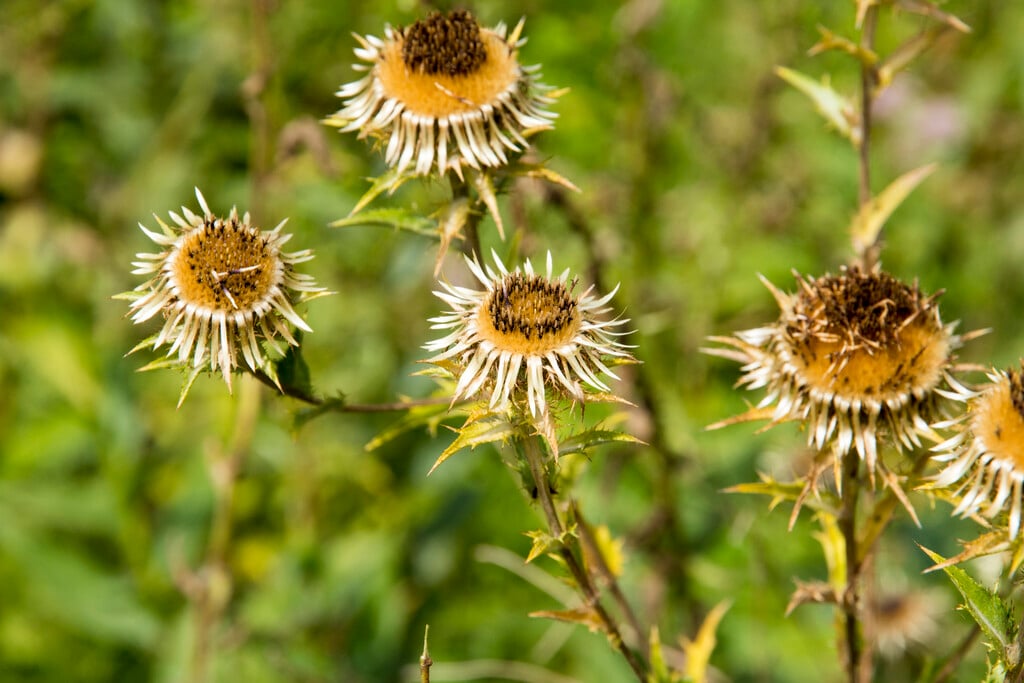
Carlina vulgaris
common carline thistle
A biennial plant with an upright, clumping growth habit, it forms a basal rosette in its first year before sending up a flowering stem in its second year. It reaches 15 to 40cm with spiny, oblong leaves that are green with a slightly grayish or silvery tint due to cottony hairs on the underside. Its distinctive flower heads, 1.5 to 4cm wide, appear singly or in small clusters, featuring shiny, straw-colored, petal-like bracts with a metallic sheen. The flowers open in dry weather and close when moist

Buy this plant
Size
Ultimate height
0.1–0.5 metresTime to ultimate height
1–2 yearsUltimate spread
0.1–0.5 metresGrowing conditions
Moisture
Moist but well–drained, Well–drainedpH
Alkaline, NeutralColour & scent
| Stem | Flower | Foliage | Fruit | |
| Spring | Green Grey Silver | |||
|---|---|---|---|---|
| Summer | Grey Silver Yellow | Green Grey Silver | ||
| Autumn | Green Grey Silver | |||
| Winter | Green Grey Silver |
Position
- Full sun
Aspect
South–facing or West–facing
Exposure
Exposed or Sheltered Hardiness
H7Botanical details
- Family
- Asteraceae
- Native to GB / Ireland
- Yes
- Foliage
- Semi evergreen
- Habit
- Bushy, Columnar upright
- Genus
A genus of flowering thistle-like herbs, annuals, perennials, shrubs and dwarf trees with spiny, upright stems and daisy-like brown and golden flowers
- Name status
Correct
How to grow
Cultivation
Thrives in sunny, dry, well-drained, alkaline soils, especially on chalky grasslands, rocky slopes, and coastal areas
Propagation
Propagate by seed
Suggested planting locations and garden types
- Wildlife gardens
Pruning
No pruning required
Pests
Generally pest-free
Diseases
Generally disease-free
Get involved
The Royal Horticultural Society is the UK’s leading gardening charity. We aim to enrich everyone’s life through plants, and make the UK a greener and more beautiful place.