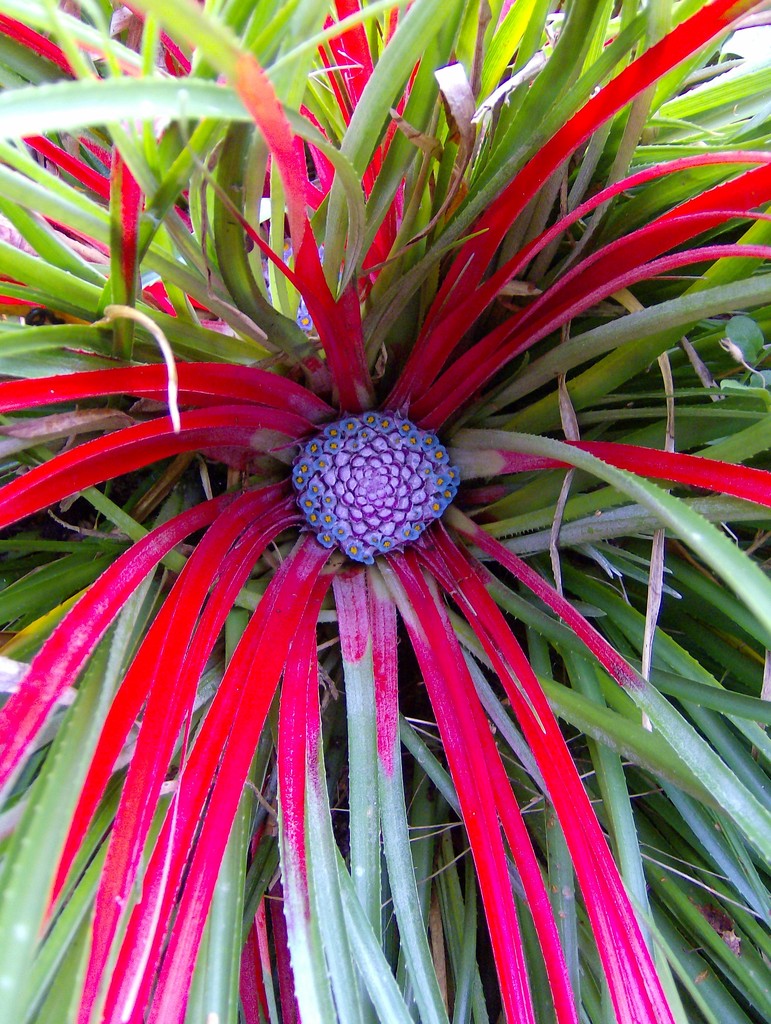
Fascicularia bicolor

RHS Plant Profile
crimson bromeliad
crimson bromeliad RHS

Synonyms

Rhodostachys bicolor
Fascicularia kirchhoffiana
Fascicularia pitcairniifolia misapplied
Fascicularia andina

Herbaceous Perennial

A rosette-forming, terrestrial bromeliad with slender, spiny-toothed, rigid, mid to dark-green, evergreen leaves up to 50cm long. In summer each mature rosette produces a dense central cluster of pale sky-blue flowers surrounded by ivory-white bracts. At this time, the innermost leaves of the rosette turn scarlet red

Position

Full sun

Soil Types

Loam, Sand

Max Height

0.1-0.5 metres

Max Spread

0.5-1 metres

Size

Time to Maturity
5–10 years
Max Spread
0.5-1 metres
Max Height
0.1-0.5 metres

Growing Conditions

Loam Sand
Moisture
Well–drained
pH
Acid or Alkaline or Neutral

Position

Full sun
Aspect
South–facing or West–facing or East–facing
Exposure
Sheltered
Hardiness
H3

Colour & Scent

Season Stem Flower Foliage Fruit
Spring
Summer
Autumn
Winter

Botanical Details

Family
Bromeliaceae
Native to GB/Ireland
No
Foliage
Evergreen
Habit
Tufted
Genus
Fascicularia is a small genus of, usually terrestrial, perennial bromeliads. Toothed, linear leaves are arranged in rosettes; dense flowerheads are embedded in the centre of these rosettes
Name Status
Correct
Plant Range
C Chile

How to Grow

Cultivation

Grow outdoors in terrestrial bromeliad compost or sharply-draining, gritty, humus-rich soil, in a sheltered frost-free location. Protect from winter wet. Under glass grow in terrestrial bromeliad compost, full light and with good ventilation. During active growth water moderately and apply a high nitrogen-based fertiliser monthly. Water more sparingly during the winter

Propagation

Propagate by offsets

Suggested planting locations and garden types

  • City and courtyard gardens
  • Patio and container plants

Pruning

No pruning required

Pests

May be susceptible to aphids

Diseases

Generally disease-free