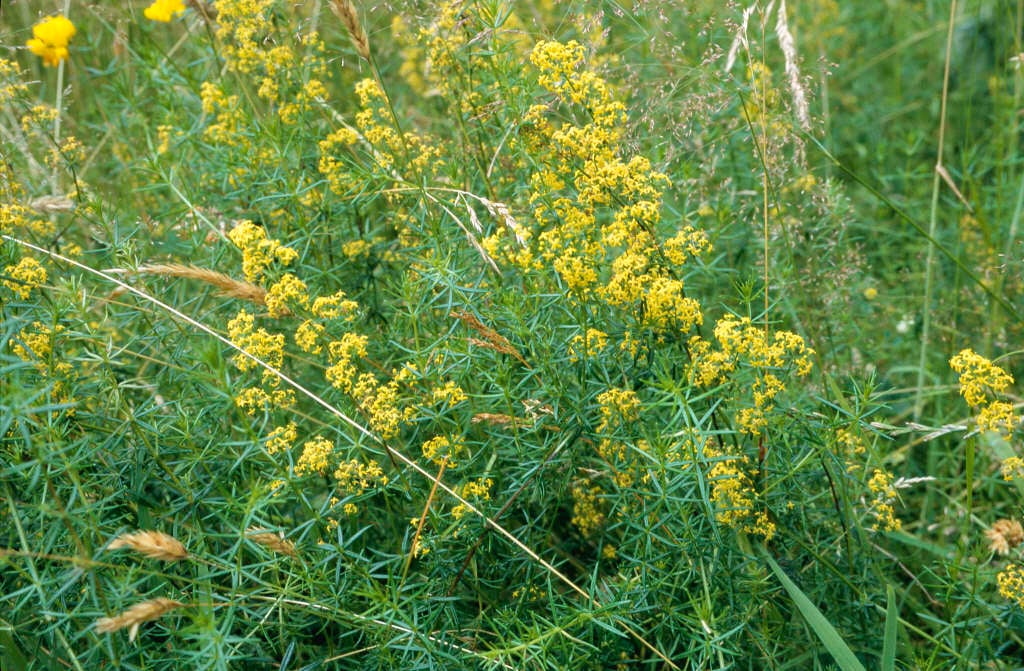
Galium verum

RHS Plant Profile
lady's bedstraw
lady's bedstraw RHS 2002

Other common names

bed flower, cheese rennet, fenwort, hundredfold, maiden's hair, maid's hair, Our Lady's bedstraw, petty mugget, rennet weed, yellow bedstraw, briwydden felen

Plants for pollinators
Herbaceous Perennial

A low, scrambling, carpeting perennial with stems to 1.2m long, often rooting where they touch the ground, and bearing whorled linear green leaves, and terminal panicles of tiny 4-lobed yellow flowers in mid and late summer, scented of hay when dried

Position

Full sun, Partial shade

Soil Types

Chalk, Clay, Loam, Sand

Max Height

0.1-0.5 metres

Max Spread

0.1-0.5 metres

Size

Time to Maturity
2–5 years
Max Spread
0.1-0.5 metres
Max Height
0.1-0.5 metres

Growing Conditions

Chalk Clay Loam Sand
Moisture
Moist but well–drained or Well–drained
pH
Alkaline or Neutral

Position

Full sun Partial shade
Aspect
South–facing or North–facing or East–facing or West–facing
Exposure
Exposed or Sheltered
Hardiness
H7

Colour & Scent

Season Stem Flower Foliage Fruit
Spring
Summer
Autumn
Winter

Botanical Details

Family
Rubiaceae
Native to GB/Ireland
Yes
Foliage
Deciduous
Habit
Matforming
Genus
Galium can be annuals or perennials, with weak, sometimes scrambling stems bearing whorls of narrow leaves and usually terminal panicles of small, white or yellow flowers
Name Status
Correct
Plant Range
Europe, Asia, NW Africa

How to Grow

Cultivation

Grow in any moist but well-drained soil in sun or partial shade; it spreads freely with the potential to become a nuisance in gardens, but ideal for meadow planting, where the flowers provide nectar for pollinating insects such as bumblebees and butterflies and food for caterpillars of several moths

Propagation

Propagate by seed, sowing when ripe, or propagate by division

Suggested planting locations and garden types

  • Wildflower meadow
  • Wildlife gardens

Pruning

No pruning required

Pests

Generally pest-free

Diseases

Generally disease-free