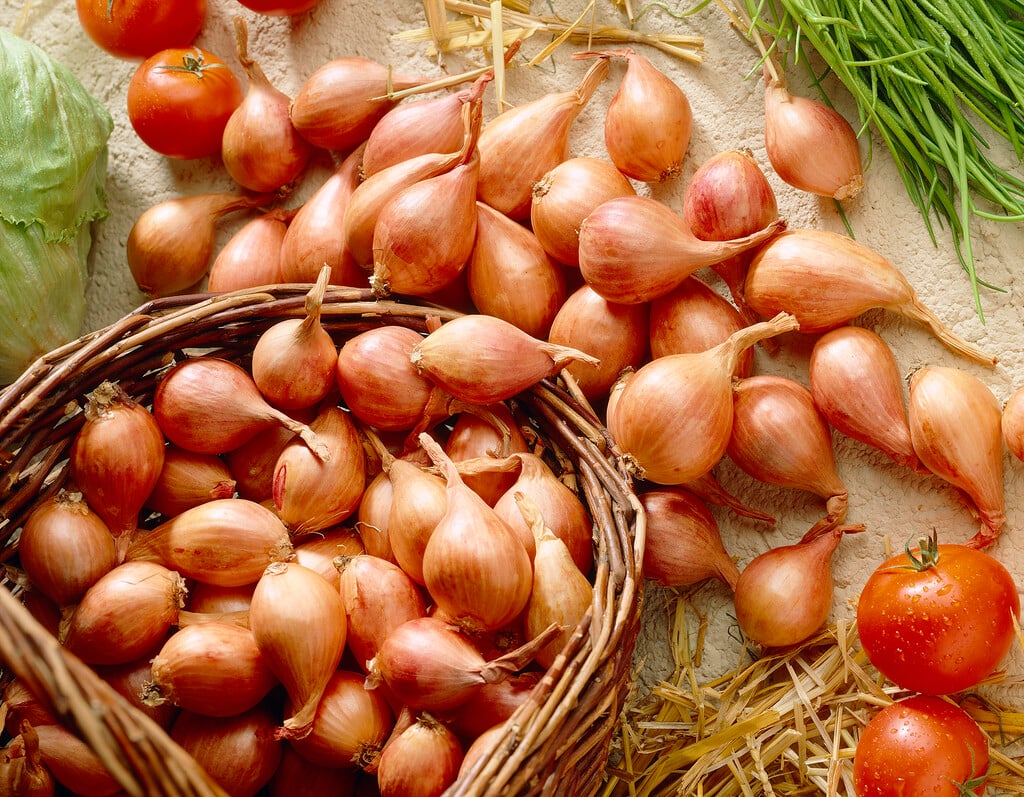
Allium cepa Aggregatum Group

RHS Plant Profile
shallot
shallot visionspictures.com

Other common names

scallion

Synonyms

Allium ascalonicum misapplied

Herbs - Culinary Bulbs

A perennial plant, often grown as cultivated annual, with linear, hollow leaves and pink or red flowers. This group, commonly knows as shallots, has been selected for milder and sweeter flavour. Bulbs usually grown in a cluster and are up to 5cm large. Many named cultivars of shallots are available, varying in colour, shape and size

Position

Full sun

Soil Types

Chalk, Clay, Loam, Sand

Max Height

0.1-0.5 metres

Max Spread

0.1-0.5 metres

Size

Time to Maturity
1 year
Max Spread
0.1-0.5 metres
Max Height
0.1-0.5 metres

Growing Conditions

Chalk Clay Loam Sand
Moisture
Moist but well–drained
pH
Alkaline or Neutral

Position

Full sun
Aspect
South–facing or West–facing
Exposure
Sheltered
Hardiness
H4

Colour & Scent

Fragrance Foliage
Season Stem Flower Foliage Fruit
Spring
Summer
Autumn
Winter

Botanical Details

Family
Amaryllidaceae
Native to GB/Ireland
No
Foliage
Deciduous
Habit
Clump forming
Genus
Allium are bulbous herbaceous perennials with a strong onion or garlic scent, linear, strap-shaped or cylindrical basal leaves and star-shaped or bell-shaped flowers in an umbel on a leafless stem
Name Status
Unresolved

How to Grow

Cultivation

Grow in fertile, moisture retentive, but well-drained soil in full sun. Yellowing and toppling of the foliage is a sign that the shallots are reaching maturity. Lift and store in a cool dry place. See how to grow: shallots for further advice

Propagation

Propagate by seed or by onion sets. See how to grow: onions or sowing vegetable seeds

Pruning

Not required

Pests

May be susceptible to onion fly, leek moth and narcissus eelworm

Diseases

May be susceptible to onion white rot, onion downy mildew, leek rust and onion neck rot. Bolting, producing flowers, may be a problem