Ligularia dentata 'Othello'
leopard plant 'Othello'
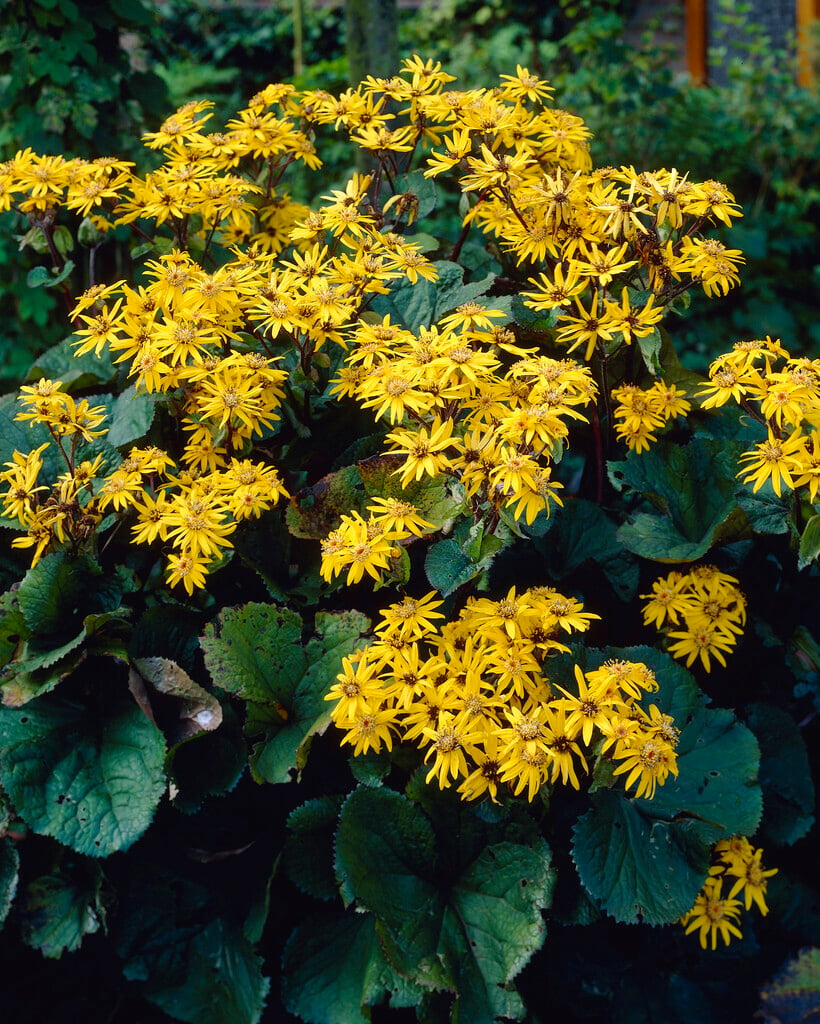
A clump-forming herbaceous perennial with large, rounded, saw-edged leaves which are flushed deep purple in spring, before fading to dark green. The undersides of the leaves remain dark red/purple. In summer and early autumn branched stems topped by large, daisy-like, yellow-orange flowers with narrow petals are held above the leaves. Height around 1m (3.2ft).
Size
Ultimate height
0.5–1 metresTime to ultimate height
2–5 yearsUltimate spread
0.5–1 metresGrowing conditions
Moisture
Poorly–drainedpH
Acid, Alkaline, NeutralColour & scent
| Stem | Flower | Foliage | Fruit | |
| Spring | Purple | |||
|---|---|---|---|---|
| Summer | Yellow Orange | Green Purple | ||
| Autumn | Yellow Orange | Green Purple | ||
| Winter |
Position
- Full sun
- Partial shade
Aspect
South–facing or West–facing
Exposure
Sheltered Hardiness
H6Botanical details
- Family
- Asteraceae
- Native to GB / Ireland
- No
- Foliage
- Deciduous
- Habit
- Clump forming
- Genus
Ligularia are robust herbaceous perennials, with large, often attractively lobed leaves and yellow or orange, daisy-like flower-heads in terminal racemes or branching clusters
- Name status
Accepted
How to grow
Cultivation
Grow in moderately fertile, deep, reliably moist soil, in full sun with some midday shade. Shelter from strong winds.
Propagation
Propagate by division in spring, or after flowering.
Suggested planting locations and garden types
- Sub-tropical
Pruning
No pruning required. Cut down withered stems in winter/early spring
Pests
Diseases
Generally disease-free
Get involved
The Royal Horticultural Society is the UK’s leading gardening charity. We aim to enrich everyone’s life through plants, and make the UK a greener and more beautiful place.