


_8929.JPG?w=1280&fit=clip&fm=jpg&auto=format)

10 award-winning hollies and ivies
When they are both fully grown, holly and ivy make impressive winter evergreens with all the traditional holiday associations

Discover an array of hollies on display as part of a National Plant Collection at RHS Garden Rosemoor in Devon
Hollies are a versatile and surprisingly diverse group of plants, providing structure in formal and informal garden areas and playing an important role for wildlife, offering shelter and food. The collection at RHS Garden Rosemoor was originally started by the garden’s creator and former owner, Lady Anne Berry, and was accredited by Plant Heritage as a National Plant Collection in 1988. Today it includes 187 species and cultivars.
The holly collection is found throughout RHS Rosemoor but particularly in the Formal Shrub Garden borders, formal hedging areas, woodland banks of Lady Anne’s Garden and the Arboretum . Lady Anne’s Garden is generally more rich in Ilex species, with more of the cultivars located in the Formal Garden areas. Visitors can explore the collection themselves using the Holly Trail leaflet .
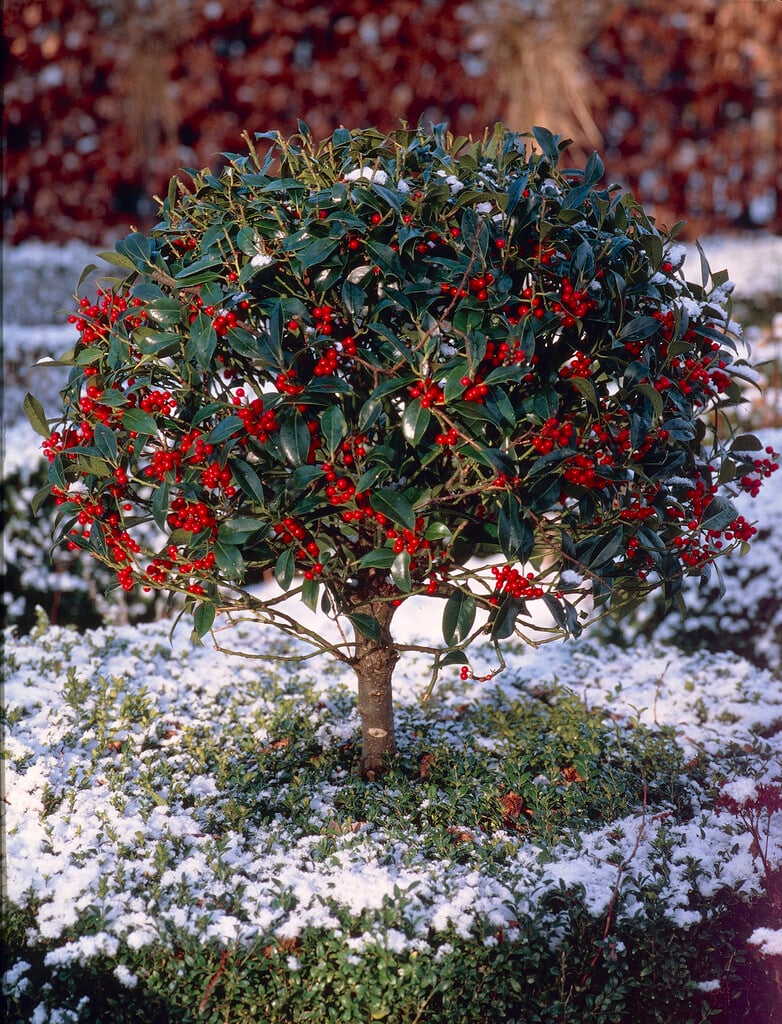
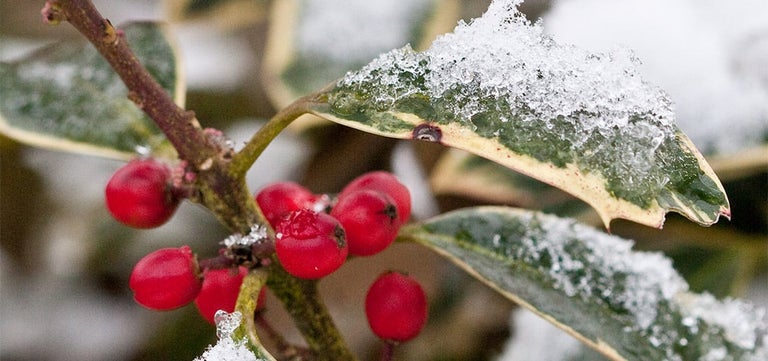
Although hollies look good all year, the winter period is an excellent time to see the collection when the structure of the evergreen species is shown off at its best and when colourful berries are also produced.
"Don’t leave your visit until Christmas as by then most of the berry displays have been eaten by blackbirds and fieldfares! Don’t forget that the deciduous hollies – yes, there are some – also have good berry displays."
The diversity of holly species and cultivars available means there is huge scope for using them in different garden situations. “With many hollies being evergreen, they provide good structure to backs of borders, though smaller forms can be used for more selective placing at the front of borders,” says Jonathan Hutchinson, former Woody Ornamental Team Leader. “Some cultivars are naturally slow growing with interesting bonsai-style growth, such as Ilex crenata ‘Dwarf Pagoda’ , so lend themselves to a range of horticultural situations.”

Ilex aquifolium ‘J.C. van Tol’ with an RHS Recommended: Award of Garden Merit, illustrates the versatility of the genus for hedging, and as it’s a self-fertile , has the added attraction of producing fruit displays. Ilex crenata has a wide range of available cultivars that can be used as alternatives to box hedging or in Japanese-style cloud pruning.
The larger hollies can reach small to medium tree-size proportions and offer a wide range of leaf form and . “Many within the RHS Rosemoor collection have un-holly-like leaves without prickles, and others are ,” says Jonathan.
"The collection shows the diversity of uses of the different species and cultivars and how these rewarding plants have value in formal and informal areas."


A genus of about 400 species, Ilex is one of two genera within the family Aquifoliaceae, the other genus being Nemopanthus. Ilex are distributed throughout the Northern Hemisphere and are particularly diverse in Asia. South America is also rich in species whereas Africa has only one species, Ilex mitis.
With Ilex aquifolium RHS Recommended: AGM being a British , this would have been one of the traditional evergreens brought indoors over the winter months along with ivy and mistletoe to celebrate the winter solstice.
Yaupon tea is made from the leaves of Ilex vomitoria , which is said to have many health benefits and is the only caffeinated plant native to North America. The name refers to its use as a purgative by native Americans when taken in large quantities.

“There’s a lovely tree of the native Ilex aquifolium on the woodland bank at RHS Rosemoor that has beautiful dark green glossy leaves and always has a heavy crop of berries in autumn. Another favourite of mine is Ilex yunnanensis , an evergreen that has a lovely, graceful habit, soft crenulated leaves and a pink flush of new foliage in spring.”
"Though familiar to all because of their festive connotations, hollies are underused as a garden plant. As the National Plant Collection is spread throughout RHS Rosemoor, it gives visitors the opportunity to see them growing in the widest range of uses and garden styles."
Hollies are generally regarded as being happy in alkaline or acid soils with relatively good drainage. Some species, such as Ilex verticillata , are happy growing in wetter soils, but do not require this in the UK for successful cultivation. Others, such as Ilex perado subsp. platyphyllus prefer more sheltered situations and grow successfully with lower light levels under other tree canopies as long as there is sufficient soil moisture.
The native species, Ilex aquifolium, can be host to the holly leaf miner, Phytomyza ilicis . This native fly has little impact on the plant’s growth or vigour, but if thought unsightly, affected leaves can be removed and added to council .
There is a particular pathogen, Phytophthora ilicis, that can be detrimental to some species of holly. This is spread within the droplets of rain splash and will work its way up into the canopy, killing the branches as it goes. The easiest part of the remedy is to cut off and destroy all the affected branch material. Though it is more difficult to remove and destroy the leaf litter from beneath the plant, these processes will inhibit re-infection and the plant will respond with new growth from the cut stems. Make sure that all cuts are taken back to clean wood and do not have any staining. Sterilise tools throughout the process.
There is a tendency for some hollies to have thin patches midway up their main stems before filling out again with strong growth. Some cultivars of Ilex aquifolium seem to be most prone. This can be rather frustrating but further pruning back of these gaps will produce re-growth to fill these areas out. It’s a good policy with these cultivars to give frequent light pruning to promote regular re-growth, reducing the chances of this happening.