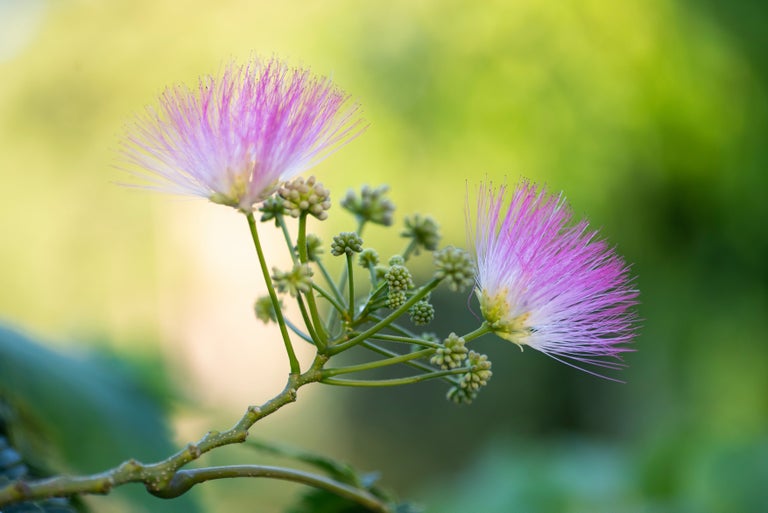
The Plant Heritage National Plant Collection of Albizia julibrissin species and cultivars is held at RHS Garden Wisley. These elegant small trees are prized for their finely divided, fern-like foliage and distinctive silky flowers, which are made up of colourful stamens rather than petals, says RHS Head of Horticultural Relations, Emma Allen
Emma Allen
Head of Horticultural Relations
3-minute read
About the collection
The collection contains eight Albizia julibrissin species and cultivars, which can be found in several areas of RHS Garden Wisley, including the Old Laboratory borders, Trials Garden, the Exotic Garden and Battleston Hill. The collection is curated by RHS Horticulturist Liam Anderson.
Albizia are members of the pea family and are to south-west and eastern Asia. They are commonly known as Persian silk trees and are valued for their late-summer flowers, varied growth habits and range of foliage colours.
When to visit
The best time to see the collection is from July to August, when the trees are in flower and at their most spectacular.
Albizia julibrissin f. rosea
History and interesting facts
The genus Albizia was named after the Italian nobleman Filippo degli Albizzi, who introduced the tree to Europe in the mid-18th century. The common name, Persian silk tree, refers to the silky appearance of the flowers, created by masses of showy stamens.
In the United States, Albizia can self-seed freely and is considered in some areas.
Why grow Albizia?
Albizia are attractive small trees that offer several ornamental qualities:
Late-summer flowers with a distinctive silk-like appearance
Delicate, feathery foliage
A range of habits, including weeping and spreading forms
Varied leaf colours, including purple-leaved cultivars
Suitable for smaller gardens as they do not grow excessively large
Collection highlights
Some I'd particularly recommend are the purple-leaved cultivars Albizia julibrissin Chocolate Fountain (’Ncaj1’) and A. julibrissin 'Summer Chocolate , the latter being a weeping form. Although not considered rare, these cultivars are excellent choices for smaller gardens and deserve to be grown more widely. They provide a low, wide, spreading habit, which brings a distinctive character to a garden.
Albizia julibrissin
Growing and propagation
Albizia need a warm, sheltered position and perform best in the south-east of Britain, where they receive enough warmth to flower well. They can be propagated by or .
Climate resilience
The collection has responded positively to recent warmer, drier summers, showing good resilience as trees that enjoy hot, dry conditions.
This collection demonstrates the diversity and garden value of Albizia, showcasing forms that range from graceful weeping trees to striking purple-leaved cultivars, all united by their distinctive summer flowers and elegant foliage.
"What’s not to like about these trees? They are resilient, have beautiful feathery foliage, diverse forms within such a small group and beautiful flowers. Surely there is something for everyone."