Phalaenopsis (moth orchid), windowsill trial results 2024–2025

Objectives and purpose of the trial

This trial focused on Phalaenopsis (moth orchids), a popular, showy, and exotic houseplant with long-lasting flowers. Using a new trial format, volunteers cared for a moth orchid plant at home and provided feedback, which was combined with data collected from central trial locations. This information helped inform the RHS Orchid Expert Group on which plants performed best. The top-performing selections were awarded the RHS Recommended: Award of Garden Merit.
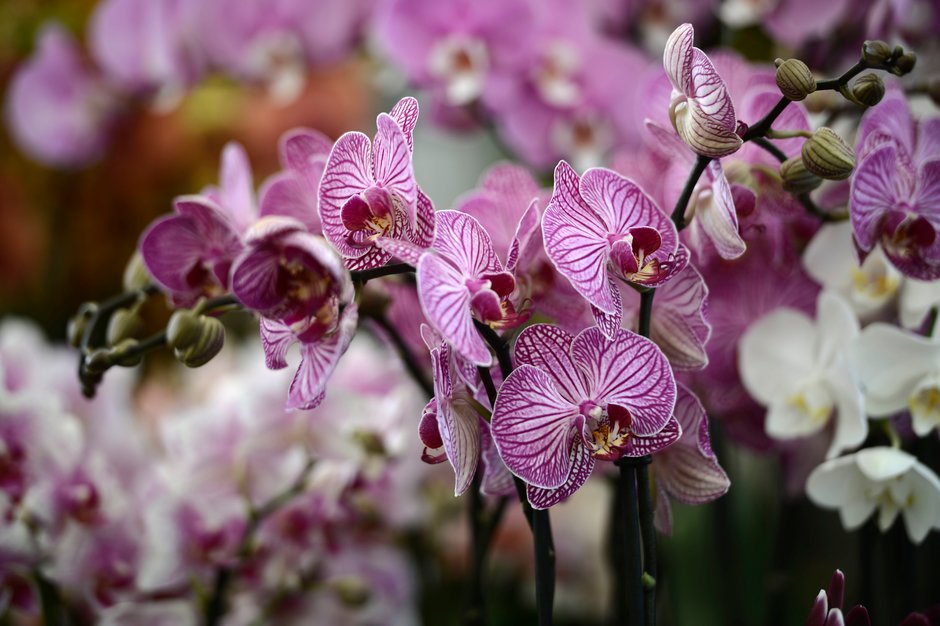
Moth orchid plants creating a colourful display on a windowsill
Moth orchid enjoying the windowsill light in a home setting

What is an RHS Recommended: Award of Garden Merit?

The RHS Recommended: Award of Garden Merit helps gardeners choose plants that are reliable and perform well in real gardens. Plants that receive the RHS Recommended: AGM have been thoroughly tested and shown to be:

  • Easy to grow and reliable in normal garden conditions
  • Readily available to buy in garden centres or online
  • Healthy, robust plants with strong growth and appearance
  • True to type, maintaining consistent shape, colour and form
  • Reasonably resistant to common pests and diseases

Judging criteria

The following factors were all taken into consideration as part of the judging of the trial:

  • Healthy leaves
  • Strong and long-lasting flower spikes that branch evenly
  • Lots of flowers, evenly arranged

  • Good size flowers with stable colour
  • Ease of re-flowering and quality of new flower spikes

Moth orchids – RHS Recommended: AGM winners

In this first RHS windowsill trial of moth orchids, volunteers and RHS Trials team members tested how well plants performed under everyday home conditions, focusing on flowering duration, plant health and the ability to reflower. Three new cultivars proved themselves alongside established favourites and were awarded an RHS Recommended: Award of Garden Merit, while 17 existing award holders were reconfirmed. With no awards rescinded, the trial delivers a refreshed and reliable list of moth orchids well suited to growing at home.

I’ve had my Phalaenopsis for 21 years, so if you keep them happy, they can live a long life.

Jean Barker, RHS Trial judge and RHS Orchid Expert Group member

Why the RHS Recommended: AGM was awarded

New award winners with volunteer comments

PhalaenopsisANTHURA MODENA (‘Phalhoch’) 2025

  • Volunteer comment: Flowered for many months. Consistent. Good performer
  • Size: Large orchid, usually sold in 12cm container

Phalaenopsis ‘Safe Haven’ 2025

  • Volunteer comment: Looks nice and easy to maintain. This orchid was voted top in the RHS People’s Choice vote at the RHS Urban Show in Manchester in 2024
  • Size: Small orchid, usually sold in 9cm container

Phalaenopsis  ‘Sunny Shore’ 2025

  • Volunteer comment: Long flowering with healthy-looking plants afterwards
  • Size: Small orchid, usually sold in 9cm container

Please note: Dates shown in brackets indicate the year the plant received its award.

Reconfirmed awards with volunteer comments

Phalaenopsis NEW LIFE (or PISCO) (‘B9020’) 2014 

  • Volunteer comment: Compact. Flowered prettily for a long time. Easy to care for. Not as vigorous as other orchids
  • Size: Small orchid, usually sold in 9cm container

PhalaenopsisANTHURA DOVER (‘Phalcomwel’) 2017 

  • Volunteer comment: Flowered so well the first and second time, easy to reflower. Healthy
  • Size: Large orchid, usually sold in 12cm container 

Phalaenopsis ‘Violet Queen’ 2017 

  • Volunteer comment: Healthy. Likely to produce further flowers
  • Size: Small orchid, usually sold in 9cm container 

PhalaenopsisANTHURA DENVER (‘Phaldancip’) 2022 

  • Volunteer comment: Elegant, long-lasting spikes. Easy to grow
  • Size: Large orchid, usually sold in 12cm container

PhalaenopsisANTHURA FOLKESTONE (‘Phalgondal’) 2022 

  • Volunteer comment: Elegant, consistent. Strong grower. Too big for some spaces
  • Size: Large orchid, usually sold in 12cm container

PhalaenopsisANTHURA LA PAZ (‘Phalgalyi’) 2022 

  • Volunteer comment: Compact, good colour and leaves stayed healthy
  • Size: Small orchid, usually sold in 9cm container 

PhalaenopsisANTHURA LINZ (‘Phalfytyo’) 2022 

  • Volunteer comment: Attractive, compact with long-lasting. Has dainty white flowers with dark pink markings
  • Size: Small orchid, usually sold in 9cm container 

PhalaenopsisANTHURA MILWAUKEE (‘Phalgaqxyk’) 2022 

  • Volunteer comment: Reliable. Healthy with beautiful blooms
  • Size: Large orchid, usually sold in 12cm container 

PhalaenopsisANTHURA PUEBLA (‘Phalfufly’) 2022 

Volunteer comment: Easy to look after but hasn't flowered again

Size: Small orchid, usually sold in 9cm container 

PhalaenopsisANTHURA SALTA (‘Phalfauf’) 2022 

  • Volunteer comment: Low maintenance, small and didn't outgrow space
  • Size: Small orchid, usually sold in 9cm container 

PhalaenopsisANTHURA SANTOS (‘Phalcrazoh’) 2022 

  • Volunteer comment: Easy to look after, has flowered again
  • Size: Small orchid, usually sold in 9cm container

Phalaenopsis ANTHURA ZURICH (‘Phalguoch’) 2022 

  • Volunteer comment: Shy to flower, no repeat flowering. Easy to grow, low maintenance and doesn’t take up too much space
  • Size: Small orchid, usually sold in 9cm container 

Phalaenopsis Birdie gx ‘Birdie’ 2022 

  • Volunteer comment: Compact and healthy. Reflowered with minimal effort
  • Size: Small orchid, usually sold in 9cm container 

Phalaenopsis ‘Electric Vibes’ 2022 

  • Volunteer comment: Compact. Has bright petals contrasting with dark foliage. Resilient and reflowering. Easy to care for
  • Size: Small orchid, usually sold in 9cm container 

Phalaenopsis ‘Honeybee’ 2022 

  • Volunteer comment: Attractive, compact and easy to grow. Flowers last so long and managed to reflower unlike previous orchids
  • Size: Small orchid, usually sold in 9cm container

Phalaenopsis ‘Perceval’ 2022 

  • Volunteer comment: Healthy, and easy to care for. Easy to flower again
  • Size: Small orchid, usually sold in 9cm container 

PhalaenopsisPUPPY (‘Mi00121’) 2022 

  • Volunteer comment: Attractive. Compact enough for a narrow ledge
  • Size: Small orchid, usually sold in 9cm container

Please note: Dates shown in brackets indicate the year the plant received its award.

The trial launched at the RHS Urban Show, Manchester
Display of the Phalaenopsis trial in The Orchid House at RHS Wisley

RHS Recommended: AGMs rescinded

For this Phalaenopsis (moth orchid) trial, no existing RHS Recommended: Award of Garden Merit selections lost their award.

Plants and location

What was planted?

Twenty varieties of Phalaenopsis were trialled, with multiple plants of each variety divided into four collections. In April 2024, 120 volunteers, including RHS Director General Clare Matterson, were each given one moth orchid to care for and observe at home. The orchids were distributed at a shop-ready stage, with flower spikes partly in bud and partly open. These varied home environments allowed the trials team to assess flowering duration, overall health and whether plants reflowered under different conditions.

Where was it planted?

As well as being grown in volunteers’ homes on windowsills in a range of rooms and aspects, sets of orchids were trialled at RHS Wisley, Surrey, and RHS Bridgewater, Greater Manchester. Plants were kept in The Orchid House and back offices to provide comparative data. Here are some considerations for growing moth orchids:

  • Moth orchids have been widely bred to produce many free-flowering and easy-to-grow hybrids
  • Grow in very loose, airy compost, mainly made of composted bark

  • Keeping the roots in good condition, not too wet or too dry, is the key to success with moth orchids
  • Position your moth orchid in bright light. An east or west-facing windowsill is ideal. Keep your plant out of direct sun, as this can scorch the leaves

Phalaenopsis facts

These tropical orchids produce exotic displays of showy blooms that last for several months. The flowers come in a range of colours, most often white, pink or purple, but also shades of yellow, peach and burgundy. The petals may be veined, patterned or blotched with a combination of these colours. The tall, arching flower stems can be produced at any time of year and sprout from a clump of long, leathery, evergreen leaves.

Cultivation

Planting process

The moth orchids were supplied by Double H Nurseries who grow the plants on over time, starting from smaller plug plants. When they were delivered to the RHS in early April 2024, they were at a similar stage to shop-bought plants with the larger plants in 12cm pots and the smaller ones in 9cm pots.   

Once the orchids were at a stage to begin the trial, an orchid was given to each volunteer in mid-late April 2024 to take home and care for over a 13-month period. The RHS Trials team provided the volunteers with a grower’s guide to help look after the orchid with the following suggestions: 

  • Keep the orchid in the transparent plastic pot it arrived in. Moth orchids only need repotting every two years or so, to refresh the bark compost
  • Position the orchid in bright light. An east or west-facing windowsill is ideal. Keep it out of direct sun, as this can scorch the leaves
  • Moth orchids prefer consistently warm conditions all year round. They do reasonably well in temperatures down to 10–12°C, but 15°C is better
  • Water once weekly throughout the growing season
  • Feed lightly but regularly using a specific orchid fertiliser
To encourage their plants to reflower, volunteers used a range of orchid feeds, from rubbing banana skins on the leaves to applying general orchid food.

How plant health was managed

Challenges

Moth orchids are generally untroubled by pests and diseases and only occasionally attract mealybugs. The volunteers and RHS Trials team checked plants regularly for white fluffy wax around the leaf bases and other hiding places, as the earlier it is spotted, the easier it will be to avoid them spreading. Picking off the bugs is the only way to control them.

Location and heating

During the trial, moth orchids were kept on windowsills in a range of rooms and aspects. Although Phalaenopsis hybrids are generally tolerant plants, the trial highlighted conditions they do not cope with well. One participant, whose home was unheated, lost her plant. Moth orchids prefer warm, stable conditions and are sensitive to cold drafts, but they should also be protected from strong, direct sunshine on south-facing windowsills. Several participants noted that temperature fluctuations caused buds to drop.

Once they’ve been watered, the roots turn green and healthy and then go silvery again when the plant needs water.

Jean Barker, RHS Trial judge and RHS Orchid Expert Group member

Discoveries

While carrying out the trial, a lot of time was spent observing the plants, and details were noticed that did not relate to the formal trial assessment. Here are some of the interesting findings from the trial:

April 2025 | Unusual growths

Some of the volunteers noticed plantlets growing from nodes on the flowering stem of their orchids (known as keiki). These baby plants can simply be detached once they’ve grown several roots, then potted up in orchid compost to give you new plants for free. The RHS experts advised that keiki are sometimes produced when moth orchids have been stressed, so the volunteers who had noticed keiki were also able to check on the conditions their orchids were growing in.

December 2024 | Winter care

During the winter part of the trial, the volunteers fed back on how the temperatures in their homes were changing. The RHS experts advised not to leave orchids on the outside of curtains when closing them in the evening in the winter as they might get too cold. In winter, moth orchids do reasonably well in temperatures down to 10–12°C but 15°C is better.

Did you know?

Orchids are equatorial epiphytes that experience dry seasons in the wild. This is good and bad. You can forget to water for a month or two, but the orchid won’t let you know it is stressed immediately. Summer growth is faster, so maybe up watering and feeding. In mid to end November reduce watering again as light levels drop and growth slows.

Who Was Involved?

Judges of the trial

This type of trial didn’t have the usual judging panel assigned to it as the performance is based on information gathered from volunteers looking after the orchids for the RHS Orchid Expert Group to review. The information was captured via short quarterly online surveys. Findings and expert tips were shared with everyone by optional video calls.

Suppliers to the trial

List of plants in the trial

View all the moth orchids trialled at RHS Wisley, RHS Bridgewater and at home
  • Phalaenopsis ‘Birdie’
  • Phalaenopsis ANTHURA DENVER (‘Phaldancip’)
  • Phalaenopsis ANTHURA DOVER (‘Phalcomwel’)
  • Phalaenopsis ‘Electric Vibes’
  • Phalaenopsis ANTHURA FOLKESTONE (‘Phalgondal’) 
  • Phalaenopsis ‘Honeybee’
  • Phalaenopsis ANTHURA LA PAZ (‘Phalgalyi’)
  • Phalaenopsis ANTHURA LINZ (‘Phalfytyo’)
  • Phalaenopsis ANTHURA MILWAUKEE (‘Phalgaqxyk’)
  • Phalaenopsis ANTHURA MODENA (‘Phalhoch’)
  • Phalaenopsis NEW LIFE (‘B9020’)
  • Phalaenopsis ‘Perceval’
  • Phalaenopsis ANTHURA PUEBLA (‘Phalfufly’)
  • Phalaenopsis PUPPY (‘Mi00121’)
  • Phalaenopsis ‘Safe Haven’
  • Phalaenopsis ANTHURA SALTA (‘Phalfauf’)
  • Phalaenopsis ANTHURA SANTOS (‘Phalcrazoh’)
  • Phalaenopsis ‘Sunny Shore’
  • Phalaenopsis ‘Violet Queen’
  • Phalaenopsis ANTHURA ZURICH (‘Phalguoch’)
RHS Award of Garden Merit logo
Buy AGM plants at RHSplants.co.uk

Choose from hundreds of specially-selected plants, bulbs, seeds and gardening products in our online shop.

Shop now

Handy tools and information


Get in touch

For more information on our RHS Plant Trials or to access older trial reports, please get in touch with our team via email at [email protected].

Get involved

The RHS is the UK’s gardening charity, helping people and plants to grow - nurturing a healthier, happier world, one person and one plant at a time.