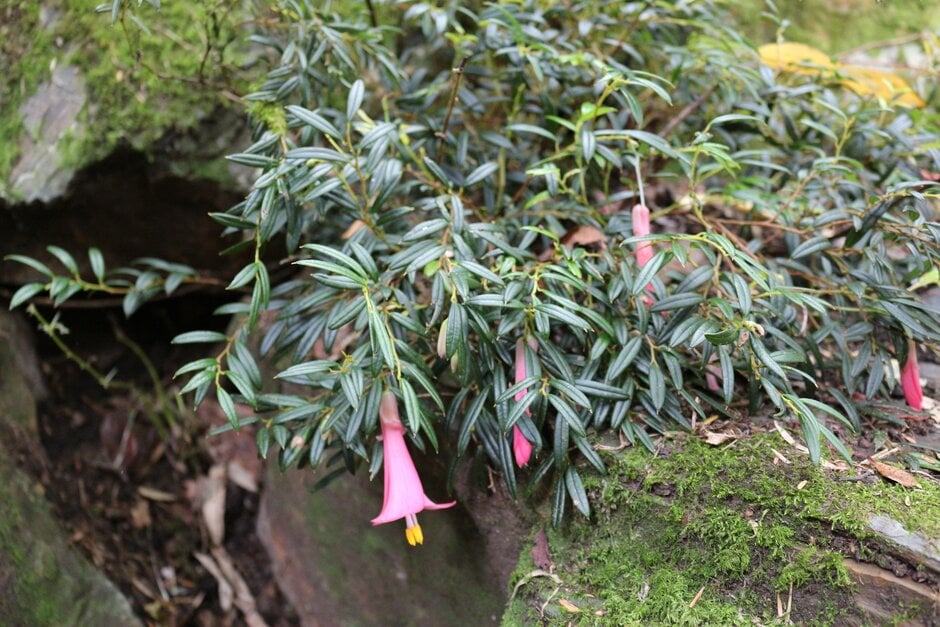
Philesia magellanica

RHS Plant Profile
Magellan austral bellflower
Magellan austral bellflower RHS

Synonyms

Philesia buxifolia

Shrubs

An unusual, evergreen, suckering, sometimes climbing shrub with upright rigid stems which can have a pinkish hue when young and become arching over time. Foliage is narrow and very dark green and thick, waxy, tubular pink flowers, with a flared mouth, appear irregularly in summer through to autumn. Performs well in shady, mossy, rocky areas and will climb around mossy trees

Position

Partial shade

Soil Types

Sand, Loam

Max Height

0.1-0.5 metres

Max Spread

0.1-0.5 metres

Size

Time to Maturity
2–5 years
Max Spread
0.1-0.5 metres
Max Height
0.1-0.5 metres

Growing Conditions

Sand Loam
Moisture
Moist but well–drained or Poorly–drained
pH
Acid

Position

Partial shade
Aspect
East–facing or South–facing or West–facing
Exposure
Sheltered
Hardiness
H3

Colour & Scent

Season Stem Flower Foliage Fruit
Spring
Summer
Autumn
Winter

Botanical Details

Family
Philesiaceae
Native to GB/Ireland
No
Foliage
Evergreen
Habit
Suckering
Genus
A genus of just one known species of suckering, evergreen flowering plant, native to South America with narrow, rigid green foliage and crimson-pink, trumpet-shaped flowers appearing in summer to autumn
Name Status
Correct
Plant Range
Chile, Argentina

How to Grow

Cultivation

Grow in humus-rich, moist, acidic soil in part, dappled shade and in a sheltered position. Performs best in shady, mossy and rocky areas which remain damp throughout the summer

Propagation

Propagation by suckers or semi-ripe cuttings in summer may not always be successful. Layering of shoots can produce better results

Suggested planting locations and garden types

  • Cottage and informal garden
  • Gravel garden
  • Rock garden

Pruning

No pruning required. Remove suckers in spring

Pests

May be susceptible to slugs, snails, scale insects and red spider mite

Diseases

Generally disease-free but young shoots may be susceptible to fungal diseases