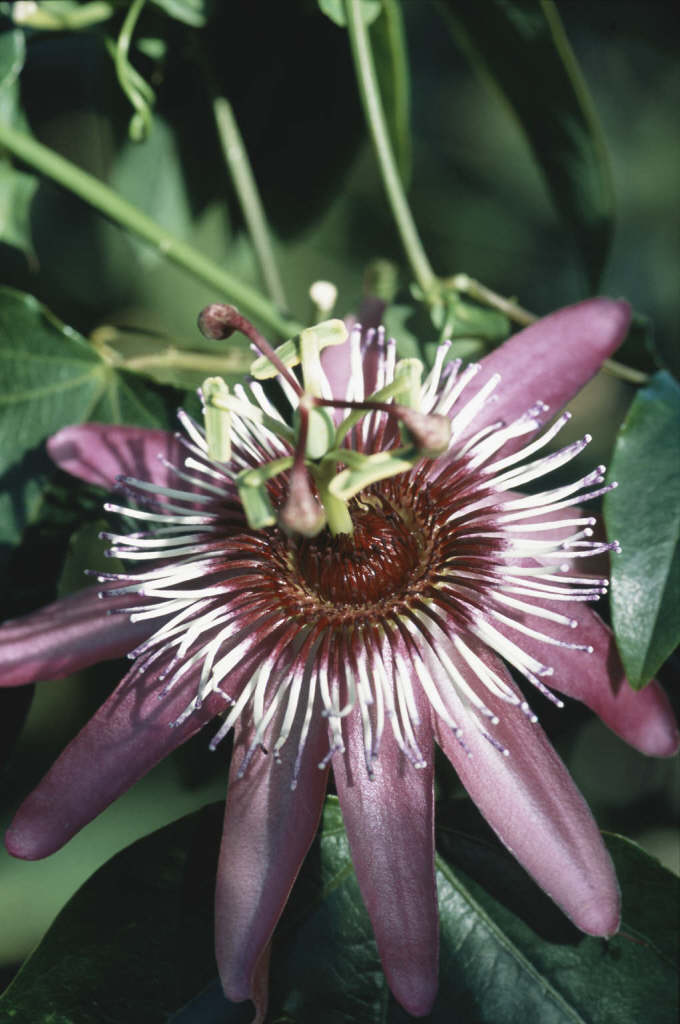
Passiflora × violacea

RHS Plant Profile
violet passion flower
violet passion flower RHS 1999

Synonyms

Passiflora × caeruleoracemosa

Award of Garden Merit
Conservatory Greenhouse Climber Wall Shrub

An evergreen climber to 6m, with 5-lobed leaves and bowl-shaped, deep reddish-purple flowers to 12cm across, coronal filaments deep violet with white tips; fruits ovoid, green, often sterile. The pulp in the fruits only can be eaten when they are fully ripe and yellow-orange. Unripe fruit is toxic

Position

Full sun, Partial shade

Soil Types

Loam, Sand

Max Height

4-8 metres

Max Spread

0.5-1 metres

Size

Time to Maturity
5–10 years
Max Spread
0.5-1 metres
Max Height
4-8 metres

Growing Conditions

Loam Sand
Moisture
Moist but well–drained
pH
Acid or Alkaline or Neutral

Position

Full sun Partial shade
Aspect
South–facing or East–facing
Exposure
Sheltered
Hardiness
H2

Colour & Scent

Season Stem Flower Foliage Fruit
Spring
Summer
Autumn
Winter

Botanical Details

Family
Passifloraceae
Native to GB/Ireland
No
Foliage
Evergreen
Habit
Climbing
Potentially harmful
Fruit are ornamental - not to be eaten. Wear gloves and other protective equipment when handling Pets: Fruit are ornamental - not to be eaten - see the HTA guide to potentially harmful plants for further information and useful contact numbers
Genus
Passiflora are mostly tender tendril-climbing shrubs, with simple or palmately-lobed, generally evergreen leaves and showy flowers of distinctive structure with often colourful coronal filaments, followed by conspicuous fruits, edible in some species
Name Status
Correct

How to Grow

Cultivation

Under glass grow in peat-free, loam-based potting compost such as John Innes No. 3 in full light with shade from hot sun. Water freely when in growth and sparingly in winter. Well suited for a conservatory. May be grown outdoors in most fertile, moist but well-drained soils in mild areas. Hardy to about -1°C, an excellent drainage is essential, but best grown under cover. Provide support for climbing stems and shelter from cold, drying winds

Propagation

Propagate by seed sown at 13 to 18°C in spring or root semi-hardwood cuttings in summer. Layering can be carried out in spring or autumn

Suggested planting locations and garden types

  • Patio and container plants
  • Wall side borders

Pruning

Pruning group 11 or pruning group 12 in early spring

Diseases

May be susceptible to honey fungus (rarely) and a virus