Supporting bee-flies at your school
This learning resource helps pupils explore the fascinating world of bee-flies, discover their role as early spring pollinators and find simple ways to support them at school.
- Identify a bee-fly
- Describe the life cycle of a bee-fly
- Understand how bee-flies have adapted to suit their environment
- Know the part we can play in helping bee-flies
- Science: Identification and naming, pollination, life cycles and adaptation
- PSHE: Promotes responsibility for the environment and an understanding of human impact on nature
Jump to
Key vocabulary
Bee-fly | Pollinator | Metamorphosis | Mimicry
What is a bee-fly?
Bee-flies are one of the earliest flying insects to spot in spring. The adults feed on nectar from flowers, which gives them the energy they need to survive, mate and produce eggs.
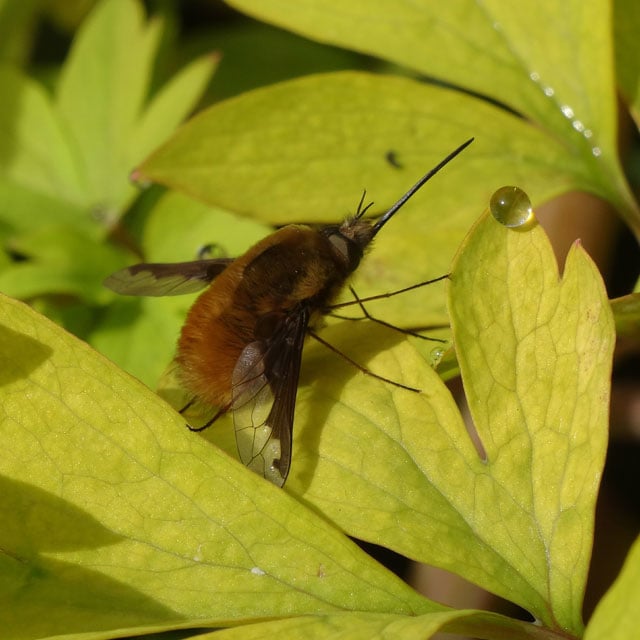
With its furry yellow-brown body and buzzing noise, the bee-fly (see photo on the left) is an insect which can be mistaken for a bumblebee (see photo on the right), but it’s actually a fly in disguise!
Dark-edged bee-fly resting on a leaf
Common carder bumblebee feeding on a flower
How to Identify a bee-fly
Here are some clues that you may have spotted a bee-fly rather than a bumblebee. Bee-flies have:- One pair of wings (bumblebees have two pairs)
- A long rigid proboscis (a long feeding tube some insects use to suck up food)
- Short antennae (feelers on the insect’s head which help it to sense things around it)
Bee‑fly life cycle
- Eggs: When the adult female bee-fly is ready to lay eggs, she will coat an egg with sand or soil to make it heavier and easier to throw (and to help camouflage it). Once she finds the nest of a ground-nesting solitary bee, she throws a sequence of eggs into the nest
- Larvae: When the bee-fly egg hatches, it feeds on the bee larvae in the nest
- Pupa: Eventually the bee-fly larva becomes a pupa, spending winter in the soil protected by a hard case
- Adult: In spring, it crawls out as an adult
This type of life cycle, which happens in stages and where the adult doesn't look like their young, is known as metamorphosis.
Bee-fly adaptations
- Mimicry for protection: Bee-flies don't have a bite or sting to defend themselves against predators, but by looking like a bumblebee (which does have a sting to defend itself), they send a message to predators to avoid them. This is known as mimicry
- A long proboscis for feeding: Bee-flies use their long proboscis to reach deep into long-tubed flowers so they can feed on the nectar at the end of the tube. Insects with shorter mouthparts need to visit more open flowers to feed
Why are bee-flies important?
- Pollinators: When a bee-fly visits a flower to feed on nectar, some of the pollen from the flower sticks to its body and is taken with them when they visit the next flower. If this next flower is compatible it is now pollinated and will be able to produce seeds
- Supporting biodiversity: Biodiversity is the number of types of living things and the number of each of those types in an area. It includes plants, animals, fungi and microorganisms. Lots of biodiversity helps to keep ecosystems healthy. We need healthy ecosystems to provide us with things we need to survive and to help defend against climate change
What can you do to help bee-flies?
You can help bee-flies by growing some of the flowers they feed from at your school.
Primroses can be planted as plug plants (small plants) either in containers around the school grounds, or straight into the ground. Your primrose plants will need to be in a damp spot with some light shade to grow.
A primrose plant. If you look at the flower on the left, you can see the flower’s long tube. The flower’s nectar is at the base of the tube.
Reflection questions:
-
Do you think you could spot the difference between a bumblebee and a bee-fly? What would you look for?
-
Can you think of anywhere that you could plant primroses at your school? Why might that be a good place?
Remember to look from a distance and not to touch any insects.
Keywords:
| Larva | A young, immature stage of development. The plural is larvae. Commonly used for insects where the early stages look very different from the adult e.g. caterpillar (larva) and butterfly (adult). |
| Mate | When a female has partnered with a male to produce young. |
| Nectar | Sweet liquid mainly produced by flowers to attract pollinators. Honeybees make honey from nectar. |