
Changing what it means to be a modern gardener
Wildlife gardening experts John Little and Benny Hawksbee have launched a free training course to pass their principles on

If a handful of treasured plants can make a house a home, what impact might 2,000 of them have? In his Worcestershire barn conversion home, Jonny Balchandani has taken the idea of bringing the outside in to staggering extremes
There are houseplant collectors, and then there are houseplant collectors. There are those with a few prized specimens; those who load up every single windowsill; and then there’s the rarest of the lot: the jungle enthusiasts. For these plant lovers, their enthusiasm can unfurl into an obsession, an addiction even, as they fill every possible space in their homes. Every inch of floor, shelf, beam and banister comes alive with the textures and tones of beautiful living ornaments.
In a way it’s surprising, given the healthy interest – and associated sales figures – for indoor plants, that more of us don’t find ourselves in this latter camp. After all, if you’re able to confidently care for 10 houseplants, then why not 100? And, when it’s been scientifically proven that even a lone houseplant can filter our air, lower cortisol levels, enhance productivity and more, what benefits might 1,000 of them bring? And when so many of us devote so much of our time, energy and passion to creating plant-rich gardens outside, what keeps us from also bringing some of this botanical abundance inside?

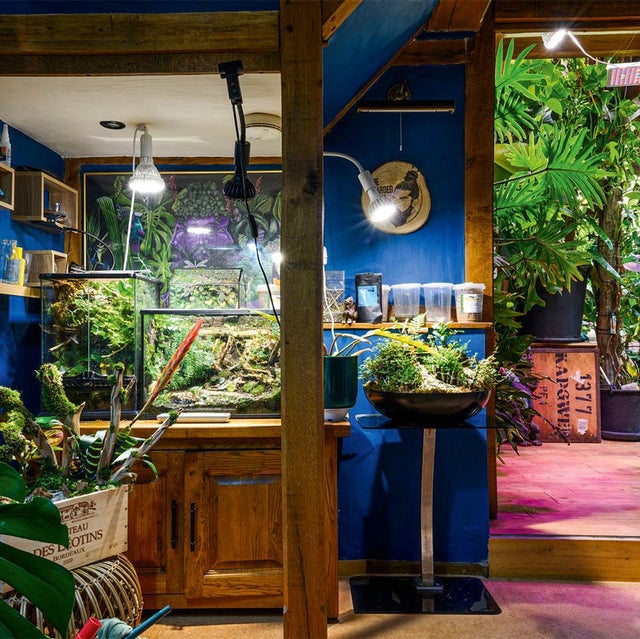
For answers to these questions, you can do little better than to ask Jonny Balchandani. Known to his 403k (and counting) Instagram followers as The Bearded Plantaholic, Jonny has long since departed the constraints of the window ledge. From the outside, the Midlands home he shares with his wife and children looks like many other converted barns. Venture inside, however, and it’s as if you’ve stepped out of the Worcestershire countryside and into a tropical rainforest. “Weirdly, I did always want to live in a jungle,” says Jonny. “I guess I didn’t realise it was going to be an indoor one.”
With some 2,000 plants – 4,000 if you include his propagations, some of which he keeps, the rest being sold through his online shop – Jonny’s house can only be described as a staggering botanical showcase. One that exhibits his big soft spot for foliage plants, namely those from the Araceae family. “Plants have taken over every corner, including the bathroom and, yes, even near the bed,” says Jonny. “The golden pothos might just say good morning before anyone else.” Everywhere you look, on every surface, are plants, in every conceivable size and form.

"There’s no such thing as too much in my world"
It would be wrong to assume that any home so very fit to burst with plants is in and of itself attractive. There are plenty of similarly expansive collections out there that look more like a horticultural jumble than a carefully curated interior. But inside Jonny’s home there’s a clear sympathy for design – an eye for aesthetics. It’s a rich tapestry, and one woven with a deliberate hand. “There’s definitely thought behind it, but it’s a natural flow rather than strict design,” says Jonny. “I like the space to evolve. I’ll move plants around based on light needs or when I’m trying out new combos. You know, you start with a few plants, get hooked and, before you know it, you’ve got a rainforest vibe going on. Over the years, it became more intentional as I learned more about each plant’s needs and personalities.” Of course, the plants themselves are only half the story. “Containers and pots play a big part – they’re the plant’s stage, so I try to mix textures and tones that feel organic yet grounded.”

There are practical reasons, of course, as to why more of us don’t follow Jonny’s example. Namely, the tastes and needs of our cohabitants. Jonny shares this space with his wife and school-aged children. It’s all very well having an enormous Strelitzia nicolai in a 50-litre ceramic pot in your living room, but it doesn’t leave a lot of space for games of Twister. “Living here can be a bit like navigating a botanical jungle gym! Leaves brush your shoulders, you’ll occasionally need to duck under a hanging vine, and you might even sidestep a pothos trailing down from the ceiling,” says Jonny. “My family is used to it – in a way, it’s like we’re sharing the space with a whole community of green roommates, each with their own quirks.”
Jonny’s wife Charlotte prompted him to join Instagram, where he could “find more people like himself”. It’s safe to say, however, that with his unique style and larger-than-life personality, there are few others out there quite like Jonny. Today, combining sound plant care advice with a large dollop of humour, he’s one of the most recognisable faces in the houseplant social media world, but it hasn’t always been this way.
"I’ll never stop – my passion keeps growing"
Jonny’s parents were keen gardeners. His mum in particular had “an obsession for propagating things”, which he would eventually inherit, but he reflects that their love for and somewhat formal gardening “didn’t flick his switch”. And yet, as it seems with so many who have green-fingered parents or grandparents, a seed had been sown that later germinated. For Jonny, this was when he was a student living in Paris. He recalls his Parisian apartment “jungle room”, which had a golden pothos (Epipremnum aureum) that, by the end of his studies, had completed several laps of the room. Truly his mother’s son, when it was time to relocate, rather than leave the plant behind, he chopped it up into hundreds of , with no idea of their destination – he simply found the possibility of creating so many new plants too enticing.

Having recently installed an indoor greenhouse in order to further support his propagation efforts, not to mention the converted shipping container at the back of his garden where new plants are grown on, Jonny’s houseplant fever shows no signs of abating. Will he ever slow down? “That’s the eternal question,” says Jonny. “There’s no such thing as too much in my world, but I’ve learned to keep it a bit balanced. I might pause, but then I’ll see a unique plant or a new propagation idea, and it’s game on! I don’t think I’ll ever completely stop. It’s a passion that just keeps growing. Literally.”
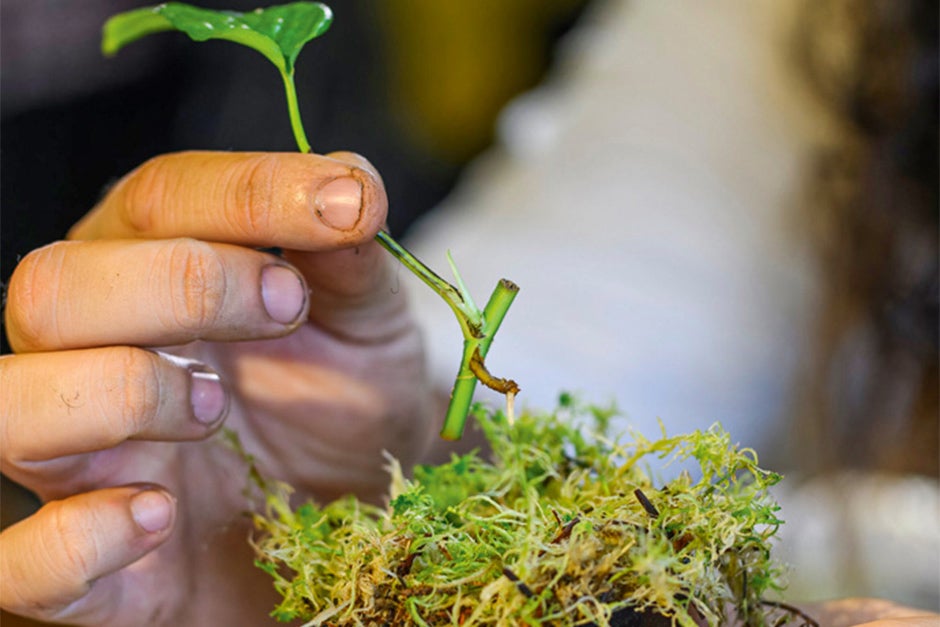
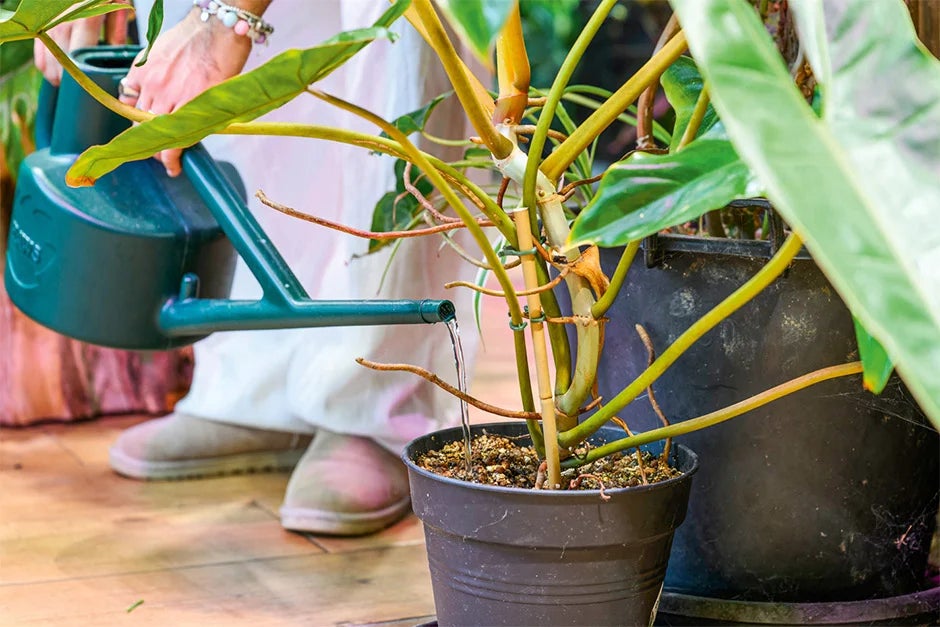
Maintaining a collection – or rather, an ecosystem – on the scale of Jonny’s is no mean feat. Watering alone is a time-intensive process, let alone all the propagation, and health checks. New plants are inspected with agonising diligence for signs of Jonny’s most dreaded foe: mealybugs. “Those little blighters hide everywhere, and eventually just spoil the health and appearance of the plants,” says Jonny. It’s of course a different situation to outdoor gardening. In this closed environment, with no dining room-dwelling birds or frogs to call upon, pest numbers can’t find a balance within the wider food chain. As such, Jonny sprays his plants with neem oil or horticultural soaps to reduce or clean up any pest outbreaks. He’s found that biological controls, under living room conditions, are not a successful marriage, given our low natural winter light levels and their rather high cost.

Some of the specimens adorning the interior of this unique home have been purchased, some propagated by Jonny or swapped with friends and fellow plant-lovers, but perhaps surprisingly given the sheer size of the collection, they’re overwhelmingly in good health. The secret to this, says Jonny, and the most important thing for anyone looking to sustainably replicate his example in their own homes, is light. “Go and sit or stand where you wish to position a plant, and ask yourself, can I see the sky from here? If you can’t, chances are it’s too dark, so think again – or buy a grow light,” he says.
"Living in a jungle is pure zen"
While the principle of “right plant, right place” applies to indoor gardens every bit as much as outdoor ones, the recent affordability and ease of installing grow lights now enables passionate indoor gardeners to have houseplants in any space they choose. Grow lights have developed a lot in recent years. No longer are they huge great units that need lots of planning and positioning – they’re now simple , some of which can be placed inside normal lamps and light fittings. Jonny uses his lamps year-round, fitted with a simple timer, for 12–16 hours a day. This allows for magnificent plant growth in even the darkest of spaces, and accounts for the ample stairwell in Jonny’s house, where lush aroids scramble for the sky even though there’s actually very little of it to be seen.
My tour of Jonny’s house was dazzling, for the scale of the plants, the number of them and, for my inner plant geek, the presence of several aroid plants I’d never seen before. There were some Swiss cheese plants that left me wide eyed – the sheer size of the deeply fenestrated, yellow-splashed leaves, would make even the most hard-hearted of indoor collectors (who tend to be nothing near as snotty about as some outdoor gardeners can be) go weak at the knees.
For any number of reasons, creating an indoor jungle will not be for everyone. And that’s fine. But when plants have the potential to bring us so much peace, so much pleasure, perhaps even in a small way, we should all take a leaf out of Jonny’s book. “Living in this jungle is like stepping into a green sanctuary. Everything slows down,” he says. “When I kick back, surrounded by these leafy companions, it’s pure Zen. It’s the kind of therapy you simply can’t buy.” So maybe when it comes to designing with houseplants, more really is more. More life. More beauty. More calm.

Monstera deliciosa ‘Thai Constellation’: “A fabulous variegated cultivar that’s more reliable than the old, white, variegated form. Leaves, flecked with yellow, get absolutely enormous in time.”
This page is an adaptation of an article published in the October 2024 edition of The Gardenmagazine, free to RHS members every month when you join the RHS.