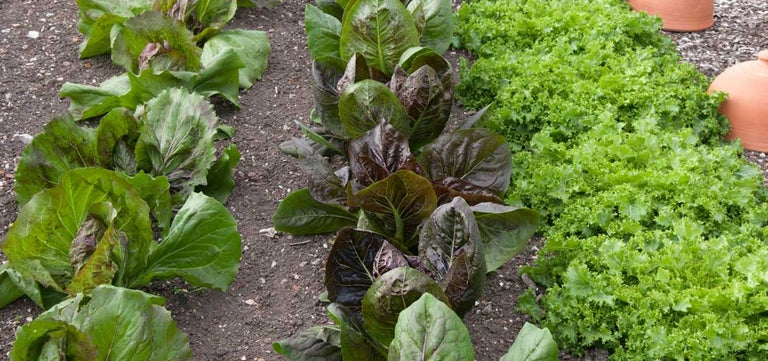
Sowing using your cookbook
Our Chief Horticulturist turns his decision-making process on its head when it comes to choosing what to grow

Once the villain of school dinners, cabbage is enjoying an unlikely cultural revival
Every so often, a plant long appreciated for its practical virtues is rediscovered. This year, rather unexpectedly, it’s the cabbage.
For years, cabbage occupied the unfashionable end of the vegetable spectrum.
Dependable, productive and capable of feeding households through winter, it was rarely glamorous. Somewhere between school dinners and cabbage soup, it lost the cultural spotlight to flashier vegetables. Kale became a wellness icon. Cauliflower reinvented itself as pizza. Avocado built an entire brunch economy. Cabbage, meanwhile, remained stubbornly ordinary, forming tight green heads in allotments and kitchen gardens across the country and appearing mostly in contexts that did little for its public image. Now, somewhat improbably, cabbage has entered the spotlight.

According to Pinterest’s annual trend forecasts , “Cabbage Crush” is set to define 2026 food trends, with interest in cabbage recipes, dishes and styling on the rise. Restaurants are placing charred cabbage wedges centre stage on menus, while social media has developed an unexpected fondness for the jewel-like interiors of red cabbage sliced neatly in half. Even fashion has taken notice: cabbage motifs are appearing across ceramics, textiles and design, while British grower Gerald Stratford has become an unlikely internet favourite thanks to his enormous vegetables.

Cabbage has spent years labouring under a reputational burden not entirely of its own making.
Its public image in Britain was shaped less by the plant itself than by what was done to it after harvest. Entire generations encountered cabbage not in its crisp, sweet form but as a limp, overboiled accompaniment to school lunches and other institutional meals of uncertain ambition. This, it turns out, was not the cabbage’s fault.
"Anyone wishing to recreate the classic experience need only boil chopped cabbage for two hours and serve it with lumpy mashed potato and a glue-like stew of indeterminate species."
Part of cabbage’s current appeal lies in the fact that it suits the moment rather well. It’s affordable, nutritious and adaptable. It stores well, grows readily and lends itself to a wide range of modern cooking styles, from slaw to stir fries to kimchi and caramelised wedges presented as “steaks”.
Perhaps part of its appeal lies in how global it has always been. In Germany, it becomes sauerkraut; in Korea, it’s transformed into kimchi. Across the Middle East, it’s rolled into dishes such as malfouf, while in Japan, delicate leaves layer soups and hotpots and in Britain, it’s boiled.

That culinary range is part of what makes cabbage feel so current. It’s a staple in countless food traditions, but also adaptable enough to slip easily into new ones. Stuffed cabbages, in particular, seem to appear almost everywhere. In Poland they become gołąbki, often served at Christmas or weddings; in Ukraine, holubtsi are filled with meat, rice and onions; in Germany, kohlrouladen wrap savoury fillings in blanched white or savoy leaves and are cooked until soft and deeply comforting. In Japan, mille-feuille nabe layers napa cabbage with slices of pork in delicate folds that are as pleasing to look at as they are to eat. Few vegetables travel so well across borders while remaining so recognisably themselves.
In 2025, The New York Times declared that “London’s sexiest produce star is a cabbage”, with hispi now a staple on menus.
It is also, importantly, photogenic.
Red cabbage, in particular, has benefited from the social media age. Slice one open and its interior reveals a marbled geometry of violet and white. Savoy cabbages have their own appeal: all ripples and folds, as though they have been pleated by hand. Even the simplest green cabbage forms a satisfyingly complete sphere.

There is something reassuringly old fashioned about a vegetable becoming fashionable simply by being looked at properly. Unlike many trend led ingredients, cabbage is also accessible and for modern cooks seeking affordable, sustainable ingredients, it is entirely of the moment.
One of cabbage’s great strengths is that, with a little planning, it can occupy the vegetable garden for most of the year.
Sow in February or March for summer cabbages‚ April for autumn and red varieties, some of which store well into winter. May is the moment for winter cabbages and savoys, and a final sowing in July or August can provide plants to overwinter for spring harvests.

Happily, cabbage does not demand much in exchange for its virtues. Usually raised from seed and around six weeks after sowing, once the plants are sturdy enough to cope outdoors. Give it fertile soil, a sunny position, good drainage and reliable watering during dry spells and it will generally thrive.
Spacing matters. Allow around 60cm between rows and 45cm between plants and resist the temptation to squeeze in extra .
Its main enemies, pigeons, caterpillars and a small supporting cast of insects who tend to regard cabbages as a shared resource, are familiar to most gardeners. A fine mesh covering is usually enough to keep the peace.
Harvesting, at least, is straightforward. When the head feels firm and solid, it’s ready. If it never quite gets there, it can still be cut and eaten as greens. Cabbage, unlike some more temperamental vegetables, is mercifully difficult to waste.

Among summer cabbages, ‘Caraflex’ , ‘Caramba’ and ‘Primero’ produce sweet, compact heads well suited to modern cooking and feel worlds away from the dense, pallid memories many people are still recovering from.
For autumn, ‘Red Jewel’ offers both colour and flavour, while winter gardeners might look to ‘Alaska’ , ‘Marabel’ or ‘Noelle’ for reliability.
Savoy remains among the most rewarding, its crinkled leaves bringing both texture and depth of flavour. ‘Providence’ is particularly good.
For those dealing with clubroot, resistant varieties such as ‘Kilaton’ and ‘Cordesa’ are well worth considering.

The cabbage’s drift into style and interiors is less surprising than it first appears.
In recent years, so-called “cabbagecore” has emerged as a small but enthusiastic design trend, fuelled by social media, Pinterest moodboards and a renewed appetite for playful, vegetable led decoration. Cabbage-leaf ceramics and leafy table settings have begun appearing everywhere from styled dining tables to fashion campaigns, proving that somewhere along the line the brassica acquired aesthetic credentials.
And yet, for all its recent internet life, cabbage in design is not new.

In Dutch and Flemish still life painting, cabbages were valued for their texture and presence, often appearing alongside fruit and silverware as symbols of abundance. By the 19th century, they had found their way into decorative arts, most notably in majolica ceramics, where cabbage leaves were transformed into richly detailed serving dishes and tureens.
The tradition continued. The Portuguese ceramicist Rafael Bordallo Pinheiro made cabbageware a signature, while in the 20th century, Dodie Thayer’s handcrafted cabbage pottery became a cult favourite in interiors.
There are grander examples still. The Jadeite Cabbage, a 19th century Qing dynasty carving, remains one of the most celebrated objects in Taiwan’s National Palace Museum – proof, if it were needed, that a cabbage can carry considerable cultural weight.

Fashion has taken note too. The layered, ruffled structure of cabbage leaves translates surprisingly well into textiles and silhouettes.
What makes cabbage’s return so pleasing is not simply that it has become fashionable, but that it has done so without changing very much at all.

Gardeners have always understood that beauty and usefulness are not opposing virtues. A cabbage can be decorative and dependable, sculptural and sustaining. It can sit quietly in a row through wind, frost and rain and still produce something both nourishing and rather lovely.
That the rest of the world has finally noticed is welcome, if faintly overdue. In any case, cabbage wears its new status rather well and unlike many trends, it’s unlikely to disappear next season.