Top tips on how to keep your Venus fly trap alive from Matt Soper of Hampshire Carnivorous Plants
Lia Hervey
RHS Executive Digital Editor
5-minute read
Matt Soper was just seven years old when he got his first Venus fly trap. He now grows thousands of carnivorous plants and owns the largest carnivorous plant nursery in the UK.
Requiring specific conditions, Venus flytraps aren’t for everyone. But with Matt’s top tips on how to keep them alive, anyone can give it a go. Spoiler alert: it doesn’t include feeding them mince pies, turkey, cheese or chocolate.
“I saw a Venus fly trap on a David Bellamy programme when I was seven years old and I was desperate to own one, and asked my mum to buy one. Fifty years ago, they were difficult to find but my neighbour was a florist and she managed to find one. When I got it, I was so disappointed that it was so small.
“They were dug up from the wild then – today, we should always go for nursery-grown plants, not wild-collected. I fed it chocolate and killed it. Then I got a second one, fed it cheese, and killed that one too. By the time I had a third, I’d learnt my lessons and it flourished.
Dionaea muscipula (Venus fly trap)
"They are fantastic plants to get children into horticulture. They are a gateway plant. I’ve taken them to schools before and the children are fascinated."
Matt Soper, Hampshire Carnivorous Plants
“It grew to the size of a washing-up bowl and I actually displayed it at RHS Chelsea Flower Show with The Carnivorous Plant Society. It was the mid-80s and I was an amateur grower. I’d had it since the age of seven and just continued growing them as a hobby and started to build a collection. By 1995, I went to my first show – the Southampton Flower Festival, and in 1999 I did my first exhibition at RHS Chelsea.”
How to care for a Venus fly trap
In the wild they grow in peat, but we shouldn’t do this in cultivation as we don’t want to harm the natural habitat and contribute to climate change.
A good peat-free alternative is sustainable farmed sphagnum moss, but don’t use other types of moss.
New plants won’t need repotting for at least a year. Repot in spring if needed.
Tap water kills them so instead feed them rainwater. Sit them in a saucer with 1cm of water and let them suck water up from underneath in spring and summer. Reduce this to ½cm in winter. Only water from below and never let them dry out, as they are a bog plant.
Don’t ever feed them with fertiliser as anything with nitrogen can kill them. They get their food from insects.
Don’t feed them dead bugs, mince pies or turkey; they can sense movement and can’t taste anything and this can kill them.
They only need a few bugs a year and are not the best fly catchers. They can survive for over three months without an insect.
Don’t poke them. Every time they close they use energy, and if not fed, they will decline and go black. You can cut off any black traps.
If they flower, cut their flowers off as they can weaken the plant.
Give them a period of winter rest by putting them outside through the colder months; they will die down and emerge again in March.
Master Grower Hampshire Carnivorous Plants in the Floral Marquee at RHS Hampton Court Palace Flower Show 2018
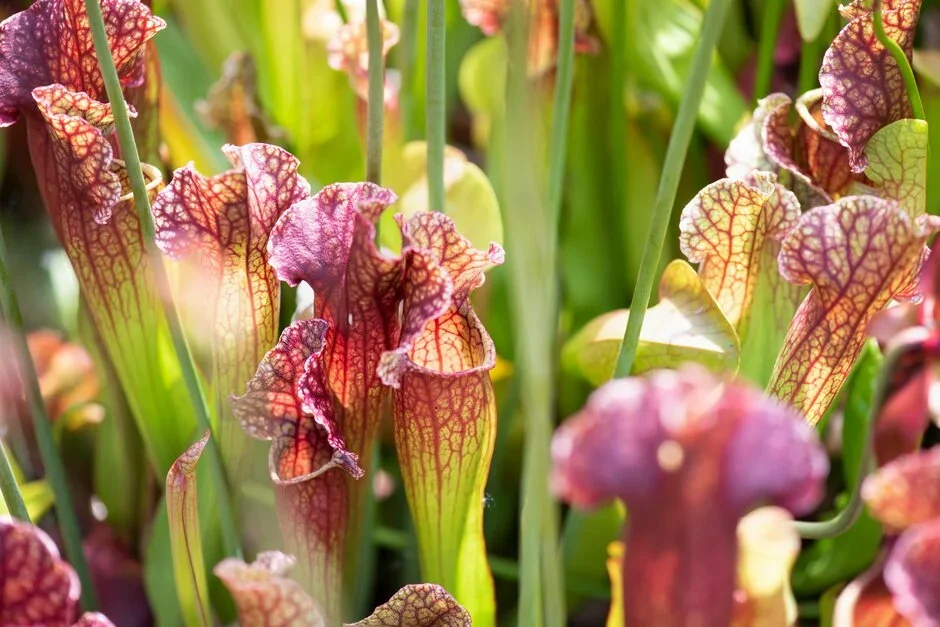
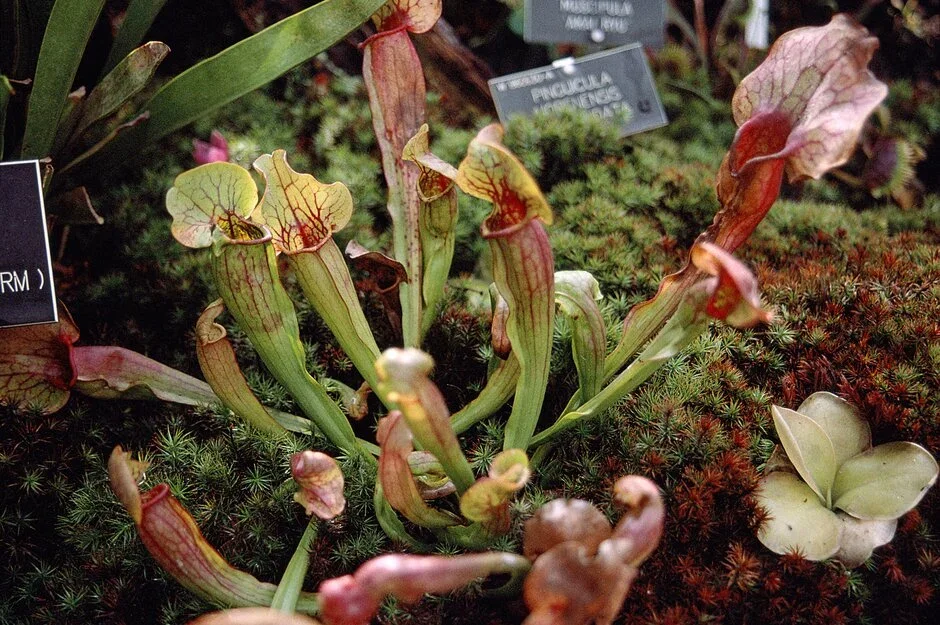
Although Venus was his first love, Matt says Sarracenia are now his favourite carnivorous plant and he has an immense collection. “Venus fly traps are a great gateway plant for children to get into horticulture though and was the plant that started it all for me.”
The plants are originally from Wilmington in North Carolina and some areas of South Carolina. It’s the only place in the world where they’ve been discovered growing naturally. Although they look exotic and tropical, they’re actually very weather hardy.
Charles Darwin described the Venus fly trap as “one of the most wonderful plants in the world.”
Venus fly traps are perennial and will look good from March to November and die down the rest of the year.
They are not actually a houseplant and benefit from being outside in winter.
In the wild, the Venus fly trap grows in bogland and savannahs which are low in the nitrogen needed to build proteins. To overcome this problem the plant developed a taste for meat. It has convex bi-lobed leaves with three trigger hairs on each lobe. When something knocks these hairs twice an electrical signal flips the leaves into concave shapes. If the captured creature struggles to escape it continues to tickle the trigger hairs. This causes the plant’s trap to close tighter and release enzymes to digest its prey.
When the traps close, there are gaps between the ‘teeth’ at the edge of the trap that a small creature could escape through. Insect victims with little useful nitrogen can escape, ensuring the plant doesn’t waste energy digesting them. The Venus fly trap is not a merciless killer.