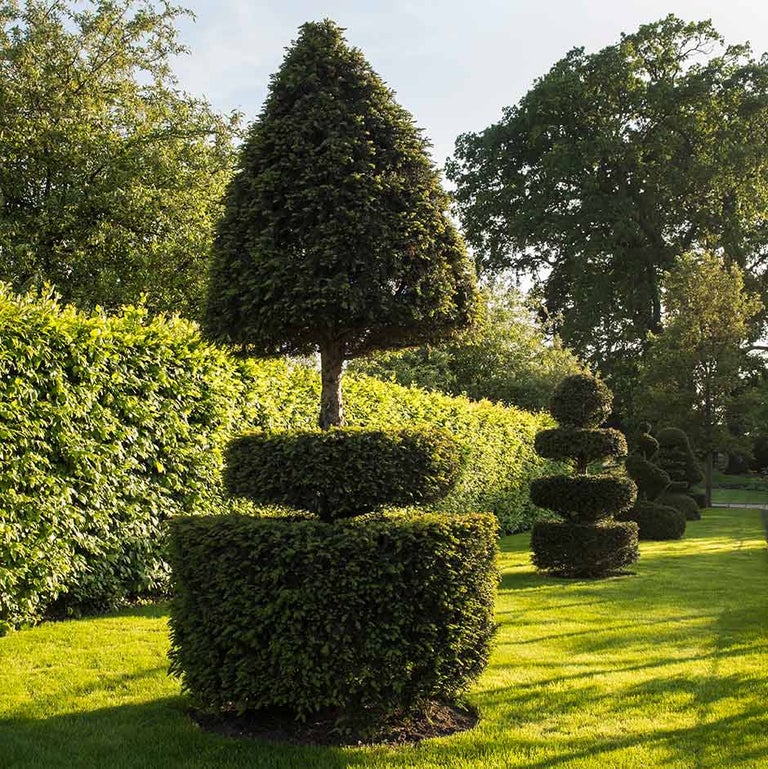
Wild, wonderful, and sometimes wacky - celebrate topiary at RHS Partner Gardens
RHS Editorial Team
From Roman times to today, creating shapes from evergreen shrubs has been a much-loved pastime for many. It requires skills and ancient techniques that are not to be quaffed at. There are many RHS Partner Gardens that have displays worthy of an Alice in Wonderland film. Which will you choose to visit this year?
Athelhampton House and Gardens
Athelhampton House & Gardens
At Athelhampton House & Gardens in Dorset, topiary takes centre stage in the Great Court, where twelve towering yew pyramids define one of England’s most distinctive formal garden spaces. Around 135 years ago, the young Victorian owner Alfred Cart de Lafontaine, working with his garden architect and friend Francis Inigo Thomas, set out to create a sequence of formal gardens, with the Great Court as the principal feature. Originally laid out as a parterre within a sunken lawn, each bed was punctuated at the corners by small yew trees.
Although the parterre planting was gradually lost, particularly through the disruption of two world wars, the yews endured. Today, they rise to almost 40 feet, clipped into bold pyramidal forms that lend the space structure and drama.
Now under the care of Head Gardener Sophy Robertson, these trees remain the defining image of Athelhampton. Set within five acres of formal gardens and a one acre kitchen garden, the wider scheme includes over 1000 feet of deep herbaceous borders. Sophy tells us that while visitors are drawn to these borders, it is the monumental yews that leave the lasting impression. Their maintenance demands skill, consistency and vigilance, as climate change and emerging pests present ongoing challenges, highlighting the continued relevance of topiary in contemporary garden stewardship.
Free days out for RHS Members in 2026: Every Saturday when open, plus all of February and November
At Deene Park in Northamptonshire, prominent English designer, David Hicks, was commissioned in the 1980’s to design an Elizabethan-style parterre garden using the Serlio inspired strapwork patterns on the Front Porch as inspiration. Small topiary shapes rise out of its beds, in spring surrounded by such as tulips and hyacinths, followed by summer’s lavender, nepeta, irises, tradescantia, salvias and geraniums, filling the beds with their soft colours.
An inspired enhancement was the addition of the playful topiary teapots in yew, placed in the four outer corners. They are not part of the Hick’s original, disciplined scheme, but these charming bits of whimsy were shaped afterward, to celebrate the late Edmund Brudenell’s renowned enjoyment of a cup of tea.
The topiary at Felley Priory was the first element in the garden to be planted in the 1970s by Maria Chaworth Musters and much of it remains the same 50 years later. The principle topiary hedges give structure to the garden and the formal herbaceous borders. Over the years, additional structures have been added including more decorative elements, such as the yew topiary swans and the peacocks which sit surrounded by the climbing roses, vines, clematis and lonicera.
Free days out for RHS Members in 2026: Tuesday and Wednesday, when open
The yew hedges, and the yews along the terraces at Hutton were planted in the 1870s when the Arts & Crafts movement made them fashionable. They have since developed characters of their own and the team here follow what the shrubs dictate. There are more than 20 individually shaped yews, as well as those that cover two sides of the Walled Garden and also some smaller hedges within this space which make an excellent backdrop for the vibrancy of the flower borders.
The hedges are cut in the autumn, which is several weeks of hard and skilled work, and incorporates the use of a cherry picker for the high-level work. The yews then remain sharp until June when they start putting on new growth and some years they become very hairy looking. Hutton used to sell the clippings to be used in medications to treat cancer, now the clippings are no longer wanted for this purpose they are kept at the garden and allowed to break down for use as back on the flower beds.
To continue their upkeep, a maintenance programme has begun which involves cutting back lengths of hedge, one side at a time, as many of the hedges are now more than two metres wide and have outgrown their space. This will ensure they look their best for years to come and remain a striking feature of this garden.
At Kelmarsh Hall & Gardens there is a mixture of Taxus, Buxus, Lonicera and Osmanthus hedges throughout the gardens. Many have been an integral part of the garden for more than 100 years. Large cloud pruned Buxus create vistas and boundaries between areas of the garden. The two large Taxus hedges create raised dividers along the double borders, planted many years ago to act as a screen to prevent the laundry drying ground from being seen from the house. Lonicera and Taxus 'parterre' hedging has largely replaced the Buxus that had been used throughout the garden.
Free days out for RHS Members in 2026: March - October, Tuesday - Thursday when open
Under the stewardship of Ethel Labouchere, who purchased Mapperton as her residence in 1919, the gardens underwent major development through the 1920s. Mrs Labouchere created the formal Fountain Court gardens with their topiary of box and yew, in memory of her late husband. The topiary forms were various geometric shapes surrounding the central axial design, planted to provide structure and contrast contributing to the garden’s “1920s pastiche of seventeenth century formality”.
Considerable alterations were carried out in the mid-1950s when the estate was bought by Victor Montagu, the current Earl’s Grandfather. Some areas of topiary were removed to allow a different style of planting, whereas two columns of yew topiary were added to emphasise the increased openness of the terraces. Their sculptural shapes of simple cones and domes create contrast against the softer herbaceous planting.
Maintaining the defined, dense shape of these topiaries is a skilled and ongoing process to preserve crisp lines while encouraging healthy regrowth. The larger forms of Yew are trimmed during Mapperton’s winter closure using electric trimmers, whereas sharp manual shears are used to clip the smaller pieces carefully by hand once or twice a year. Together, these living forms anchor the garden’s design, offering a timeless framework and year-round interest to the terraced gardens.
Free days out for RHS Members in 2026: March - October, Tuesday, when open
Sitting comfortably within the broad definition of topiary, while being strongly informed by niwaki principles, the collection is a little more interpretive than purely formal. The combination of trees and shrubs create impact rather than stand alone examples. Fred Green, Head Gardener explains they ‘predominantly use conifers for topiary, as they provide consistent colour and respond well to regular clipping.
Species such as pine are carefully managed with spring -rubbing (candle pinching) techniques, adapted from bonsai practice, to control extension growth, improve density, and maintain proportion. Rather than focusing solely on crisp, geometric forms, the aim is to work with each plant’s natural growth habit. Thuja varieties are particularly well suited to cloud pruning and are trimmed several times a year to achieve soft, sculptural shapes. We find that frequent, light pruning produces the best results and avoids stressing the plants. Incorporating shaped species such as larch, acer, and beech adds contrast.
Free days out for RHS Members in 2026: March - October, Monday and Friday when open
Over the last three years, Plas Brondanw Gardens have been restoring their topiary and hedges. With limited photographs and documents, the team are slowly piecing together how the garden once looked and then recreating that but with emphasis on this being more practical in the modern setting. Historically, large houses employed many gardening staff and were able to maintain elaborate pieces throughout the year. However, now as a charitable trust with a much more modest budget, these designs need to endure whilst only being clipped once a year.
With much more focus on plant health, Plas Brondanw Gardens hope to increase longevity of the topiary as well as being pleasing to visitors. Two topiary displays which have stood for a long time are being given some extra attention, with the garden team attempting to grow one larger and reduce the size of the other! A great amount of progress has already been made as part of this restoration project, but there is still a way to go and lots more work involved for the team.
The sculptural 300-year-old yew hedges at Raby Castle, Park and Gardens are an impressive and prominent feature in the Walled Gardens and are immensely popular with Raby’s visitors. When renowned garden designer, Luciano Giubbilei, remodelled the 18th century gardens in 2024 with Lady Barnard, he recognised their significance immediately and they formed the basis for his design.
Originally straight in structure, the yew hedges have developed their now-famous, topiary cloud-like shapes after being left untrimmed during World War I. Raby's team of expert gardeners now maintain the hedge throughout the seasons, most notably in the summer months, often requiring cherry pickers to reach the highest points.
Throughout the rest of the Walled Gardens, Luciano's design features a striking, contemporary approach to topiary, including additional yew topiary, trimmed into glorious abstract shapes placed informally within a geometric grid of densely planted Deschampsia cespitosa in the West Garden. Their solid forms providing a wonderful contrast with the swaying grasses.
The five-acre gardens are designed to offer a mix of formality and informality, with the topiary enhancing the ‘hide and seek’ views of the castle.
Free days out for RHS Members in 2026: Mondays–Fridays, January–February, and Mondays–Tuesdays, March–December. Closed on Bank Holidays, school holidays, and for private events
At Scampston, the topiary plays a defining role in both the Serpentine Garden and the Silent Garden, where carefully clipped yew forms create a striking visual counterpoint to the surrounding landscape. These sculpted shapes were deliberately incorporated into the early design by Piet Oudolf to contrast with his signature naturalistic planting. The crisp lines, structure and symmetry of the yew provide a sense of order and permanence, while the meadow-style planting introduces movement, seasonality and a softer, more spontaneous feel.
This juxtaposition is what makes the topiary at Scampston so distinctive, a rare and beautifully preserved example of Oudolf’s evolving design approach. The yew offers not only longevity and tolerance of repeated clipping, but also rich, evergreen presence throughout the year.
To maintain a strong topiary display, regular trimming is essential to keep forms sharp and defined. Above all, patience is key: topiary is a long-term commitment, but one that rewards with enduring structure and elegance in the garden.
Free days out for RHS Members in 2026: April–September, Friday; October, Wednesday–Sunday when open