Flowering cherry trees for small gardens
With delightful spring flowers and beautiful forms, many ornamental cherries make ideal small garden trees

Many RHS Partner Gardens include Japanese-style gardens, with cherry trees, bamboo, and tranquil ponds that evoke a sense of calm, reflection, and serenity
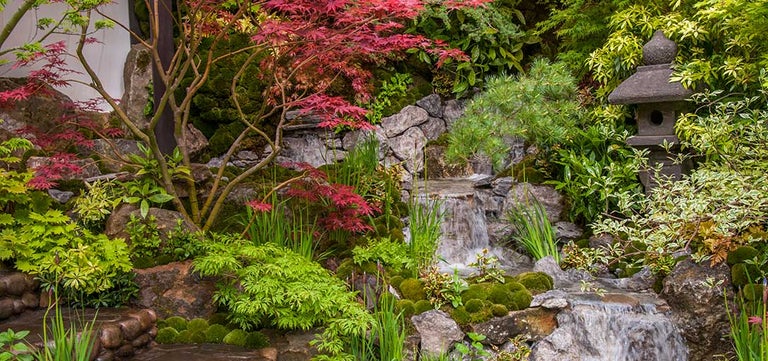
Japanese gardens are designed with tradition and minimalism in mind. They often feature cherry trees, which beautifully blossom during the spring, as well as still and flowing water features, which create movement and sound along rocks which symbolise stability and strength.

Inspired by the Japan – British Exhibition of 1910 and now matured over 116 years into a very good representation of a Meiji period tea garden, Tatton Park’s Japanese Garden is one of the most famous in the UK and continues to enthral and intrigue visitors today, as it did its owners and creators in 1911. Nestled within the extensive Pinetum, fed by natural spring waters, the garden is a restful haven of mosses, ferns, azaleas, maples and pines, carefully managed in traditional Japanese Garden style.

The interpretation of a Japanese garden at Bridgemere Show Gardens was originally constructed in 2006 and later refurbished in 2023 when a new entrance, pond and waterfall were added. New planting was also added at the same time to the original bamboos, acers and Cryptomeria . Three essential elements are used to create the garden. Stone forms the structure of the landscape, water represents the life-giving force and plants provide the colour and form throughout the seasons.
Japanese inspired gardens are defined by their calming atmosphere and restrained colour palette. This garden has been designed with this in mind. The red painted pagoda is framed by plants to Japan, including Japanese evergreen azaleas, Japanese cherries, pines, maples, cloud trees and ferns. Each plant is meticulously placed so it has real significance within the look and feel of the space. In Japan the colour red is said to scare away wicked spirits and is used to represent protection, strength, peace and power.

The SAKURA Friendship Garden was officially opened in April 1999 by the Japanese Ambassador to Britain, Mr Sadayuki Hayashi, alongside the then University Vice-Chancellor Professor Sir Kenneth Calman. Among the original planting, 57 various cherry trees were used to reflect the Japanese devotion to cherry blossom, with a circle of 11 granite benches laid out and encompassed by 12 large Prunus ‘Hanagasa’ trees to create a dome within which you can sit and contemplate.
When the garden was set up, a specially designed stone lantern was imported from the Japanese region of Kyoto to bestow harmony and peace to the garden. This was a donation by Professor Evelyn Algernon Valentine Ebsworth and his wife Rose, who came up with the initial concept of the Friendship Garden, to mark their retirement as University Vice-Chancellor.
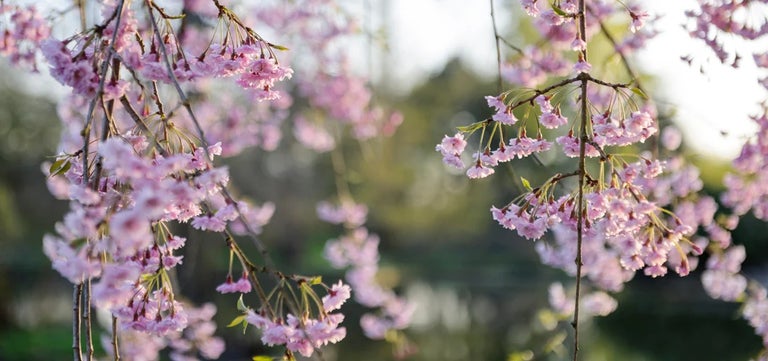
The cherry trees usually flower mid to late spring and the circle is the perfect place to sit as the blossom falls, almost as if it is snowing flowers. The Sakura Friendship Garden also features some other amazing trees such as Cercidiphyllum japonicum (Katsura tree), Paulownia tomentosa (Foxglove tree) and Eleutherococcus henryi , (a National Champion tree).
At Belvoir Castle, the Duchess of Rutland, Emma Manners, began the creation of the Japanese Woodland Garden back in 2004. Natural springs maintain consistent ground moisture, while the light canopy of oak trees provides optimal levels of light and shelter for young plants.
The duchess worked closely with renowned Japanese plant expert Charles Williams of Burncoose Nurseries to maximise the potential of this naturally sheltered site. With its rich, well-nourished soil, the garden provides ideal conditions for growing rhododendrons and camellias .
The Japanese Woodland Garden now comprises over 500 specimen plants, including rhododendrons, azaleas, camellias and hydrangeas, alongside tree magnolias, cherries, snake- maples and Japanese maples. A diverse selection of bamboos is complemented by Gunnera, Rodgersia, Darmera and candelabra primulas, creating a layered and immersive woodland landscape.

The Japanese Garden at Cowden has recently seen the completion of a 10–year restoration. From the garden’s first inception in 1907, great care has been taken to ensure the authenticity of the design and the maintenance of this space.
Examples of Japanese design can be seen throughout the garden. For instance, Ma is a Japanese principle that emphasises negative or unused space, where the space between objects is considered just as important as the objects themselves. Another key concept used throughout the garden is Mitate‑mono, which refers to the use of readily available local materials and the repurposing of items. Examples of this can be seen in the structures and, in particular, in the paths and surfaces at Cowden Garden.
With all of the hard landscaping and structures now in place, the gardeners are focussing on the formative pruning of the trees, shrubs and plants.

The Japanese Garden at Green Island Gardens in Essex is a small courtyard area designed specifically to look good all year round as it is viewed from the designer's ground floor bedroom. There are lots of acers crammed in for foliage, texture and colour, along with unusual climbers and wall shrubs trained along the trellis panels. Spectacular in late winter is Prunus mume ‘Beni-chidori’ trained on the wall, along with winter flowering camellias and unusual varieties of galanthus.
Please check the gardens’ website before you visit, as times and access may change.