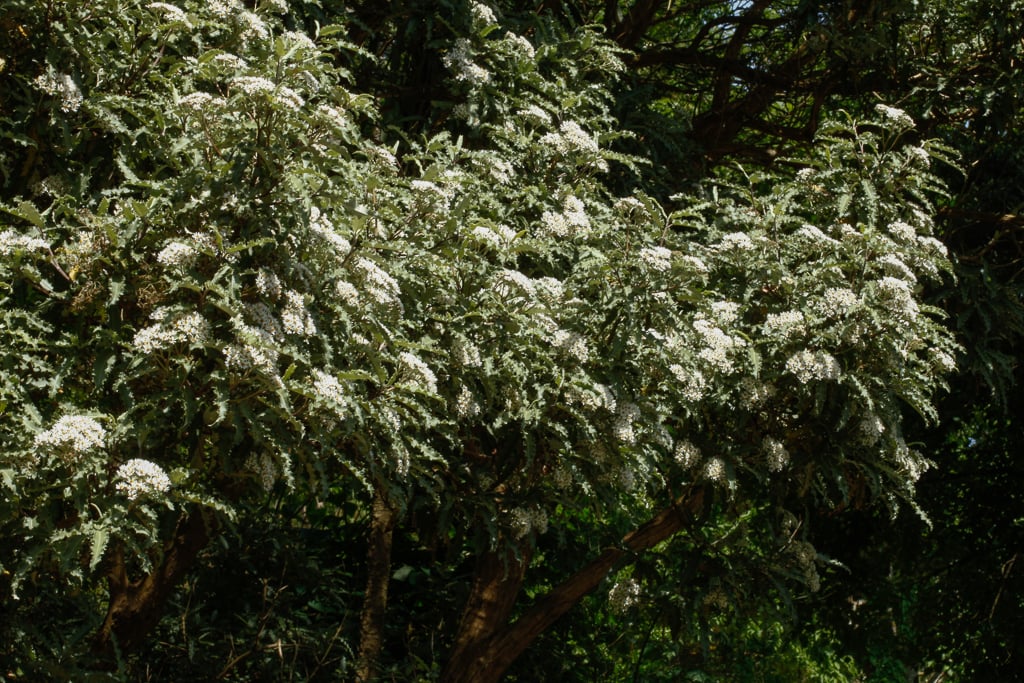
Olearia ilicifolia

RHS Plant Profile
mountain holly
mountain holly John Fielding

Other common names

New Zealand holly

Plants for pollinators
Shrubs Trees

An evergreen bushy shrub or small tree to a height of up to 3m, with leathery, oval, spiny-edged, green-grey leaves. The white clusters of daisy-like flowers appear in summer and are fragrant

Position

Full sun

Soil Types

Chalk, Loam, Sand

Max Height

2.5-4 metres

Max Spread

2.5-4 metres

Size

Time to Maturity
5–10 years
Max Spread
2.5-4 metres
Max Height
2.5-4 metres

Growing Conditions

Chalk Loam Sand
Moisture
Well–drained
pH
Acid or Alkaline or Neutral

Position

Full sun
Aspect
South–facing or West–facing or East–facing
Exposure
Exposed or Sheltered
Hardiness
H4
Drought Resistance
Yes

Colour & Scent

Fragrance Flower
Season Stem Flower Foliage Fruit
Spring
Summer
Autumn
Winter

Botanical Details

Family
Asteraceae
Native to GB/Ireland
No
Foliage
Evergreen
Habit
Bushy, Spreading branched
Genus
Olearia can be evergreen shrubs, small trees or herbaceous perennials, with simple, leathery, toothed or entire leaves and corymbs of daisy-like flower-heads
Name Status
Correct

How to Grow

Cultivation

Grow in a sunny position in well-drained soil. Makes a good windbreak or hedge in coastal areas

Propagation

Propagate by softwood cuttings or semi-ripe cuttings from summer to autumn Propagate by hardwood cuttings in winter

Suggested planting locations and garden types

  • City and courtyard gardens
  • Coastal
  • Cottage and informal garden
  • Gravel garden
  • Mediterranean climate plants
  • Wildlife gardens
  • Low Maintenance
  • Hedging and screens
  • Flower borders and beds

Pruning

Pruning group 8 In freestanding specimens allow to develop naturally. To keep within bounds, cut out one third to half of the previous year's growth after flowering. If required, can be hard pruned and will regenerate well from low down

Pests

Generally pest-free

Diseases

Generally disease-free but may be susceptible to honey fungus (rarely)