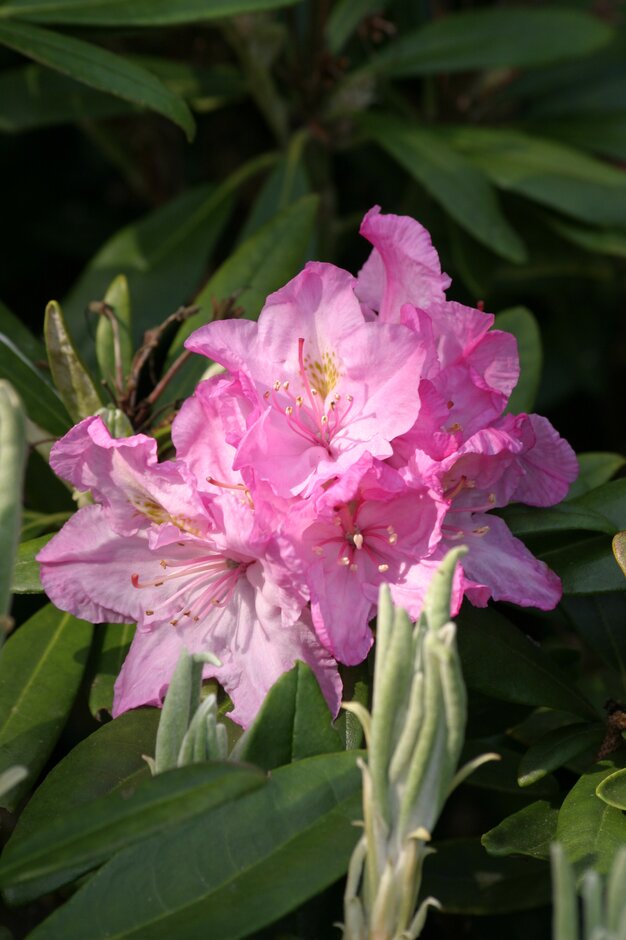
Rhododendron smirnowii

<em>Rhododendron</em> <em>smirnowii</em> RHS
Shrubs

A slow-growing evergreen shrub, up to 4m high, with a compact habit, and elliptic green leaves with rounded tips and grey or cinnamon-brown felting on the undersides. Young shoots are coated with woolly white felt. Produces dense clusters of 7-15 broadly funnel-shaped, rose pink to lilac pink flowers with wavy edges and yellow-brown speckles on the upper petals, from late spring to early summer

Position

Partial shade

Soil Types

Clay, Loam, Sand

Max Height

2.5-4 metres

Max Spread

2.5-4 metres

Size

Time to Maturity
10–20 years
Max Spread
2.5-4 metres
Max Height
2.5-4 metres

Growing Conditions

Clay Loam Sand
Moisture
Moist but well–drained
pH
Acid

Position

Partial shade
Aspect
North–facing or West–facing
Exposure
Sheltered
Hardiness
H6

Colour & Scent

Season Stem Flower Foliage Fruit
Spring
Summer
Autumn
Winter

Botanical Details

Family
Ericaceae
Native to GB/Ireland
No
Foliage
Evergreen
Habit
Bushy
Potentially harmful
Harmful if eaten. Wear gloves and other protective equipment when handling. Pets (dogs, cats, rabbits, tortoises) Harmful if eaten - for further information and contact numbers regarding pets, see the HTA guide to potentially harmful plants
Genus
Rhododendron can be evergreen or deciduous shrubs or trees, with simple leaves, sometimes with a dense colourful indumentum of hairs on the lower side, and funnel-shaped, bell-shaped or tubular flowers that may be solitary or in short racemes
Name Status
Correct
Plant Range
Turkey to Transcaucasus

How to Grow

Cultivation

Grow in moist but well-drained, humus rich, acidic soil, in partial or dappled shade. Choose a site away from frost pockets and sheltered from strong winds, and do not allow plants to dry out. Mulch annually, ideally with leaf mould. See rhododendron cultivation for more detailed advice

Propagation

Propagate by semi-ripe cuttings in late summer, by layering in autumn, or by grafting in winter

Suggested planting locations and garden types

  • City and courtyard gardens
  • Cottage and informal garden
  • Flower borders and beds
  • Wall side borders

Pruning

Minimal pruning required, see pruning group 8 (evergreens)

Pests

May be susceptible to vine weevil, rhododendron and azalea whitefly, rhododendron leafhopper, Pieris lacebug, scale insects, caterpillars and aphids

Diseases

May be susceptible to powdery mildews, honey fungus, silver leaf and Phytophthora, as well as more specific Rhododendron diseases