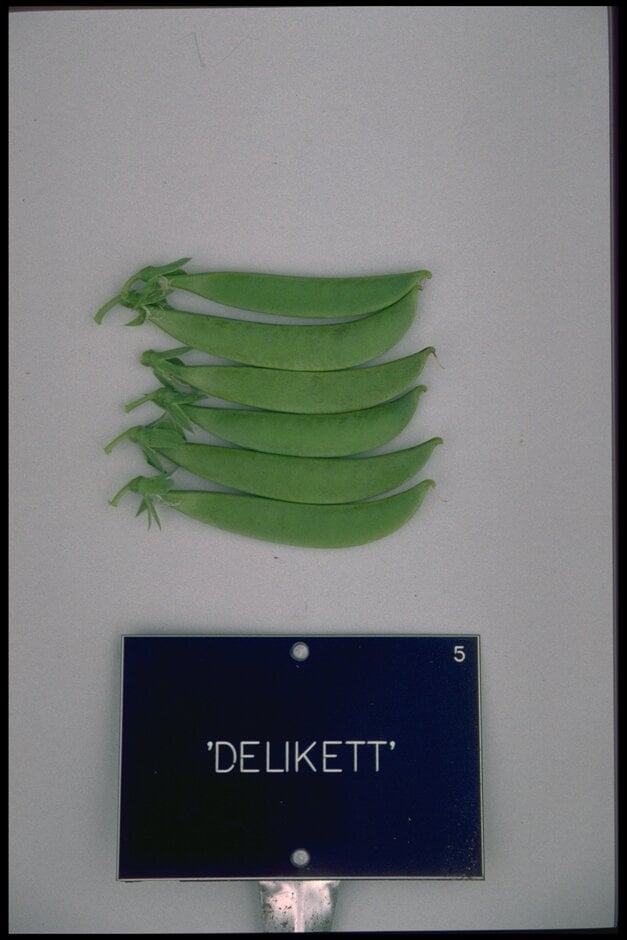
Pisum sativum 'Delikett'

RHS Plant Profile
pea (sugarsnap) 'Delikett'
pea (sugarsnap) 'Delikett' RHS
Award of Garden Merit
Annual Biennial

A compact sugarsnap variety growing to 0.6-1.5m high, with fleshy, sweet, green edible pods, about 8cm long, 1.3cm wide, and 0.8cm thick, which are stringless when young but become fleshier and sweeter as well as stringier with age, and can be picked over a long season. Peas are nitrogen-fixing annuals, climbing by tendrils up to 2m high, with pinnate leaves of up to eight glaucous, rounded elliptic to oblong leaflets, up to 7cm long, and usually white flowers up to 3cm long, in summer, followed by round, green, edible, protein-rich seeds, in long cylindrical pods from summer until the first frosts; the pods as well as the seeds of sugarsnap varieties are also edible, as are the flattened pods of mangetout varieties; the young shoots and leaves are also edible.

Position

Full sun

Soil Types

Chalk, Clay, Loam, Sand

Max Height

1-1.5 metres

Max Spread

0.5-1 metres

Size

Time to Maturity
1–2 years
Max Spread
0.5-1 metres
Max Height
1-1.5 metres

Growing Conditions

Chalk Clay Loam Sand
Moisture
Moist but well–drained
pH
Acid or Alkaline or Neutral

Position

Full sun
Aspect
South–facing or West–facing or East–facing
Exposure
Sheltered
Hardiness
H2

Colour & Scent

Season Stem Flower Foliage Fruit
Spring
Summer
Autumn
Winter

Botanical Details

Family
Fabaceae
Native to GB/Ireland
No
Foliage
Deciduous
Habit
Climbing
Genus
A very small genus of annual, flowering plants from legume family. Native to SW Asia and NE Africa, species P. sativum is widely cultivated for food. Hollow. Climbing or trailing stems bear compound leaves and tendrils. Flowers are butterfly-shaped, 1-3 per stalk. The fruit is a pod
Name Status
Accepted

How to Grow

Cultivation

Sow seed from early spring, once the soil is warm, to early summer, in a double row at about 7cm spacings in a flat-bottomed drill 5cm deep and 15cm wide, in full sun in well-drained but humus-rich, moisture-retentive, preferably near-neutral soil, provide support such as twiggy hazel sticks, trellis or netting, and pick pods regularly to ensure a continuous crop; for more advice, see pea cultivation See https://www.rhs.org.uk/plants/trials-awards for further information about RHS plant trials and awards

Propagation

Propagate by seed sown 5cm deep, from early spring to early summer

Suggested planting locations and garden types

  • City and courtyard gardens
  • Cottage and informal garden
  • Flower borders and beds
  • Wall side borders

Pruning

No pruning required

Pests

May be susceptible to pea moth, aphids, pea and bean weevil, pea thrips, pigeons, slugs, and snails; mice may eat newly-sown seeds

Diseases

May be susceptible to powdery mildews, downy mildews, foot and root rot, Fusarium wilt, grey moulds, pea leaf and pod spot, and virus diseases