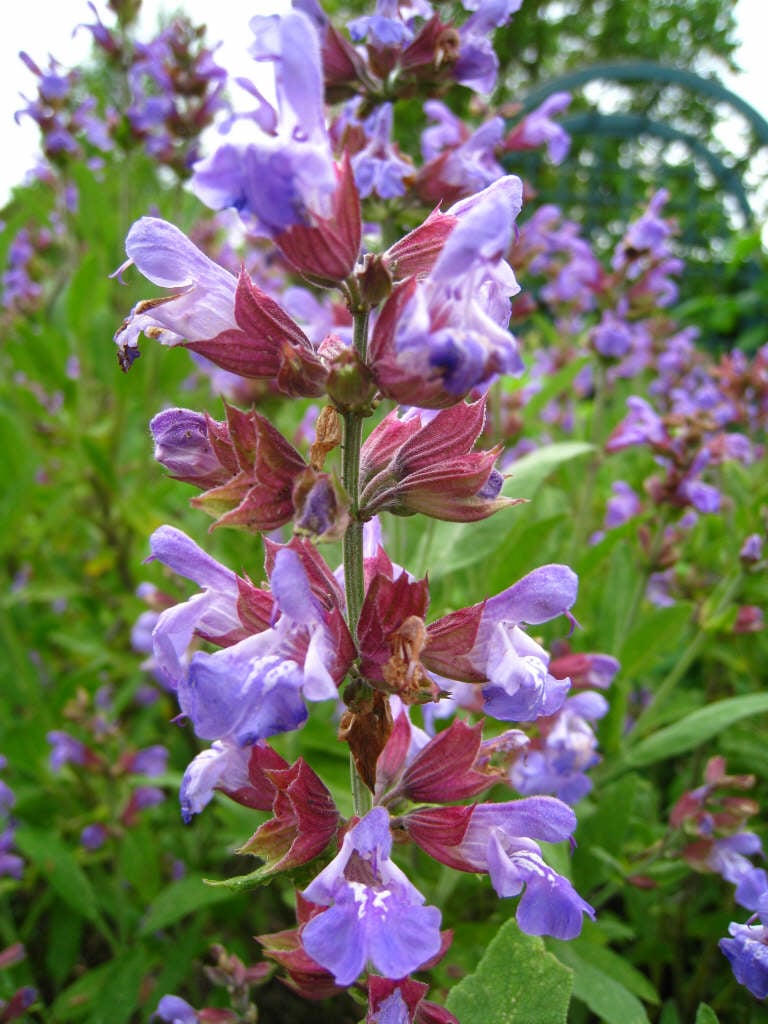
Salvia officinalis

RHS Plant Profile
common sage
common sage RHS

Other common names

common garden sage, sage, sauge

Synonyms

Salvia officinalis 'Greek'

Plants for pollinators
Herbs - Culinary Herbaceous Perennial

A bushy, spreading evergreen sub-shrub to 75cm tall, with very aromatic, finely veined, grey-green, oblong leaves to 6cm long and 2.5cm wide and short spikes of pale blue flowers in early summer. Fresh and dried leaves are used as a popular culinary herb. There are many cultivated varieties of sage available, varying in size, strength and leaf-colour. 'Purpuracens' has attractive purple foliage. 'Tricolor' has grey-green with cream-variegated leaves that are flushed with purple on young growth and 'Icterina' has yellow-variegated, pale green leaves

Position

Full sun

Soil Types

Chalk, Loam, Sand

Max Height

0.5-1 metres

Max Spread

0.5-1 metres

Size

Time to Maturity
2–5 years
Max Spread
0.5-1 metres
Max Height
0.5-1 metres

Growing Conditions

Chalk Loam Sand
Moisture
Moist but well–drained or Well–drained
pH
Acid or Alkaline or Neutral

Position

Full sun
Aspect
South–facing or West–facing
Exposure
Sheltered
Hardiness
H5

Colour & Scent

Fragrance Foliage
Season Stem Flower Foliage Fruit
Spring
Summer
Autumn
Winter

Botanical Details

Family
Lamiaceae
Native to GB/Ireland
No
Foliage
Evergreen
Habit
Bushy
Genus
Salvia can be annuals, biennials, herbaceous or evergreen perennials, or shrubs. They have paired, simple or pinnately lobed, often aromatic leaves and 2-lipped flowers in whorls, forming simple or branched spikes or racemes
Name Status
Correct
Plant Range
Mediterranean, Africa

How to Grow

Cultivation

Thrives in a sunny spot, in moderately fertile soil with good drainage. Drought tolerant once established. Protect from excess winter wet. See sage cultivation

Propagation

Propagate by by seed sown in spring or by softwood cuttings in early summer

Suggested planting locations and garden types

  • City and courtyard gardens
  • Coastal
  • Cottage and informal garden
  • Patio and container plants
  • Mediterranean climate plants
  • Gravel garden
  • Wall side borders
  • Flower borders and beds

Pruning

Pruning group 9 in spring. Cut back flower spikes after flowering to keep plants compact

Pests

May be susceptible to rosemary beetle, sage leafhopper and capsid bug

Diseases

May be susceptible to honey fungus (rarely), powdery mildews, verticillium wilt and foot and root rots