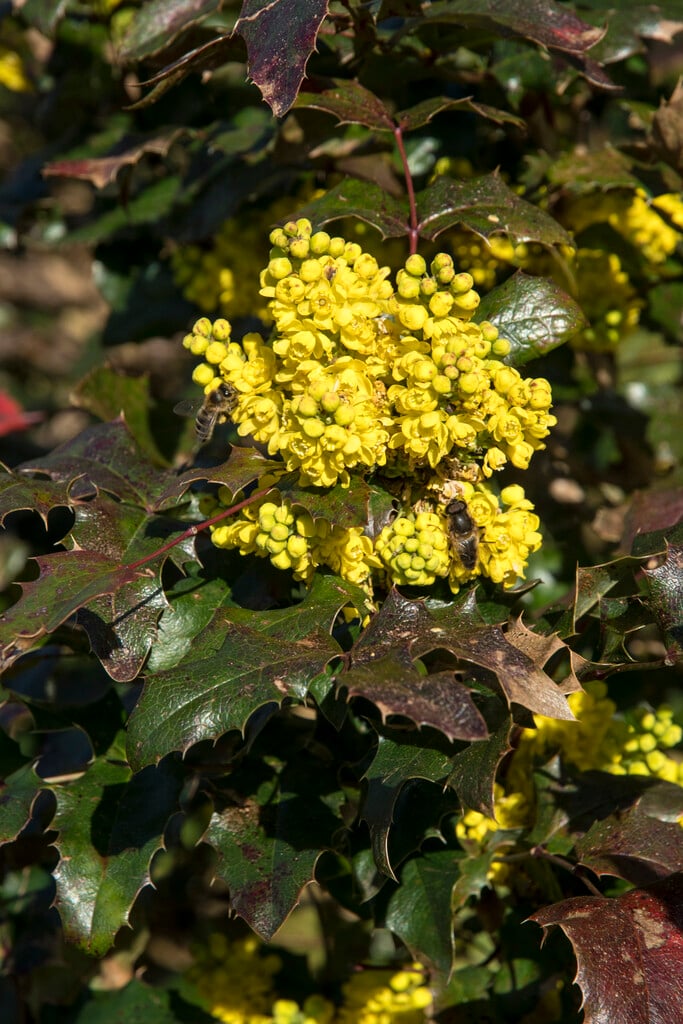
Mahonia aquifolium 'Moseri'

<em>Mahonia</em> <em>aquifolium</em> 'Moseri' visionspictures.com

Synonyms

Mahonia × wagneri 'Moseri'
Mahonia 'Moseri'

Plants for pollinators
Shrubs

An upright, evergreen shrub with oval-shaped prickly green foliage which turns to orange then pinkish-red in autumn. Clusters of yellow, fragrant flowers appear in the spring, followed by white-frosted, blue-black berries

Position

Full sun, Partial shade

Soil Types

Chalk, Clay, Loam, Sand

Max Height

1-1.5 metres

Max Spread

1-1.5 metres

Size

Time to Maturity
5–10 years
Max Spread
1-1.5 metres
Max Height
1-1.5 metres

Growing Conditions

Chalk Clay Loam Sand
Moisture
Moist but well–drained or Well–drained
pH
Acid or Alkaline or Neutral

Position

Full sun Partial shade
Aspect
East–facing or North–facing or South–facing or West–facing
Exposure
Sheltered
Hardiness
H5

Colour & Scent

Fragrance Flower
Season Stem Flower Foliage Fruit
Spring
Summer
Autumn
Winter

Botanical Details

Family
Berberidaceae
Native to GB/Ireland
No
Foliage
Evergreen
Habit
Bushy, Columnar upright
Potentially harmful
Berries are ornamentalnot to be eaten. Wear gloves and other protective equipment when handling
Genus
Mahonia are evergreen shrubs with leathery, pinnate leaves which are often spine-toothed, and clustered racemes of sometimes fragrant yellow flowers, sometimes followed by black or purple berries
Name Status
Unresolved

How to Grow

Cultivation

Grow in humus-rich moist but well-drained soil, suited to full or partial shade in a sheltered position but tolerant of sun if soil is not too dry. See mahonia cultivation for further information

Propagation

Propagate by semi-ripe cuttings

Suggested planting locations and garden types

  • City and courtyard gardens
  • Coastal
  • Cottage and informal garden
  • Wildlife gardens
  • Low Maintenance
  • Flower borders and beds

Pruning

Pruning group 8

Pests

Generally pest-free

Diseases

May be susceptible to a rust and powdery mildews