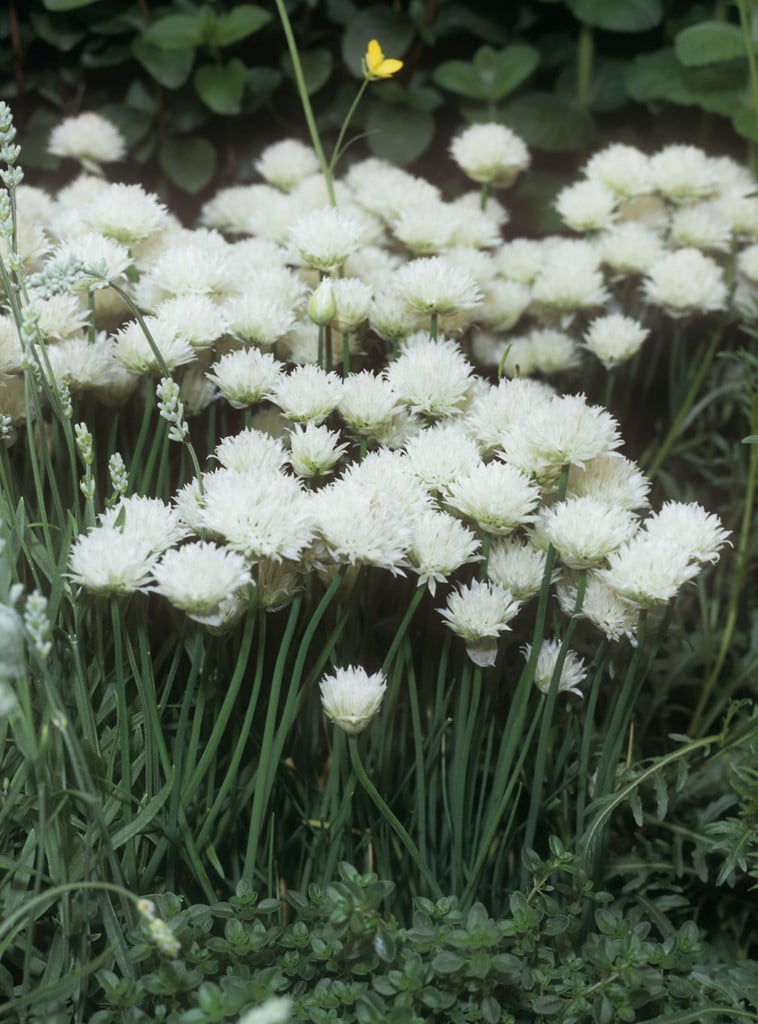
Allium schoenoprasum f. albiflorum

RHS Plant Profile
white-flowered chives
white-flowered chives RHS

Synonyms

Allium schoenoprasum 'Alba'
Allium schoenoprasum 'Album'
Allium schoenoprasum white-flowered

Plants for pollinators
Herbs - Culinary

A clump-forming, bulbous herbaceous perennial, up to 30cm high, with edible, hollow, cylindrical, grass-like leaves, and spherical, pure white flowerheads, 1.5cm across, in early summer

Position

Full sun, Partial shade

Soil Types

Chalk, Clay, Loam, Sand

Max Height

0.1-0.5 metres

Max Spread

0.1-0.5 metres

Size

Time to Maturity
2–5 years
Max Spread
0.1-0.5 metres
Max Height
0.1-0.5 metres

Growing Conditions

Chalk Clay Loam Sand
Moisture
Moist but well–drained
pH
Acid or Alkaline or Neutral

Position

Full sun Partial shade
Aspect
North–facing or South–facing or West–facing or East–facing
Exposure
Exposed or Sheltered
Hardiness
H6

Colour & Scent

Fragrance Foliage
Season Stem Flower Foliage Fruit
Spring
Summer
Autumn
Winter

Botanical Details

Family
Amaryllidaceae
Native to GB/Ireland
No
Foliage
Deciduous
Habit
Clump forming
Genus
Allium are bulbous herbaceous perennials with a strong onion or garlic scent, linear, strap-shaped or cylindrical basal leaves and star-shaped or bell-shaped flowers in an umbel on a leafless stem
Name Status
Correct

How to Grow

Cultivation

Grow in full sun or partial shade; for edible leaves, grow in moist but well-drained medium soil, while for flowers, grow in lighter and drier soil. May have the potential to become a nuisance if not managed well. See chive cultivation for further advice

Propagation

Propagate by seed (may not come true if non-white chives are growing nearby) or by division during spring or autumn into groups of 5 or 6 plants, and replant at spacings of 20-30cm

Suggested planting locations and garden types

  • Patio and container plants
  • Wildlife gardens
  • City and courtyard gardens
  • Cottage and informal garden
  • Flower borders and beds
  • Garden edging

Pruning

No pruning required, except cutting the leaves for eating, preferably with scissors, and deadheading

Pests

May be susceptible to allium leaf miner and onion fly

Diseases

May be susceptible to onion white rot and onion downy mildew