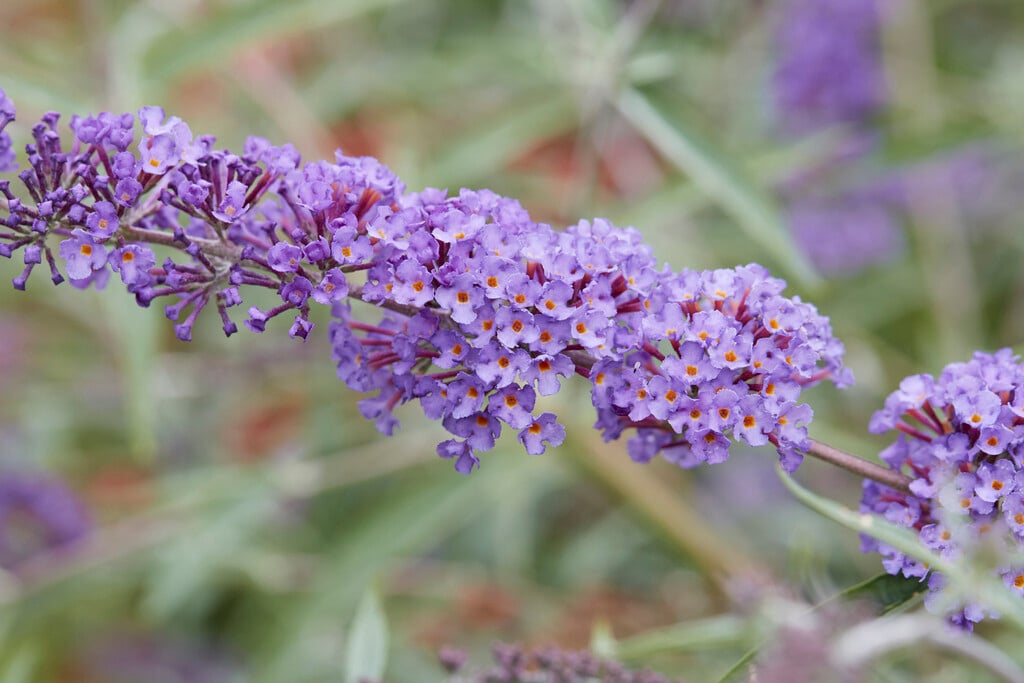
Buddleja davidii var. nanhoensis

RHS Plant Profile
Nanho butterfly bush
Nanho butterfly bush visionspictures.com

Synonyms

Buddleja nanhoensis

Plants for pollinators
Shrubs

A compact deciduous shrub, sometimes up to 1.5m high, with slender stems and narrow, dark grey-green leaves. Long, narrow clusters of pale lilac flowers are produced from summer into autumn

Position

Full sun, Partial shade

Soil Types

Chalk, Clay, Loam, Sand

Max Height

1-1.5 metres

Max Spread

1-1.5 metres

Size

Time to Maturity
5–10 years
Max Spread
1-1.5 metres
Max Height
1-1.5 metres

Growing Conditions

Chalk Clay Loam Sand
Moisture
Moist but well–drained or Well–drained
pH
Acid or Alkaline or Neutral

Position

Full sun Partial shade
Aspect
East–facing or South–facing or West–facing
Exposure
Sheltered
Hardiness
H6

Colour & Scent

Season Stem Flower Foliage Fruit
Spring
Summer
Autumn
Winter

Botanical Details

Family
Scrophulariaceae
Native to GB/Ireland
No
Foliage
Deciduous
Habit
Bushy
Genus
Buddleja can be evergreen or deciduous shrubs, occasionally trees or scrambling climbers with simple leaves and panicles of small, tubular fragrant flowers
Name Status
Correct
Plant Range
C China

How to Grow

Cultivation

Thrives in a sunny, well-drained situation, though will tolerate partial shade. Protect from strong winds and excess winter wet. See buddleja cultivation for more detailed advice

Propagation

Propagate by semi-hardwood cuttings in summer, or by hardwood cuttings in autumn

Suggested planting locations and garden types

  • City and courtyard gardens
  • Cottage and informal garden
  • Patio and container plants
  • Wildlife gardens
  • Flower borders and beds
  • Wall side borders

Pruning

Pruning group 6; can be cut back to a low framework in early spring. Deadhead after flowering

Pests

May be susceptible to aphids, capsid bugs, caterpillars, earwigs, figwort weevils, glasshouse red spider mite, leaf and bud eelworm, and mullein moth

Diseases

May be susceptible to honey fungus, fungal leaf spot, and virus diseases