
![rose [Little Rambler]](https://apps.rhs.org.uk/plantselectorimages/detail/WSY0042448_5280.jpg?w=1280&fit=clip&fm=jpg&auto=format)
![rose [Open Arms]](https://apps.rhs.org.uk/plantselectorimages/detail/Web_Use-PUB0039723_5164.jpg?w=1280&fit=clip&fm=jpg&auto=format)
![rose [Graham Thomas]](https://apps.rhs.org.uk/plantselectorimages/detail/moja04093.jpg?w=1280&fit=clip&fm=jpg&auto=format)
10 award-winning bulbs to add interest to your summer border
Bulb expert Christine Skelmersdale shares 10 award-winning bulbs to brighten up and add interest to your summer border

If you’d like to grow roses around a doorway, pick the right variety and you’ll get months of fragrant flowers
Roses growing around a doorway is many people’s idea of the most idyllic garden feature. What could be nicer than a frame of bright blooms and delicious scent to greet you every time you come home?
Pottering round the Cotswolds last summer, I spotted one of those pretty thatched stone cottages that Americans think of as typically English and with the traditional roses round the front door. Well, sort of. In fact, most of the flowers were round the chimney and the stems by the door were mostly bare, even of leaves. Problem? Wrong variety.
Some climbing and rambling roses can produce shoots that go from ground level to head height in one season, so the right choice is crucial. Roses for round the door, or even roses in containers, need to be much less vigorous. And, of course, we’re looking for months of colour and fragrance too.

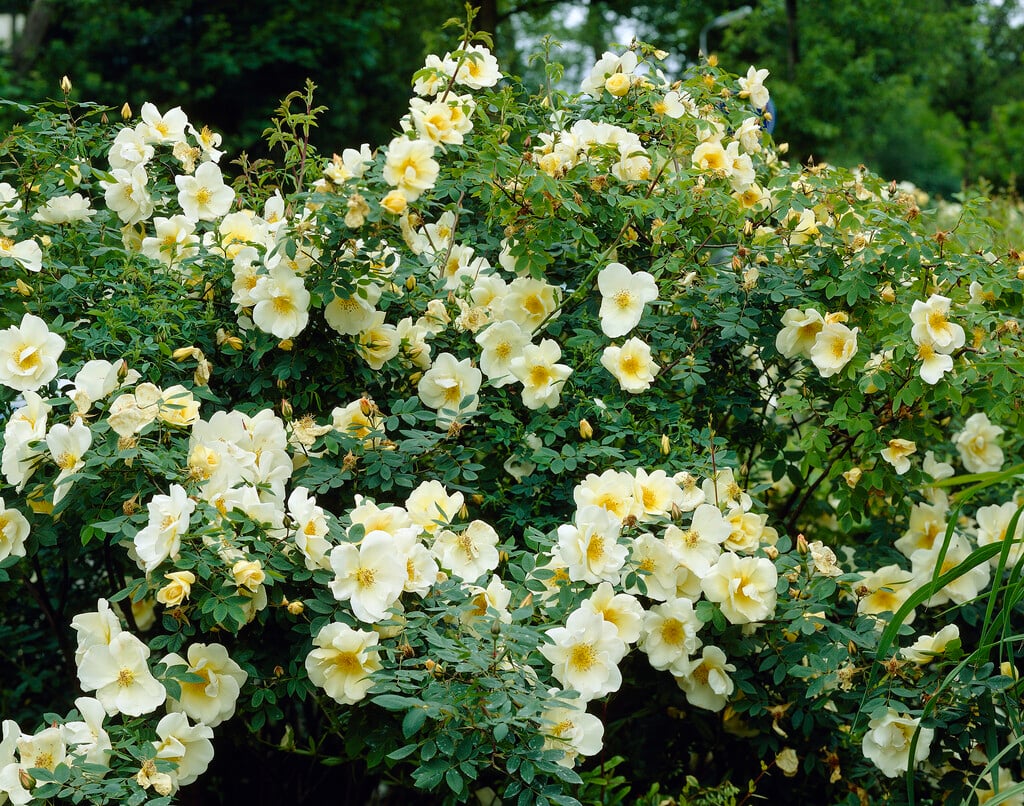
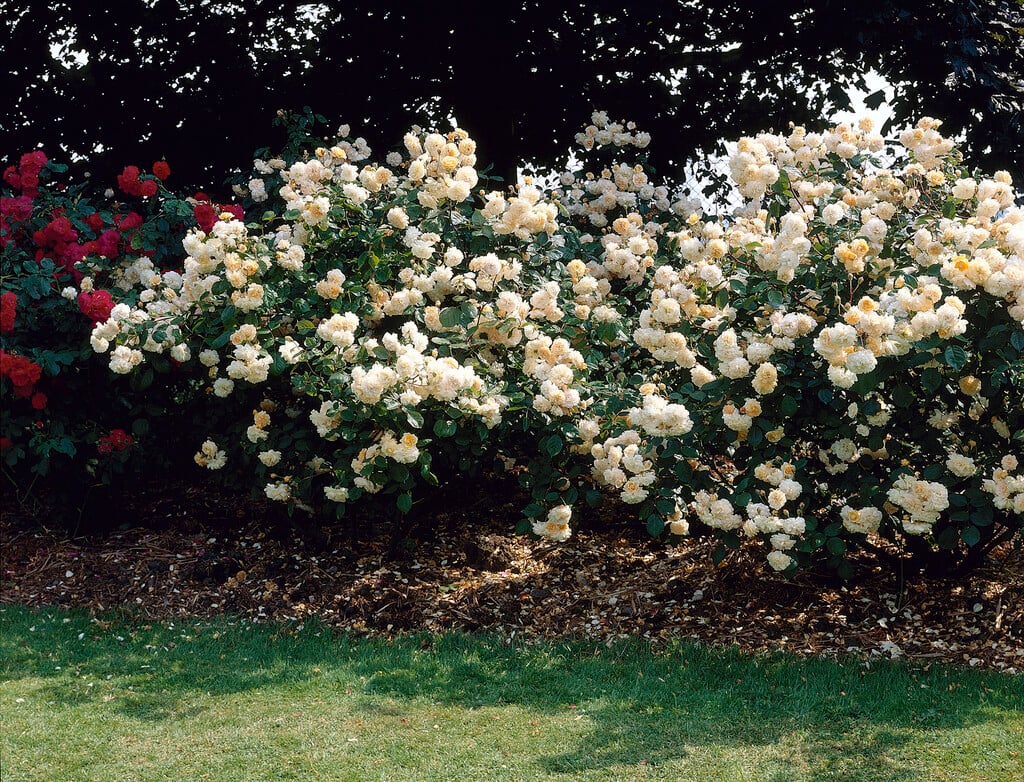
The Musk roses tend to mature wider than they are tall, so are not easy to fit into smaller gardens. As climbers, however, they are superb. The fully double flowers of ‘Buff Beauty’ are coral yellow in opening to rich apricot-yellow – almost primrose in some seasons - and carried first in small clusters on the older growth and then, later, in far more generous clusters on the new shoots. Up to 1.5m in height. Hardiness rating: H6.

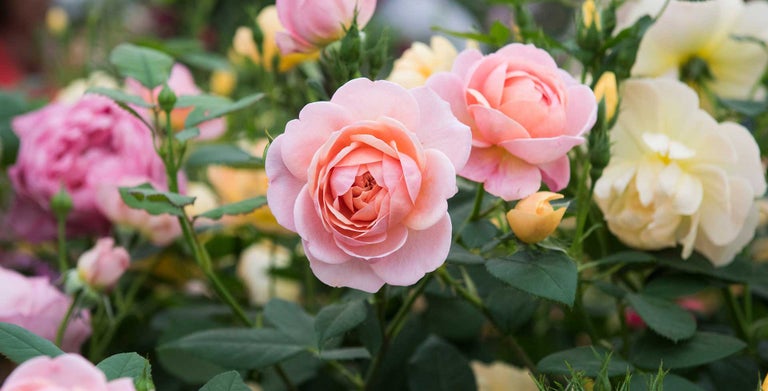
Little Rambler ‘(Chewramb)’ is a miniature rose that climbs or forms a lax shrub with thorny, arching stems bearing dark greeen foliage. Clusters of fragrant, blush pink, fully double blooms repeat-flower through summer and autumn; suitable for a shady north-facing wall. About 2m in height. Hardiness rating: H6.

Rosa ‘Maigold’ is an early-flowering, thorny-stemmed climbing rose with plentiful, glossy rich green foliage, and fragrant, semi-double, coppery-yellow blooms flushed orange. Flowers in late spring or in early summer and in a good summer will repeat flower until autumn. 3.5m in height and up to 10cm across. Hardiness rating: H6.

Many of David Austin’s English Roses make excellent, relatively restrained, climbers. The peachy-pink cupped flowers of A Shropshire Lad (‘Ausled’), fade prettily to pale pink as they age, have a strong, fruity fragrance and the rich, dark green foliage sets the flowers off beautifully. Cut the shoots that have flowered back to three buds in February. Not to be confused with ‘Shropshire Lass’. English Rose. 2.4m. Hardiness rating: H6.

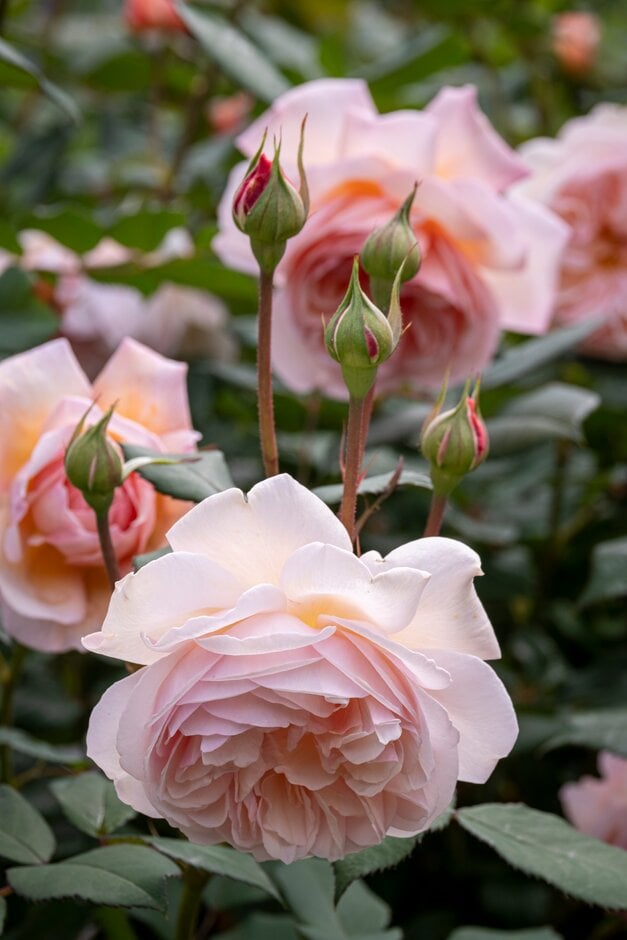
This most famous of English Roses, Graham Thomas (‘Ausmas’), is named for the great rosarian and recommended by its raiser as a climber rather than for growing as a shrub; its growth is more lax than that of other English Roses. The pure rich colouring of the cupped flowers, coupled with their powerful tea rose scent and their long season, is always captivating. 2-3m. Hardiness rating: H6.

Rosa ‘Constance Spry’ is a large, climbing rose with thorny stems. It bears abundant grey-green foliage, and rounded, fully double, pink flowers 12cm in width, with a strong myrrh scent, produced in one flush of flower in midsummer. 6m in height. Hardiness rating: H6.

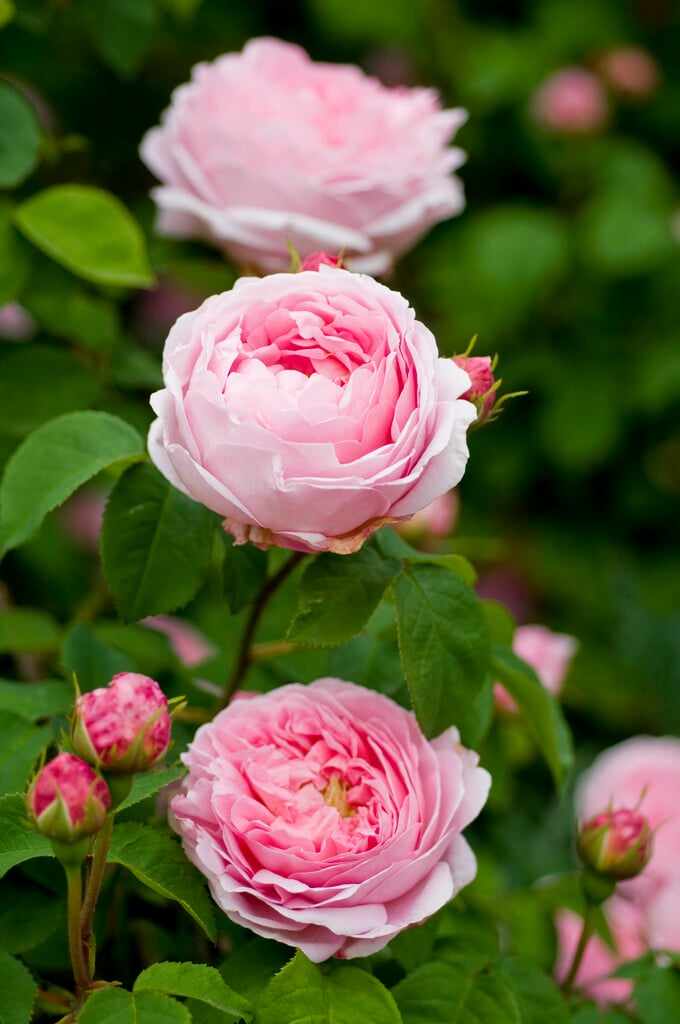
We usually think of rambling roses as growing like the one I saw strangling that Cotswold chimney or growing into large mature tress. Open Arms (‘Chewpixcel’) grows in the same way but is much more manageable. The peachy, perfumed semi-double flowers with their musky scent have golden centres and fade to pale rose pink as they mature. Good in a large pot. Miniature Rambler. 1.8-2.4m. Hardiness rating: H6.

The creamy pink, semi-double flowers of ‘Penelope’ open from slightly orange tinted buds and fade to white in summer heat. Very prolific, flowering on old and new growth, ‘Penelope’ is very generous with its musky fragrance. In winter, look forward to unusual coral pink hips. “One of the very best roses for creating a white effect without being white,” wrote Graham Thomas. Hybrid Musk. 2-2.4m. Hardiness rating: H5.

An unusual rambler, ‘Phyllis Bide’ is neat in growth, repeat flowers reliably over an unusually long period well into autumn, has very few thorns, and comes with small, unobtrusive foliage. The small, semi-double, apricot and pink and gold flowers mature to pale rose pink with paler centres and, although not powerfully fragrant, there is an attractive sweet scent. Ideal by doors and paths. Rambler. 2-3m. Hardiness rating: H6.

Rosa Warm Welcome ‘(Chewizz)’ is a climbing rose with coppery young foliage contrasting with the small, fragrant, bright orange, semi-double flowers produced in clusters. It repeat-flowers from summer to autumn. About 2.5m in height. Flowers 4cm across. Hardiness rating: H6.
RHS hardiness rating
The system of hardiness ratings enables gardeners to understand the hardiness of plants and gives a guide to the best growing conditions.
Find out more >