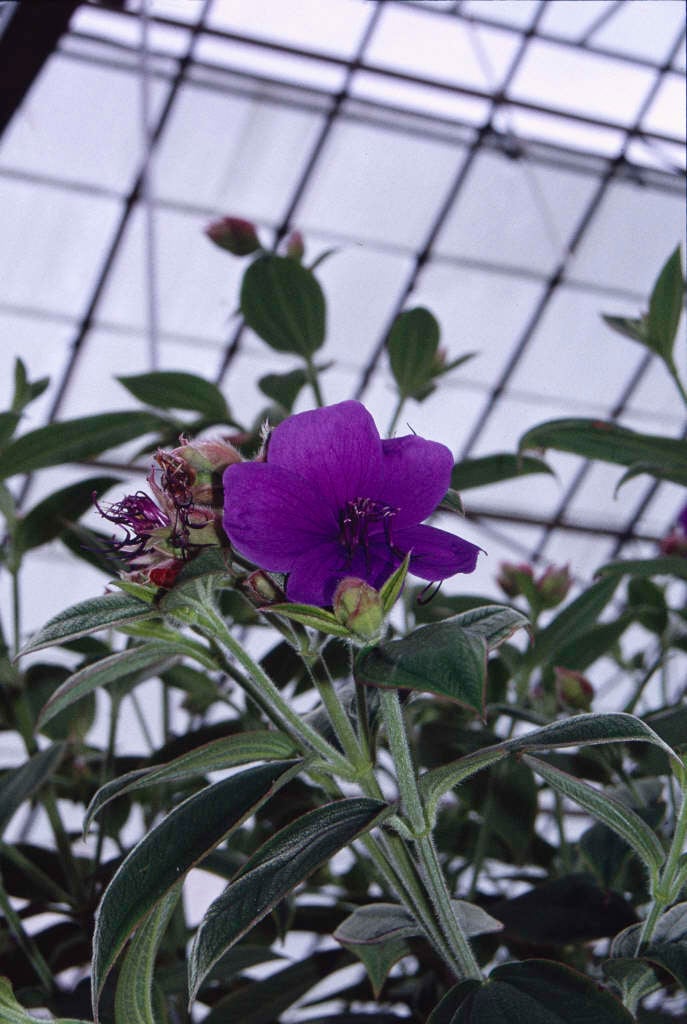
Tibouchina urvilleana

RHS Plant Profile
glory bush
glory bush RHS 2002

Other common names

lasiandra, pleroma, princess flower, purple glory tree

Synonyms

Pleroma urvilleanum hort.
Tibouchina grandiflora hort.
Pleroma semidecandrum misapplied
Pleroma grandiflora hort.
Tibouchina urvilleana
Tibouchina semidecandra misapplied

Award of Garden Merit
Shrubs Conservatory Greenhouse

A lax evergreen shrub to 4m or more, with elliptic, softly hairy leaves with prominent longitudinal veins and rich violet-purple flowers 6-10cm across, with exserted, blackish stamens

Position

Full sun

Soil Types

Chalk, Loam, Sand

Max Height

2.5-4 metres

Max Spread

1.5-2.5 metres

Size

Time to Maturity
5–10 years
Max Spread
1.5-2.5 metres
Max Height
2.5-4 metres

Growing Conditions

Chalk Loam Sand
Moisture
Moist but well–drained or Well–drained
pH
Acid or Alkaline or Neutral

Position

Full sun
Aspect
South–facing or West–facing or East–facing
Exposure
Sheltered
Hardiness
H2

Colour & Scent

Season Stem Flower Foliage Fruit
Spring
Summer
Autumn
Winter

Botanical Details

Family
Melastomataceae
Native to GB/Ireland
No
Foliage
Evergreen
Habit
Bushy
Genus
A genus of evergreen flowering subshrubs, shrubs or trees, native to Puerto Rico and tropical South America, with dark green foliage, often edged with red. Showy, dark purple flowers with long white stamens appear in late spring to early summer
Name Status
Correct
Plant Range
S Brazil

How to Grow

Cultivation

Under glass grow in peat-free, loam-based compost in full light with shade from hot sun. Water freely in summer but keep just moist in winter. Can be grown outdoors in moist, fertile, well drained soil in frost-free area

Propagation

Propagate by seed sown at 16°C in spring or strike softwood cuttings in late spring and semi-hardwood cuttings in summer, both with bottom heat

Suggested planting locations and garden types

  • City and courtyard gardens
  • Mediterranean climate plants
  • Architectural
  • Patio and container plants
  • Wall side borders

Pruning

Pruning group 9. Plants grown under glass may need restrictive pruning in late winter

Pests

May be susceptible to aphids, mealybugs and glasshouse whitefly

Diseases

May be susceptible to oedema under glass