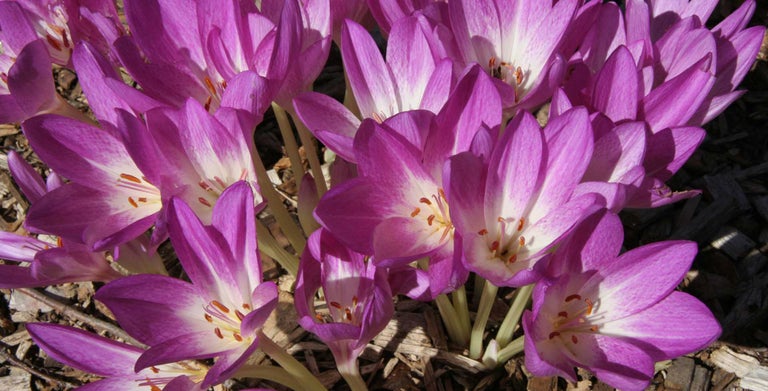
Bringing colour and interest to the garden as summer fades, colchicums are among autumn’s most distinctive plants. Explore the National Plant Collection at RHS Hyde Hall and the trial that helped secure its status
Jeanette Jones, Horticulturist
and Christine Woodhouse, Team Leader at RHS Garden Hyde Hall
3-minute read
Introduction
RHS Garden Hyde Hall achieved Plant Heritage National Plant Collection status for Colchicum (autumn-flowering) in 2021 following an RHS trial from 2015–2019. The collection consists of 13 species and 45 cultivars, representing a total of 63 taxa. The best time to view them is from mid-August to late October.
Colchicum (autumn-flowering) are valued for their striking autumn blooms, ranging from deep purple and magenta to shades of pink and white. They prefer well-drained, fertile soil in a sunny position and, once established, will flourish for many years, providing valuable colour and interest late in the gardening season. Smaller species are ideal for rock gardens, while taller species can be in grass, provided it is trimmed in time for the flowers to be seen. They create an effective display when planted in groups and require very little maintenance once established.
Colchicum are unusual in that their stemless flowers emerge directly from the ground in autumn, while the leaves appear in late winter and early spring. takes place during summer before flowering begins in late August or early September. After flowering, there is a further period of dormancy before the leaves emerge in spring. They gradually increase by producing new corms (offsets) each year but dislike poorly drained soils. Colchicum can be damaged by transplanting while in active growth and should therefore only be moved when fully dormant.
Colchicum ‘Rosy Dawn’ RHS: AGM
Name and origin
The name Colchicum originates from Colchis, an ancient region on the eastern coast of the Black Sea in present-day Georgia, part of the Caucasus region. However, most species originate from Greece and Turkey. Although commonly known as autumn crocus, Colchicum (family Colchicaceae) should not be confused with Crocus (family Iridaceae). One of the easiest ways to distinguish them is by their stamens: Colchicum has six, while Crocus has three.
Colchicum speciosum ‘Atrorubens’ RHS: AGM
RHS Colchicum (autumn-flowering) trial
The trial at RHS Hyde Hall was located at the upper end of the Dry Garden on a long, straight, east-facing bed. The site proved ideal, being well drained, sheltered and spacious enough to accommodate all entries in one location.
The heavy clay soil was improved with horticultural sand and grit before being topped with 10mm gravel. Each entry was planted in late summer 2014 while the corms were dormant. Five corms were planted in a square, with one at each corner and a fifth in the centre, spaced approximately 20cm apart. Once established, the trial required little maintenance beyond weed control, a spring feed with a low-nitrogen fertiliser and the removal of old foliage in summer.
There were four white cultivars, with the remainder displaying a range of pink and purple tones. Growing them together made it easy to compare their performance and select favourites. Two stand-out cultivars were Colchicum ‘Rosy Dawn’ RHS Recommended: AGM , with bright rosy-pink flowers, white centres, light tessellation and a delicate fragrance, and Colchicum ‘Little Woods’ RHS: AGM , a charming pale-pink that remained compact and weather resistant.
Other notable cultivars include Colchicum speciosum ‘Album’ RHS: AGM , a strong, long-lasting plant with exceptionally pure white flowers. In contrast, Colchicum speciosum ‘Atrorubens’ RHS: AGM bears some of the darkest flowers within the species, producing rich purple-crimson blooms with faint tessellation held on long purple perianth tubes that become green towards the base. Colchicum autumnale subsp. pannonicum ‘Nancy Lindsay’ RHS: AGM is a tall cultivar with deep lilac-pink flowers, suitable for borders and naturalising in grass. It is thought that Nancy Lindsay, daughter of garden designer Norah Lindsay, collected it in Romania in 1936 while returning from a plant-collecting expedition in Iran.
Colchicum speciosum ‘Album’ RHS: AGM
Since the trial ended, the collection has been relocated to a dedicated stock bed in the nursery, while a selection of gardeners’ favourites has been planted throughout the garden for visitors to enjoy.
Colchicums are a valuable addition to the garden, providing colour and interest in early autumn when many other plants are beginning to fade. Positioned carefully, they can fill gaps left by earlier-flowering plants and help extend the season.