Drought tolerant and sun loving, pelargoniums flower all summer long. RHS Garden Rosemoor in Devon is home to two collections: variegated zonal types with remarkable patterned foliage and bold, bright flowers; and wonderfully aromatic scented-leaved pelargoniums with daintier flowers
Heather Greig
Associate Editor, The Garden
5-minute read
RHS Garden Rosemoor’s pelargoniums are part of a larger collection gifted to the RHS in 2021 by Fibrex Nurseries , the former National Plant Collection holder through Plant Heritage . The whole collection, amounting to more than 1,400 accessions, was divided by group between RHS Gardens Bridgewater, Harlow Carr, Hyde Hall, Rosemoor and Wisley. It was originally started by Hazel Key of Fibrex Nurseries in 1958 and was granted National Plant Collection status in 1987.
Garden appeal
Both zonal and scented-leaved pelargoniums are drought tolerant, so are perfect for containers on sunny patios. Zonal pelargoniums have a long-flowering season and vibrantly patterned foliage, and the flower colours range from hot reds to paler pinks and white.
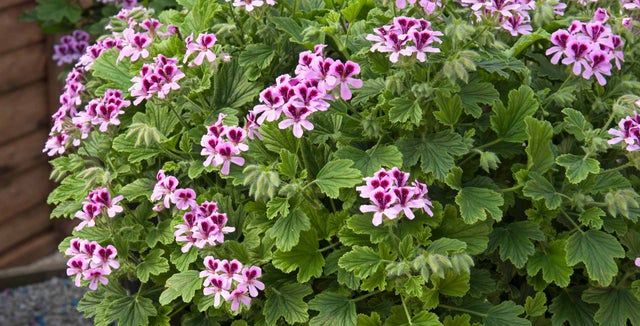
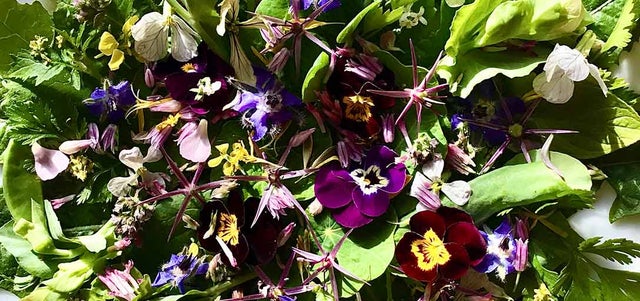
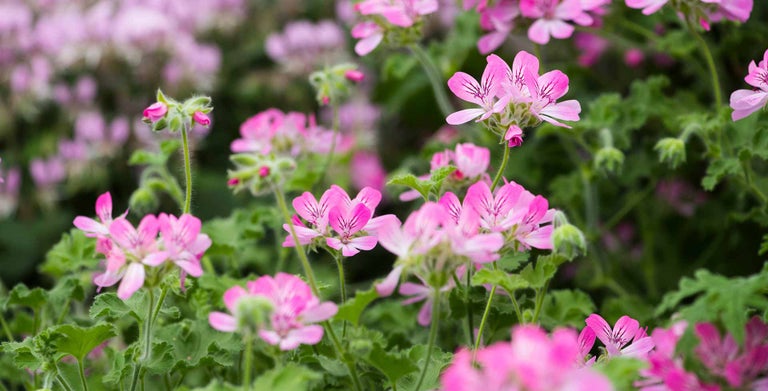
Scented-leaved pelargoniums offer a variety of foliage shapes and textures and have a fascinating range of aromas. Many are fruity such as lemon, orange, apple and peach but there are also floral scents including rose and lavender plus peppermint, pine and ginger. The flowers are more subtle than the zonals and come in cooler pinks, purples and white. Both the flowers and leaves of scented-leaved pelargoniums are edible so can be used to decorate cakes or added to cordials.
Pelargoniums in flower at RHS Garden Rosemoor, Devon
"There are so many wonderful varieties to choose from and unusual, historic cultivars to keep in cultivation. Being drought tolerant they are useful for a warming climate and as they are happy in pots they can be grown in smaller spaces."
Claire Rady, RHS Rosemoor Horticulturist
When and where to see them at RHS Rosemoor
RHS Garden Rosemoor’s collection consists of 93 different scented-leaved pelargoniums (3 species and 90 cultivars) and 100 zonal cultivars. Due to its sheer size, a sample of the collection is displayed on rotation in pots in the garden. Visitors can find the scented pelargoniums in the Formal Garden and Fruit and Vegetable Garden , and the zonals are displayed on the veranda and courtyard around Rosemoor House in Lady Anne’s Garden .
“We make a different selection of 20 zonal and 20 scented each year, so they all get their turn out on display,” says Claire Rady, custodian of the scented collection. The best months to view them are from June to September when the pots are put out on display. As they are frost tender, they’re kept under cover for the rest of the year.
RHS Rosemoor has been selling the scented varieties in its Garden Centre for a few years. These are propagated externally, and a selection is available each year representing the ones on display in the garden.
The custodians’ favourite cultivars
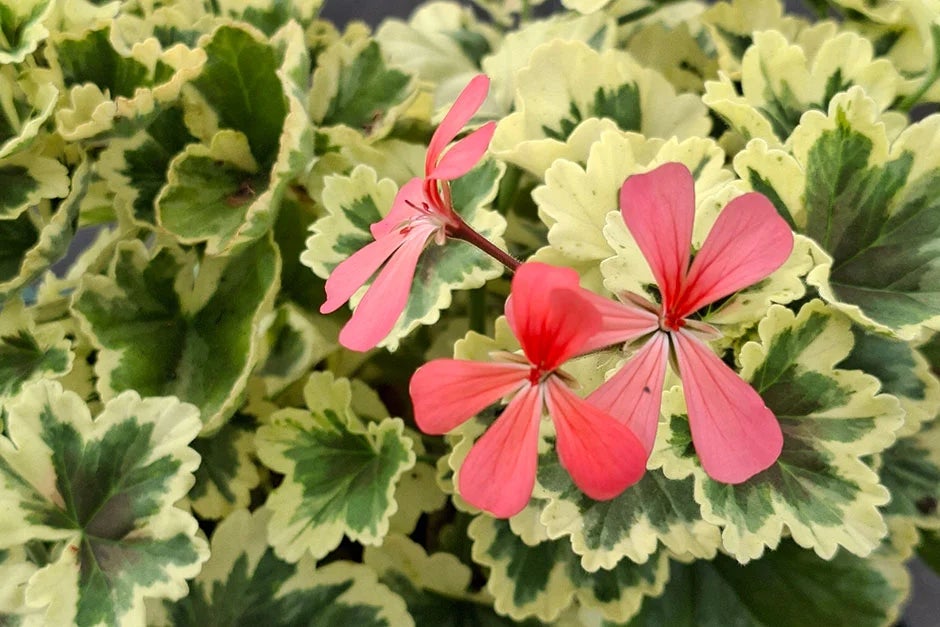
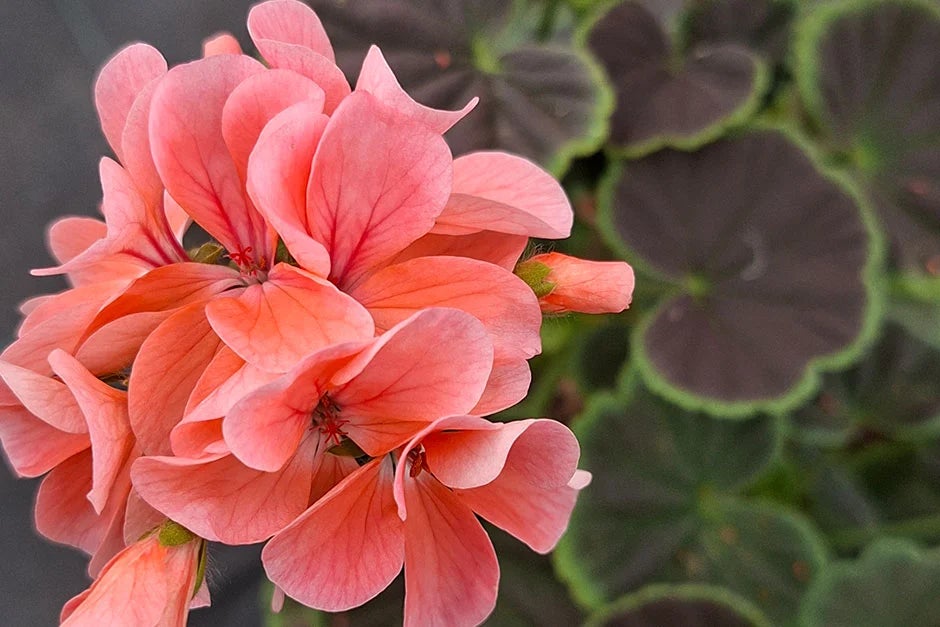
Pelargonium ‘Princess Julia’ has pretty salmon flowers and cream-edged foliage
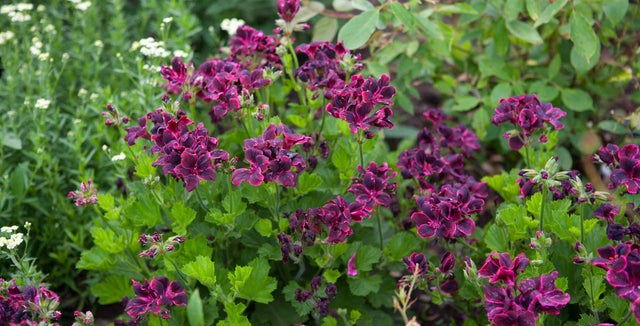
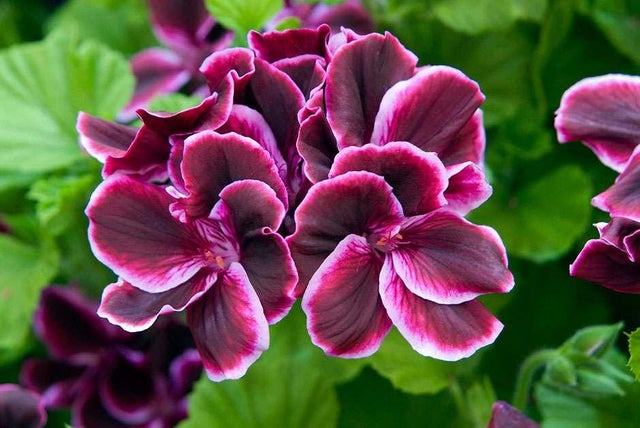
Pelargonium ‘Mr M. Guest’ has dark green edged leaves with maroon centres
Horticulturist Catherine Venn, who looks after the zonal pelargoniums, says: “I always find choosing favourites difficult as I soon get distracted by what’s looking good! However, Pelargonium ‘Princess Julia’ has a lovely form and cream-edged foliage with green and maroon centres, and a simple salmon-pink flower. Pelargonium ‘Mr M. Guest’ is another one with a striking appearance – a dark green edged leaf and deep maroon centres with a pale pink flower.”
Scented Pelargonium crispum ‘Cy’s Sunburst’ has vibrant, crinkled leaves edged with gold
Custodian of the scented-leaved collection, Horticulturist Claire Rady, says: “I really like the scented Pelargonium crispum ‘Cy’s Sunburst’ which has vibrant, crinkled green leaves edged with gold. The pink flowers are delicate yet showy with purple feathering and they contrast well with the foliage. It has a compact, upright habit and a strong citrus scent.”
"Zonal pelargoniums provide an amazing tapestry of colour just from their foliage and the flowers add another layer of interest."
Catherine Venn, RHS Rosemoor Horticulturist
Breeding notes
A number of the scented-leaved pelargoniums were bred in the 1980s and 1990s by plantswoman Edna Popperwell who crossed P. quercifolium with regal varieties and named them after roads or towns where she’d lived. The cultivars ‘Copthorne’ , ‘Brunswick’ , ‘Orsett’ and ‘Welling’ are the ones held in the RHS Rosemoor collection. “I was contacted by Edna’s daughter who had lost ‘Welling’, so I was able to propagate it for her to restore her collection of her mother’s cultivars,” says Claire.
Zonal pelargonium ‘Pride of Exmouth’ was given to RHS Rosemoor by a member of South West In Bloom a few years before the Fibrex collection came to the garden. It was accompanied by this background information:
“This was raised by Mrs. A Hitchen of 103 Salterton Road, Exmouth, Devon, and first exhibited as a novel variety by the Surrey Pelargonium Society at the Royal Botanic Garden, Kew, in June 1926. It was awarded a Reserve Medal (prohibitas non obligatum). The description states that it is vermilion flowered (intensely scarlet), dwarf, rose-like (extremely double), clustered with palmately-lobed non-zonal leaves which are plain and do not have the usual darker coloured ring around the leaf.”
The extract continues: “This account is even more historically interesting alongside this extract from the title deeds of 103 Salterton Road: ‘The vendor requests that six plants in good condition be given freely and in perpetuity to each succeeding title holder in order that the species be preserved.’ At one stage the house remained empty for several months before being bought by Exeter Health Authority as a nursing home, wherein one very tall, single stemmed straggly plant in bone dry was found, labelled, on a windowsill. A Plant Heritage member, Roger Stuckey, took , which were successful, and it is now safe. Upon such capricious circumstances do some plants retain their grasp on existence.”
Care and cultivation
Top tips from the collection custodians Claire and Catherine:
Pelargoniums are tender so need protection from frost. They hate having wet roots so need good drainage and careful watering.
They are susceptible to botrytisin the darker, colder months; good ventilation, spacing and keeping plants clean reduces this.
They need feeding in containers, so we use a controlled-release fertiliser mixed into the compost.
The scented-leaved types are prone to aphids as the smell is said to mask the scent of the pest from its predators.
The zonals are fussier as they need good light levels in winter and are prone to rust.
Pelargoniums propagate well from semi-ripe cuttings which we do the bulk of in autumn.
We propagate all the zonal pelargoniums every year to keep the plants ‘young’ as older ones can get woody. The ‘parent’ zonal pelargoniums are cut back quite hard to rest them over winter and allow new growth from this framework.