
The garden
Some flowers have microscopic ridges on their petals that scatter light, producing a blue shimmer easily seen by bees. This subtle optical effect, known as the ‘blue halo’ and discovered by the University of Cambridge. The design was inspired by the work of Professor Beverly Glover, Dr Edwige Moyroud, and Dr Heather Whitney, and is the main theme behind this design.
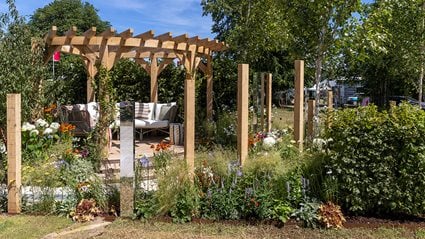
A central planter with a rising Hibiscus trionum sculpture is encircled by predominately blue and purple planting, echoing this halo effect. Nepeta ‘Six Hills Giant’ sets an ethereal scene, forming a soft, airy cloud of blue punctuated by the saturated tones of Eryngium planum ‘Blaukappe’.
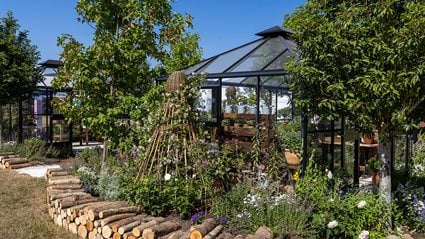
Radiating outwards, layers of plants varying in colour and texture reflect different ways flowers attract pollinators. Small bug sculptures are woven throughout, drawing attention to the insects these plants support and encouraging gardeners to do their bit to protect invertebrates.
Key plants:
-
Nepeta ‘Six Hills Giant’ with its long stems of tubular lavender blue flowers that collectively create a frothy blue cloud almost a metre high. This ethereal scene will be punctuated by the saturated blues of the Eryngium planum ‘Blaukappe’. The structure of the sea holly being sharp and jagged also forms a pleasing contrast with the catmint
-
Hibiscus trionum encompasses many key features that attract pollinators, which are visible to the naked eye. Its strong bullseye and iridescent blue halo attract pollinators to its centre. The outer parts of the petals have differently shaped cells that can aid pollinators to grip the flower, and strongly contrast with the blue halo in the centre
-
Oenothera stricta is a plant that is known to exhibit the ‘blue halo’ effect. It's pale lemon coloured flowers and sweet evening scent further justify its inclusion
-
Asclepias tuberosa, commonly known as ‘butterfly weed’ is a rarely seen plant on these shores but it has exceptional wildlife value being a rich source of nectar for butterflies, bees and other insects. Its fiery orange blooms will contrast beautifully with the blue halo plants
The designers – Natalya Scott and Lucie Dannemann-Scott
Natalya and Lucie are a mother and daughter duo that have designed the concept and overall design for the Buglife: Blue Halo garden. Natalya first studied architecture before moving over to landscape architecture in 1998. She is currently concentrating on art and garden design. Lucie is in her second year studying Biochemistry at Cardiff University. She would like to specialise in plant science.
They are fortunate to be working with a great team of people. This includes Adam Boustead (planting design), Diana Starkiss, Camilla Aslett and Amy Perkins. The graphic design is created by Maisie Scott-Leighton. Sculptures are being created by Rich Bindon.
The garden legacy
The garden is being relocated to a business park in Woking.
RHS People’s Choice Award
All Show Gardens
Get involved
The RHS is the UK’s gardening charity, helping people and plants to grow - nurturing a healthier, happier world, one person and one plant at a time.