Kazuyuki Ishihara at RHS Chelsea: “This year’s garden might be my last”
After winning both Garden of the Year and the People’s Choice Award in 2024, Kazuyuki Ishihara returns to the RHS Chelsea Flower Show chasing a 14th Gold medal – and hints this could be his final garden
This will be your 18th RHS Chelsea Flower Show. Why do you keep coming back?
I first came to the show in 2003 as a visitor and was impressed by a small, round city garden by Mark Payne called Microcosm, which won an RHS Gold medal and Best in Show. The way space was expressed with few plants was similar to my own practice and made me want to create my own Show Garden.
I knew I’d need a lot of money to do it and, at that time, nobody in Japan had heard of RHS Chelsea. So, in order to achieve my dream, I sold my house and came to RHS Chelsea a year later. I won an RHS Silver-Gilt medal, so it was worth it.
Now, the RHS Chelsea Flower Show is my life. But I also feel if I didn’t do the show, life would be easier! Every time I create a garden there, I think “This will be my last”, but I’ve been saying that for 10 years. Last year, my son Jun exhibited a container garden (Secret Base – The Another Green Room garden), which was very special. Next year, I just want my son to exhibit. I think he’s ready – I’ve tried to brainwash him.
![]()
Kazuyuki Ishihara with his Best in Show-winning garden Cha No Niwa – Japanese Tea garden at the RHS Chelsea Flower Show 2025
Kazuyuki Ishihara with his Best in Show-winning garden Cha No Niwa – Japanese Tea garden at the RHS Chelsea Flower Show 2025
I’m now 67 but didn’t start creating gardens until I was 35 and then it was another 10 years before I exhibited at RHS Chelsea. As a teenager I was a motocross racer – I’ve always enjoyed the fast life. I was discovered by Honda and raced with one of the best teams in Japan.
The skills I learned from ikebana are still central to my gardens, but my main design philosophy comes from experiencing the aftermath of the 1945 Nagasaki atomic bomb.
![]()
Satoko Matsuda (left) talks with designer Keiko about her ikebana arrangement in the Great Pavilion during press day at the RHS Chelsea Flower Show 2021
Satoko Matsuda (left) talks with designer Keiko about her ikebana arrangement in the Great Pavilion during press day at the RHS Chelsea Flower Show 2021
My family home was a few kilometres from the bomb’s hypocentre – my father cared for survivors. I was born 15 years later and saw the town rebuilding and nature recovering. It was the most beautiful thing in the world: water was springing up and the mountain was very colourful. As such, my gardens always contain the landscapes of my childhood. My gardens are not just gardens, they are landscapes of memory.
Is there a theme for your RHS Chelsea Show Garden this year?
It’s called Tokonoma Garden – Sanumaya no Niwa and has a small traditional Japanese room for family and friends to gather and tell stories. Tokonomas are in decline in Japan, but they’re important places. I have childhood memories of family parties in a tokonoma with everyone having a good time.
Tokonoma Garden – Sanumaya no Niwa by Kazuyuki Ishihara and Paul Noritaka Tange, inspired by traditional Japanese gathering spaces designed for reflection and storytelling
Your RHS Chelsea Show Gardens often use plants we Brits have relegated to car parks. What’s your secret for making them look beautiful?
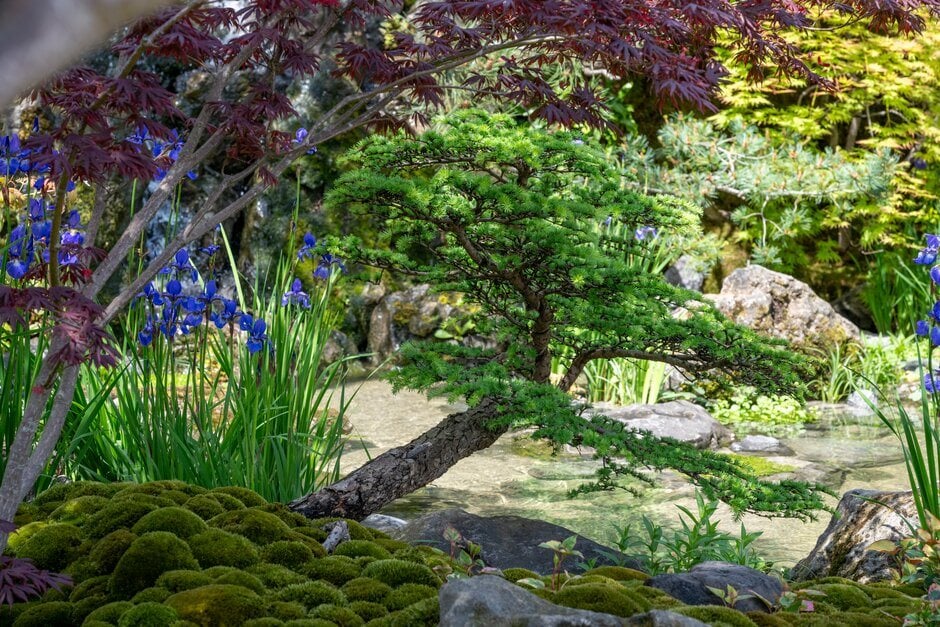
Plants such as Aucuba japonica (Japanese laurel) and Pieris japonica (lily-of-the-valley bush) can be amazing with the right cutting and pruning. You can tilt them and place them carefully to make them look good. The structure becomes a composition of irregular triangles and pruning changes the scenery you see. It’s pruning for the view. I don’t look at them just as plants but think about their colours and contrasts and how they’ll look against other objects, such as stones.
Queen Elizabeth II called you the ‘green magician’. Do all Japanese garden designers pay as much attention to detail as you?
I focus on every detail in my gardens in a way other designers do not. For example, for my Satoyama Life Show Garden in 2012, my teams and I moulded moss into 10,000 balls and then brushed them with pine needles tied into bundles until they looked clean enough to eat. It’s easy for me because it’s what I’ve always done. I used to take very good care of my bike, cleaning it every night before bed. And I cared about the balance of objects, such as the placement of the Castrol oil sticker on that same bike – up a bit, down a bit, left, right... this attention to detail comes out when I’m designing gardens.
![]()
Satoyama Life, designed by Kazuyuki Ishihara for the RHS Chelsea Flower Show 2012, where thousands of hand-crafted moss balls demonstrate his meticulous attention to detail
Satoyama Life, designed by Kazuyuki Ishihara for the RHS Chelsea Flower Show 2012, where thousands of hand-crafted moss balls demonstrate his meticulous attention to detail
I love Andy Sturgeon! Both he and his gardens are amazing. Although his gardens are very different to mine, he takes care of a lot of details. I also liked Tom Bannister’s The British Red Cross ‘Here for Humanity’ Garden at last year’s RHS Chelsea. It felt similar to my approach. British gardens often include edible plants like apple trees, and many people grow vegetables as a hobby. In Japan, vegetable gardening is less common. I think the integration of kitchen gardens and ornamental gardens is wonderful. Growing food encourages us to cook and share meals together and I’d like to learn from that.
![]()
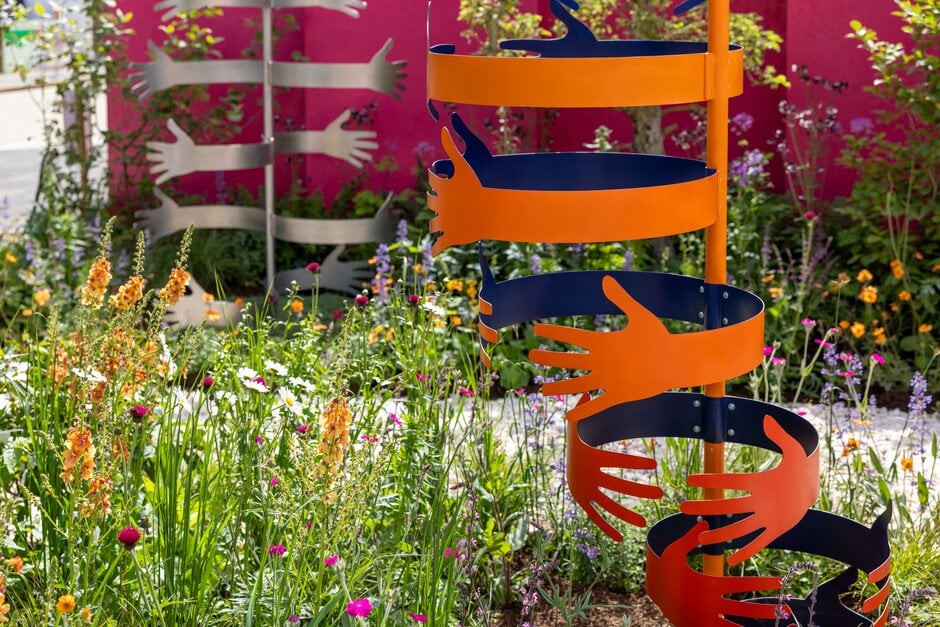
The British Red Cross Here for Humanity Garden, designed by John Warland and Tom Bannister for the RHS Chelsea Flower Show 2025
The British Red Cross Here for Humanity Garden, designed by John Warland and Tom Bannister for the RHS Chelsea Flower Show 2025
![]()
The Biophilic Garden Otsu – Hanare, designed by Kazuyuki Ishihara for the RHS Chelsea Flower Show 2023, explores biophilic design, creating a close connection between people and nature
The Biophilic Garden Otsu – Hanare, designed by Kazuyuki Ishihara for the RHS Chelsea Flower Show 2023, explores biophilic design, creating a close connection between people and nature
I include it in every garden I make, even if it’s tiny. It represents the wind. When the season goes from winter to spring in Japan, it’s very windy. In summer we have typhoons. The wind shows how nature and the seasons move along and that nature is alive. It connects to feeling the wind when you are riding a motorbike. Wind is a significant part of a garden.