With its minimalist beauty, eco-friendly techniques and mindful practice, it’s perhaps of little surprise that the ancient art of ikebana has become a modern-day phenomenon. Melissa Mabbitt visited practitioner Rie Kuchina-Day at her Lincolnshire home to find that the traditional Japanese way of flower arranging is the perfect antidote to a hectic modern world
Melissa Mabbitt
Executive Editor, The Garden
10-minute read
In a lofty floristry studio inside a stately home in rural Lincolnshire, Rie Kuchina-Day gently grasps a hydrangea stem, squeezing and bending it to create a soft arching line. Long strappy stems such as iris or Phormium are pulled between her fingers to make them curve – a bit like making a plastic ribbon spiral by pulling it between scissor blades. The precision is mesmerising.
Inspired, I peer down at the single chrysanthemum stem and small saucer of water on the workbench in front of me and ponder how this already beautiful flower, through my manipulation, might be made... perfect. As I work, I feel a palpable calm descend. This, after all, is no ordinary floristry workshop. This is ikebana.
What is ikebana?
Ikebana translates to ‘giving life to flowers’. This ancient Japanese art uses the subtle, patient and deliberate placement of plant stems as a way to clear the mind. A way to focus thoughts by noticing the small yet profound details in a single leaf or . Like much of Japanese culture, it’s about subtlety, deliberation, patience – giving each stem its own time and space to be contemplated. The meditative effects of working with plants in this way was considered so powerful that, since its inception, ikebana was practiced by Buddhist monks and samurai. Toyotomi Hideyoshi, the sixteenth-century feudal lord regarded as the second Great Unifier of Japan was said to have used it to focus his mind for both the strategy of battle and the politics of peace. Could Lord Hideyoshi ever have fathomed, I wonder, that some 600 years hence, ikebana would be a truly global phenomenon?
Why ikebana is everywhere right now
Yes, ikebana is having a moment. From boutique hotels to catwalks, and trendy high streets to social media: flowers arranged for ornament aren’t the blousy or wild bouquets of a few years ago. They’re now more often linear or sculptural creations, asymmetrically balanced, stems drifting sideways in seemingly gravity-defying assemblages. When you start to look, ikebana’s subtle influence is everywhere.
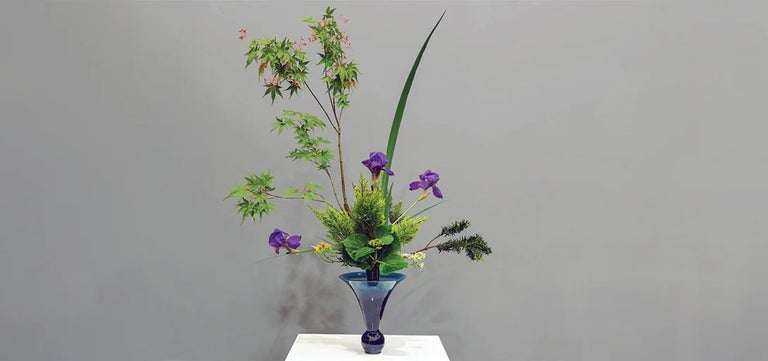
An ikebana arrangement in the Ikenobo Ikebana Rikka Shōfutai style at the RHS Chelsea Flower Show 2023
Practicing ikebana is an exceptionally tranquil experience. Watching Rie at work, her quiet deliberation, not merely observing but really seeing a flower, noticing its every detail, is instantly restful. Experts from every style of ikebana, from the most ancient to the most modern, agree that the practice yields a meditative mindset, a focused state of flow that can lead to a zen-like state of clarity.
“In Japanese culture ikebana is also called Kado – the path of flowers,” says Rie, who as well as leading today’s workshop is President of the London UK Chapter of Ikenobo Ikebana – Japan’s oldest Ikebana school.
"Everything in Japanese traditional culture has a path. You learn through practice, sensing the art to understand nature and yourself. Through discipline, you’ll discover something new – that is the treasure we’re looking for."
Like the tea ceremony, calligraphy and haiku poetry, ikebana has a deep cultural significance. Strongly shaped by Buddhism, the idea of revealing the spirit of a plant aligns closely with the Shinto value of natural balance, purity, and respect for life. By extension‚ bringing plants indoors was – and still is – a way to find meaning and acknowledge the significance of nature.
The contrast with modern life is stark. In a fast-paced world, people are searching for inner calm and increasingly finding it through ikebana.
Satoko Matsuda (left) talks with designer Keiko about her ikebana arrangement in the Great Pavilion during press day at the RHS Chelsea Flower Show 2021
The peace of art
It’s not the first time ikebana has been trendy in the UK. British florists began working with it through the middle of the 20th century as the ideal floral complement to the clean lines and minimalism of the Mid-Century Modern interior style. In Britain, Stella Coe was a principal proponent of ikebana, achieving the status of Riji, or Master – one of the first outside Japan. She organised the first British chapter, which began meeting in London in 1958 and, in 1979, she was awarded the RHS Veitch Memorial Medal for her work in promoting the art in the UK.
As the century wore on and maximalism and chintz raised their extravagant heads, we lost touch with ikebana. Now though, via workshops such as the one I’m attending, it’s finding a new audience, not only for its mindfulness, but because it aligns with growing interest in seasonal, sustainable horticulture.
Unlike traditional floristry, which often relies on imported blooms, ikebana favours locally gathered materials such as, stems, leaves and blooms that reflect the seasons. A dying iris leaf streaked with gold and bent by wind, plucked from a pot in one’s own back garden, is as worthy an item to display as one crisp and green in the first flush of growth.
"We use a lot of half-withered leaves, because it shows the progress of nature. Those can often be the most interesting elements."
The ability to appreciate beauty in aging stems and seedheads is a relatively recent development in Western gardening, popularised by new movement designers such as Piet Oudolf, but in the ancient art of ikebana it was important since the start.
Rie believes this approach is tied to Japanese philosophies of acceptance and resilience. Here there are echoes of wabi-sabi – the idea of finding beauty in imperfection and impermanence. Many gardeners come to her courses, she says, because they’re already in tune with this idea:
"In every plant everything is progressing, approaching an end. Ikebana is about appreciating every stage of life – even in the leaves that are dying, there is beauty. The season is the most important part of ikebana."
A woodblock print by the renowned Edo period artist Utagawa Toyokuni depicts a woman selecting freshly pruned cherry blossom branches for use in ikebana
As she carefully twizzles a stem in its vase, Rie tells me she walks through her garden daily in search of inspiration. “It’s a discovery – not just the flower, but the leaves and stems. For example, I might look at some rose hips on a bare stem in winter – notice how they look like a little boiled baby octopus, so intriguing! That can be my starting point for a display. Of course, ikebana designs are attractive, but the most important thing is to be in touch with nature.”
This call for connectedness feels like a modern idea – a backlash to the kinds of practices that have led us into climate and crises. In truth, of course, it is anything but.
Minimalist design, maximum impact
The oldest school of Ikebana was founded around 1462 at the Rokkaku-do temple in Kyoto by Buddhist monk Senno Ikenobo. To this day, this temple remains the centre of the Ikenobo school. “The headmaster is the 45th generation of the same family, and there are still monks looking after the temple, right in the middle of Kyoto,” says Rie. “Every November, we stage the oldest and biggest ikebana exhibition there – it’s a really important event.” Ikenobo is marked by its discipline – arrangements are minimalist and meticulously designed. They’re often tall, slim and use just one or two plants, aiming to express their inner essence. Other arrangements may use more plants, to create a landscape, or focus on more complex composition.
From the Ikenobo school, hundreds of offshoots of ikebana have evolved over the centuries. Two more styles well-known outside Japan are the Ohara and Sōgestu schools. Ohara developed in response to Japan opening its borders to international trade in 1895 – dahlias, tulips and more were available for the first time. Unshin Ohara, the school’s founder, produced the revolutionary moribana style – literally meaning flowers piled up – which has a flatter, fuller look influenced by Western styles. It was the floral equivalent of the Impressionist movement in Europe – somewhat scandalous at the time but game-changing for the art.
The youngest school is Sōgetsu, founded in 1927, so a mere nonagerian. Sōgetsu departed even further from tradition, with founder Sōfū Teshigahara believing the best way to make ikebana is to learn the rules, then break them.
1
of
2
The RHS Gold medal-winning Silk Yarn, by Mariusz Cwik wowed visitors and judges alike with cutting edge interpretation of Sōgetsu ikebana
of
The RHS Gold medal-winning Silk Yarn, by Mariusz Cwik wowed visitors and judges alike with cutting edge interpretation of Sōgetsu ikebana
Examples of some audacious concepts from the Sōgetsu school of ikebana were seen at RHS Chelsea Flower Show 2025. Co-founder of the London Flower School Wagner Kreusch and floral artist Frida Kim created a design that intertwined paper, inverted woody stems, and wheat grass to represent roots and human veins – two unseen networks that sustain life, growth and resilience. At the same show, florist Mariusz Cwik, instructor at the world-renowned McQueens Flower School in London, won a silver-gilt medal for his Sōgetsu-informed Silk Yarn, a cleverly staged creation combining silk, snaking willow stems and anemones.
“Ikebana’s influence is increasingly visible in contemporary floral design, especially as sustainability becomes a central concern in the industry,” says Scarlett Szeto, President of the Ikebana International London Chapter, an organisation that promotes ikebana around the world. “One of the most notable shifts is growing use of the kenzan as a sustainable alternative to floral foam,” referring to the pin cushion-like, stem-supporting implements integral to modern ikebana. “This blend of artistry and eco-consciousness has resonated strongly with a new generation of florists, many of whom – including Wagner and Mariusz – have a strong background in ikebana. They’re exploring its techniques, philosophies and cultural roots, often integrating them with modern styles to create innovative arrangements that honour tradition while embracing change. They skilfully incorporate its principles into their designs, creating compositions with both elegance and mindfulness.”
1
of
2
The sculptural design Humus, is an example of the Sōgetsu school of ikebana, created by Wagner Kreusch and Frida Kim
of
The sculptural design Humus, is an example of the Sōgetsu school of ikebana, created by Wagner Kreusch and Frida Kim
As well as the highest echelons of floral art, ikebana has made its mark too on our broader culture, particularly in fashion. In autumn 2025 Dior debuted its fall collection in Kyoto, incorporating ikebana-inspired floral motifs. It’s a return to form for the fashion house: Christian Dior was deeply inspired by Japanese art and in 1953 was the first Western couturier to show his collections in Japan. Georgio Armani was another of the fashion industry’s ikebana acolytes, even releasing a book of ikebana-inspired botanical creations, Armani Fiori, on the first day of Milan Fashion Week 2023.
Indicating the way ikebana has intertwined with the art world, the most striking designs can look more like surreal abstract sculpture than floristry. In the last decade, the terms freakebana, baroque ikebana and punk ikebana have emerged to describe some of these creations, playful spins on ikebana combining flowers with everyday objects such as a shoe or kitchen scourer to create an almost grotesque aesthetic.
Style for all seasons
Ikebana is more accessible than it might seem. The simplest starting point is to observe how plants grow – the upright energy of spring , the weight of summer flowers, or the stark lines of winter branches. The aim of ikebana is to accentuate that plant’s innate qualities, to create a vignette that heightens and celebrates its natural form.
The Ohara School of Ikebana at the RHS Hampton Court Flower Show 2017
In traditional ikebana plants are chosen for their meaning as well as beauty. Pine symbolises longevity, bamboo is for vitality and prosperity, Prunus mume (Japanese apricot) for nobility and endurance. These three plants are often arranged together to welcome the new year and usher in good luck, says Ikebana Morrison, Riji of Sōgetsu. If you try nothing else, when the cherry blossom begins to peep out next month, cut a branch to put in a simple arrangement. “It’s the most beloved flower among the Japanese people,” she says. “To cut a branch at its most beautiful moment and arrange it is an incomparable joy.”
Lespedeza thunbergii, Wisteria floribunda,Rodgersia podophylla and Camellia japonica are favourites for their strong shapes. Woody plants hold their shape when inserted into the pins of a kenzan. The firmer a stem, the more useful it can be for creating the main holding structure of an arrangement. Though of course that’s not to say you can’t work with softer, more flowing plants such as spring and summer bulbs.
My own first ikebana arrangement – snowberries, a palm leaf and a chrysanthemum – feels simple, but I’m fascinated.
Equal parts mindful, beautiful and sustainable it’s no wonder ikebana is taking root so deeply in 21st-century Britain. In a productivity-obsessed modern age, some may dismiss flower arranging as frivolous, but ikebana gives us permission to take it seriously – to appreciate it as an ancient art. A meditation. Even a way of life.
Enjoyed this article?
This piece comes from The Garden, the monthly magazine sent to RHS members. Filled with expert advice, planting inspiration and seasonal ideas, it’s one of the many benefits of RHS membership. Become a member to receive your copy each month.